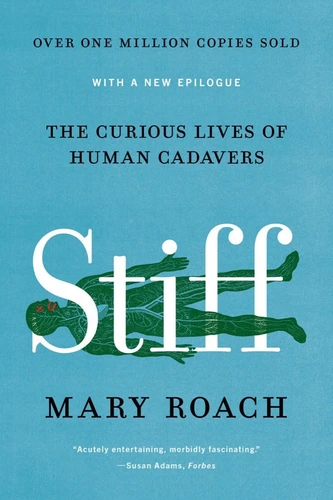
I have a confession. I picked up this book because the title made me snort. “Stiff: The Curious Lives of Human Cadavers.” I expected shock value. I expected gore. I expected to feel clever for reading something morbid.
I did not expect to cry a little.
Here is what Mary Roach does. She follows human cadavers wherever they go. Medical schools, car crash test facilities, airplane crash investigation labs, even a medieval monastery where corpses were used in a weird experiment to see if the body’s weight changes at the moment of death. She talks to anatomists, forensic anthropologists, plastic surgeons who practice face transplants on dead people. Every chapter is a new destination for the dead.
And the whole time, she is funny. Really funny. She describes a room full of severed heads with the dry wit of a stand-up comic. She calls a corpse “a cadaver” and then “our hero.” She makes jokes about decapitation. It is bizarre. It is disarming. It works.
What the body becomes
Here is the central question the book keeps circling: Is a dead body still a person?
Roach shows us cadavers being sliced, slammed into walls, burned, frozen, left to rot in the open air for weeks. In one chapter, she watches students at a medical school dissect a woman’s face. “They are not disrespecting her,” Roach writes. “They are learning to save lives.” But I felt queasy anyway.
Then I had to ask myself: Why? The person is gone. The body is just tissue. So why does it feel wrong to treat it like meat?
Roach never preaches. She just presents the facts. Cadavers have done amazing things. They helped design safer cars, better airplane seats, more effective surgery techniques. A single donated body can train dozens of surgeons. Without cadavers, modern medicine would not exist.
But she also lets us feel the discomfort. The tension never resolves, really. Because we are human, and bodies matter to us even after the person leaves.
The light in the dark
The book’s core theme is simple. Death is not a horror story. It is a biological process. And what happens to your body after death is not a tragedy. It is a choice.
Roach’s subtle light is her humor. It is not a mask. It is a tool. She uses laughter the way a surgeon uses a scalpel. To cut through the fear. To get to the tissue underneath.
The most moving chapter, for me, was about a man named Dr. Albert Jonsen. He was a medical ethicist who donated his own body to science. Roach interviewed him before he died. He was calm. He was curious. He said he wanted his body to be useful. And when he died, it was.
I realized something reading that chapter. We spend so much energy being afraid of death. We hide from it. We pretend it does not exist. But Roach says: Look at it. Touch it. Laugh at it. It is just a fact.
What we leave behind
This book came out in 2003. I read it in 2024. And honestly, it feels more urgent now than it probably did then. We live in a culture that photoshops death out of everything. We call old people “seniors.” We call death “passing.” We keep dying in hospitals, behind curtains, away from our families.
Roach smashes that curtain open.
She is not saying you should donate your body. She is not saying you should not. She is just showing you what happens either way. And after reading it, I felt less afraid. I felt more curious. I felt like I had permission to ask the questions I had been too scared to ask.
Here is what I think the book is really about. Not dead bodies. But what it means to be alive. To have a body. To know that one day, it will stop working. And to decide, while you can, what you want that ending to look like.
The core insight: A dead body is not a person. But the way we treat it says everything about the people we were.
