I remember the exact moment I heard my mother’s voice come out of my mouth. I was telling my kid to “calm down,” and the tone, the impatience, the little edge of dismissal — it was her. I froze. I had sworn I would never do that. But there it was.
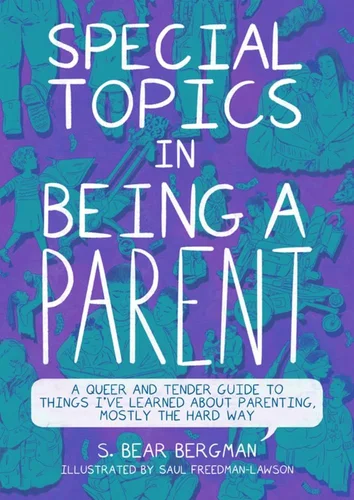
So when I picked up Special Topics in Being a Parent by S. Bear Bergman and Saul Freedman-Lawson, I thought I knew what I was getting. A queer parenting guide, maybe some practical advice. I was wrong. The book is not really about parenting kids. It is about parenting yourself, retroactively, through the act of raising someone else. And it asks one question that I have been circling ever since: What do you do when the person you are becoming as a parent is someone you promised yourself you would never be?
Character and Plot: A Father Who Keeps Looking in the Mirror
Bergman writes as a parent who is also a child. He is a father of two, a trans man, a husband. But the real protagonist of this book is his own unresolved childhood. The book is structured as a series of short chapters, each one a kind of lesson or meditation. One chapter is about how to apologize to your kid. Another is about the terror of saying “because I said so.” Another is about what happens when your child’s meltdown triggers your own.
The plot is not a story in the traditional sense. There is no central conflict that gets resolved by the last page. Instead, the movement is internal. Bergman traces how parenting keeps pulling him back to moments he thought he had buried. He writes about the impulse to punish, to control, to shut down the conversation. And then he catches himself. He asks: Where did that impulse come from? Who taught me that was the only way? It isn’t dramatic. It is more like watching someone dig through their own rubble, slowly, with a small flashlight.
I found myself stopping after every chapter. Not because the content was heavy, exactly. But because Bergman’s honesty is so direct that it felt like he was reading my own parenting failures back to me. The book does not offer easy solutions. It offers a kind of companionship. Here is what I did wrong. Here is what I am trying to do instead. It is the opposite of a how-to manual. It is a confession, a letter to himself, and maybe a permission slip for the rest of us.
Theme and Imagery: The Light Through the Cracks
The book uses a simple but powerful visual trick. It is a mix of text and comic-style illustrations by Saul Freedman-Lawson. The drawings are not flashy. They are soft lines, muted colors, faces that look tired and real. The imagery is mostly domestic: a messy kitchen table, a child’s hand reaching for a parent’s face, a shadow on the wall that looks like a father from the past.
But the key image for me was the light. Bergman writes about how his kids see him. Not the person he wants to be, but the person he actually is. And in their eyes, he says, there is a kind of forgiveness that he has never been able to give himself. He talks about how his kids will climb into his lap after he has yelled at them, and they will just sit there. They are not holding a grudge. They are just waiting. And that waiting, that small, patient light, is what forces him to look at his own wounds.
This is where the book’s central argument really deepens. Bergman is not saying that parenting is hard work. Everyone knows that. He is saying that parenting is a mirror. You cannot hold it without seeing your own reflection. And the reflection is not always pretty. But the point is not to become a perfect parent. The point is to keep looking, to keep noticing, to keep apologizing. It is a subtle kind of light, but it is enough to see by.
Elevation and CTA: The Real Work Is Inside
I have read a lot of parenting books. Most of them tell you how to manage behavior, how to set boundaries, how to get your kid to sleep through the night. This one is different. It does not care about sleep schedules. It cares about the moment when you realize that you have been treating your child the way you were treated, and you hate yourself for it. It cares about the quiet, uncomfortable work of admitting that you are still a child in some rooms of your own heart.
Bergman writes about his own parents with tenderness and sadness. He does not blame them. He sees them as people who were also doing their best with broken tools. And that is the real gift of the book. It does not ask you to be angry at your past. It asks you to be curious. It asks you to sit with the question: What did I need when I was small that I did not get? And maybe, just maybe, I can give it to my own child. Or I can try.
The book is suitable for any parent, but especially for those who carry a sense of having been hurt. It is not a light read. It is a mending read. You will put it down and feel a little raw, a little seen. I will be honest: I cried twice. Not from sadness, exactly. More from relief. Because Bergman shows you that you are not alone in this mess. And that maybe, the real work of parenting is not about raising perfect children. It is about letting your children raise you. Maybe that is the only parenting secret worth knowing. Not the absence of failure, but the presence of someone who stays in it with you.
