I was standing in my kitchen last week, staring at a jar of honey. The label said it was from a specific valley in Italy, one I had never visited. I don’t know why that made me sad. Maybe because I knew, vaguely, that the bees there were struggling. That the valley itself might not look the same in twenty years. I put the jar down and thought: what does it mean to love something you have never touched?
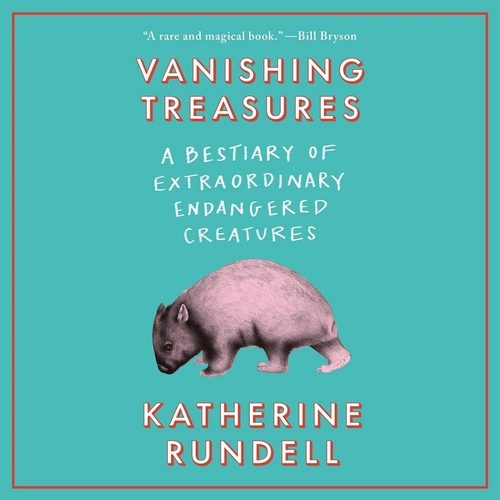
Katherine Rundell’s Vanishing Treasures: A Bestiary of Extraordinary Endangered Creatures asks that same question. Only her “something” is the pangolin. The narwhal. The California condor. Twenty-three species, each one given a short, luminous essay. She doesn’t lecture. She doesn’t wave graphs. Instead, she shows you the thing itself. The way a golden toad glints in the sun. The way a sturgeon, ancient and patient, moves through dark water. You start to care. But then you realize the point is not just to care.
How Rundell Makes You Fall in Love, Then Break Your Own Heart
Rundell writes with the eye of a poet and the patience of someone who has actually sat in the mud watching a creature. She describes the aye-aye, that strange lemur with its long, skeletal finger. Most people find it ugly. She finds it magnificent. She tells you how it taps on trees to find grubs, a method called “percussive foraging.” I didn’t know that word. Now I can’t forget it.
The core conflict is quiet but brutal. The animals are not dying in some dramatic, cinematic way. They are fading. Slowly. Because of habitat loss. Because of climate change. Because of us. Rundell never says “we are terrible.” She just describes the creature, its beauty, its strangeness, and then adds, almost as an aside: there are only a few hundred left. That’s the punch. You read it, and you feel the weight.
She also writes about the people who try to save them. The researchers who track snow leopards in the freezing dark. The keepers who hand-feed baby vultures. These people are not heroes in capes. They are stubborn. They are a little obsessed. They believe that a single species matters, even if the world doesn’t seem to agree. That belief, Rundell suggests, might be a form of love. But is love enough when the tide is rising?
The Real Subject Is Grief, and How We Carry It
The key imagery in this book is not the animal itself. It is the shape of its absence. Rundell writes about the baiji, the Yangtze River dolphin. It is almost certainly extinct now. She describes its smooth, pale skin. Its small eyes. The way it used to surface beside fishing boats. Then she stops. The silence after that description is the real point. She is not writing a eulogy. She is writing a portrait of what we have allowed to slip away.
There is a subtle light here, too. It is not the light of hope, exactly. More like the light of attention. Rundell believes that if we look closely enough, if we describe something with enough precision and love, it becomes real to us. Even if we never see it in the wild. Even if it disappears tomorrow. The act of paying attention is itself a kind of preservation. Not physical. But spiritual.
I found myself thinking about my grandfather. He spoke a dialect from a small village in the mountains. When he died, that dialect died with him. No one else in the family had learned it. I can’t bring it back. But I can remember the sound of it. The specific lilt of his voice when he told a joke. Rundell’s book made me realize that my grief for that language is not so different from her grief for the northern white rhino. We are all losing things. The question is whether we look away, or whether we look, and feel the weight.
Why You Should Read This Book, Even If It Hurts
This is not a book of easy solutions. Rundell does not tell you to recycle more or sign a petition. She assumes you already know that. Instead, she offers something rarer: a way of seeing. She argues that the world is full of treasures we have not yet named. And that naming them, describing them, falling in love with them, is a moral act.
The book’s weakness is its structure. Twenty-three essays can feel scattered. You finish one creature and move to the next without a clear thread. But maybe that is the point. The world itself is scattered. We are losing things in every direction. Rundell is just holding up a mirror.
What you will get from this book is not facts. It is a feeling. A specific, quiet ache. You will close the cover and think about the pangolin, curled in its protective ball, defenseless against poachers. You will think about the wandering albatross, flying for years without touching land. You will think about the things you love that are already half-gone. And you will realize, with a start, that the only honest response is not hope. It is attention. It is the decision to keep looking, even when it hurts.
