I walked into a crowded party last weekend and felt it again. That old familiar panic. Who am I supposed to be in this room? The funny one, the quiet one, the one who asks good questions. I caught myself performing before I even took off my coat. And later, alone in my car, I wondered: what would happen if I went somewhere where nobody had ever seen me perform? Where I had no reputation, no history, no role to play? Noraly Schoenmaker asked herself the same question, then got on a motorcycle and rode 20,000 miles through Central Asia to find out.
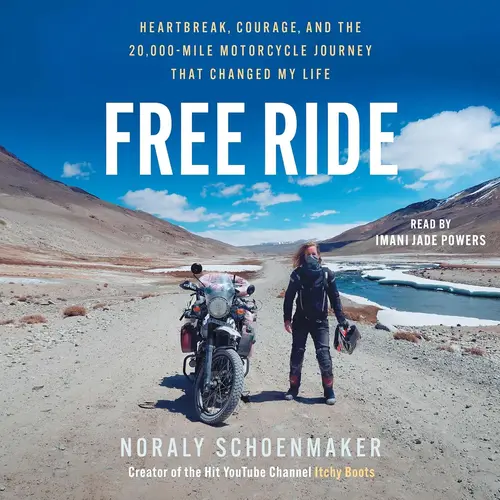
Who She Was Before the Road
Schoenmaker was a Dutch geologist with a good job and what looked like a good life. But something was off. She describes it as a quiet hum beneath everything. A sense that she was living someone else’s script. So she bought a motorcycle she barely knew how to ride and pointed it east. Toward Kazakhstan, Kyrgyzstan, Tajikistan. Places most Western travelers skip.
Her protagonist is not a superhero. She is not particularly brave. She drops her bike in mud. She cries in hotel rooms. She gets lost on roads that don’t appear on any map. What makes her compelling is her honesty about fear. She writes about the moment she realized no one would come to help her if she broke down in the middle of nowhere. That realization didn’t make her feel powerful. It made her feel small. But she kept going.
The core tension of the book is simple: can you become someone new when no one knows your old self? Or does that old self follow you like a shadow, even across borders? I won’t tell you what she finds. But I will say this: the answer is not what I expected.
The Art of Being Unseen
The central theme here is not adventure. It is not even courage. It is visibility. Or rather, the strange freedom of being invisible. Schoenmaker writes about riding through landscapes so vast and empty that she forgot she was a person with a past. She became just a body on a bike, moving through space.
Her craft is subtle. She builds scenes with small details. The weight of her helmet after eight hours. The taste of fermented mare’s milk in a village where she was the first foreigner anyone had seen. The way a stranger’s hand on her shoulder felt like both a threat and a blessing. She never explains the symbolism. She trusts you to feel it.
There is a quiet light that runs through the book. It is not dramatic. It is the light of late afternoon in the Pamir Mountains. The light of a campfire where she sits alone, eating rice from a metal bowl, realizing she has not thought about her old life in days. That is the moment the book’s question sharpens. She does not find a new identity on the road. She finds that identity itself might be optional.
What Stays When Everything Falls Away
I finished this book and sat with it for a while. I thought about all the labels I carry. Daughter, friend, employee, citizen. I thought about how much energy I spend maintaining them. Schoenmaker’s journey suggests something unsettling. Maybe we are not our stories. Maybe we are just the space between them.
The book has limits. She does not fully explore the privilege of being able to disappear. A white Dutch woman on a motorcycle has a different experience of Central Asia than a local woman would. She acknowledges this briefly but does not dwell on it. I wished she had pushed harder there.
Still, the core insight lingers. She writes about meeting a man in a remote Tajik village who asked her where her husband was. She said she didn’t have one. He asked who took care of her. She said she took care of herself. He laughed. Not cruelly, but with genuine confusion. In that moment, she realized that her entire sense of self was built on assumptions that were not universal. She was not a woman who rode a motorcycle. She was a question mark in human form.
Maybe that is what travel really does. It doesn’t give you answers. It shows you that the questions you thought were permanent were just local. And that the self you thought was solid was mostly scaffolding.
