I keep thinking about a conversation I had with my own father last month. We were sitting at the kitchen table, and I realized I could not tell you the name of his best friend from high school. I am not sure I ever asked. That failure felt like a small betrayal.
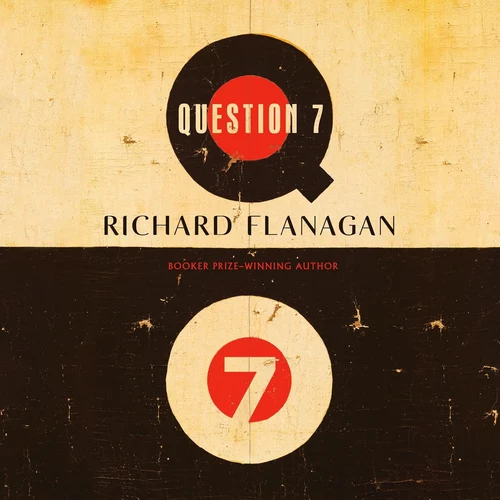
Then I picked up Richard Flanagan’s Question 7. It asks something even harder. Not just who your father was, but what he carried. What he saw that he never told you about. Can we ever really know the person who made us?
The Man Before the Silence
Flanagan’s father was a quiet man. He worked as a logger, a farmer, a union man. He died of cancer, slowly, over years. But before all that, he was a young soldier sent to witness the atomic bomb tests at Montebello Islands in 1952.
The book gives us that young man. Not a hero. Just a boy from Tasmania who did not understand what he was being asked to watch. Flanagan writes him with a kind of tenderness that feels earned. He does not romanticize the old man. He does not make him into a symbol. He just follows him through the dust and the heat and the strange light of the explosion.
The core conflict here is not dramatic. It is quiet. It is the slow erasure of a life. The tests gave his father cancer, but they also gave him something harder to name. A kind of silence. A refusal to speak about what he saw. The book becomes a son’s attempt to break that silence.
Flanagan does not reveal the ending, because the ending is not the point. The point is the space between the bomb and the deathbed. The years of not knowing. I found myself putting the book down and just staring at the wall. What was my own father not telling me?
The Light We Miss
The title comes from a philosophical puzzle. Imagine a tortoise and Achilles running a race. The tortoise gets a head start. Zeno’s paradox says Achilles can never catch up, because he must first reach where the tortoise was. But by then, the tortoise has moved on.
Flanagan uses this idea to frame his father’s life. We are always running toward the person our father was, but he is always a step ahead. We arrive at the place he used to be, and he has already become someone else. The book is not about catching him. It is about learning to run alongside him.
The key imagery is the bomb. Not the mushroom cloud you see in photographs, but the light. The terrible, beautiful light that burned the shadows of men into concrete. Flanagan describes it as something that stays in the eyes long after the event is over. A ghost light.
This is subtle work. The author does not hit you over the head with metaphors. He lets the light do its work quietly. You realize that the bomb is not just a historical event. It is a way of seeing. It is the thing that makes a father turn away from his son. It is the thing that makes a man stop talking.
I think this is the book’s real argument. That the silence between generations is not empty. It is full of light. Full of things we cannot look at directly but cannot look away from either.
The Real Work of Love
I will be honest. I finished this book feeling unsettled. It is not a warm memoir. It does not offer easy reconciliation. Flanagan does not pretend that understanding his father fixes anything.
What he offers instead is something harder. He offers attention. The kind of attention you give to a dying man. The kind that does not look away from the mess.
This is a book for anyone who has ever looked at a parent and realized they are a stranger. For anyone who has wondered what their father dreamed about before he became a dad. For anyone who has sat at a hospital bed and not known what to say.
The limitation of the book is also its strength. It is deeply personal. There are moments when the scope feels narrow. The bomb tests, the Tasmanian landscape, the slow decay of a single body. But that narrowness is the point. You cannot understand everything. You can only understand one thing well.
I learned that the questions we do not ask are the ones that shape us. I learned that every quiet father is a young man who saw something he could not forget. I learned that the distance between us and our parents is not a gap. It is a space full of light.
Maybe that is the real work of love. Not to catch the tortoise. But to keep running.
