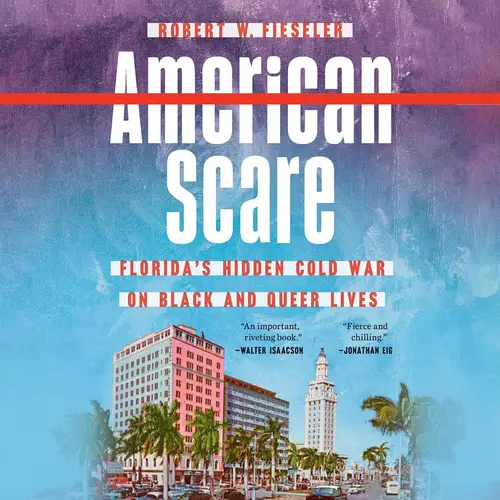
I was chatting with a friend recently about a quiet street in our city. It’s lined with old oak trees and nice houses. She mentioned that, in the 1950s, a Black family tried to move there. Someone burned a cross on their lawn. No one was ever charged. I felt a cold pause in the conversation. That pause is what Robert W. Fieseler’s American Scare lives inside. It is a history of Florida, but it is really a history of everywhere. It asks a question I can’t shake: What happens when a government, not just a mob, decides who is dangerous?
Portrait of a Fear Engine
The book focuses on a specific horror. Florida, for decades, waged a secret war against Black people and queer people. But Fieseler doesn’t just list atrocities. He shows us the machinery. He introduces us to the people who built it: politicians who passed laws, police who enforced them, and ordinary citizens who looked away. The protagonist here isn’t one person. It is the state itself. It is a character that breathes and hunts. I found myself holding my breath during a chapter about a man pulled from his home for the crime of being gay. The suspense isn’t about whether he will be arrested. We know he will be. The suspense is about what happens to his neighbors, the ones who called the police. The book never reveals the final fate of every victim, which feels right. History doesn’t give easy endings. This section left me feeling raw. It also left me with a question: If this could happen there, could it happen here?
The Craft of Hidden Violence
Fieseler writes with a quiet, almost forensic precision. He doesn’t shout. He shows. The key imagery in American Scare is darkness. Not metaphorical darkness, but the real, physical dark of a room without a door, a closet, a jail cell. He describes how authorities used “vagrancy laws” to arrest anyone who looked “suspicious.” The subtle light in the book comes from the people who resisted. A mother who hid her son. A lawyer who filed a complaint knowing he would lose. Fieseler is careful. He does not make them heroes. They are just people who chose to act. I realized that the book’s real subject is not the past. It is the pattern. The way fear gets written into rules, and those rules then create more fear. It is a cycle. This character, this state of Florida, shows us a universal truth: a society that fears a group of its own people will build a cage for everyone.
Echoes Across Time
I finished the book on a Sunday morning. I went for a walk. I looked at the city council building downtown. It is a nice building, brick and glass. But now I wonder: What laws were passed there? Who did they target? American Scare has an uncomfortable resonance today. We argue about book bans, about drag shows, about who gets to use public bathrooms. Fieseler’s book reminds me that these are not new fights. They are old fights wearing new clothes. The book has a small weakness. It sometimes gets lost in legal details. I wanted more of the human stories. But that is a minor complaint. The recommendation is simple: Read this. It is not a comfortable book. It is not meant to be. It is a book about the scars we inherit. It is about the quiet violence of a law that says “you are not welcome here.” Maybe that is the scariest part. The scare is not in the past. It is in the possibility that we are not done with it yet.
