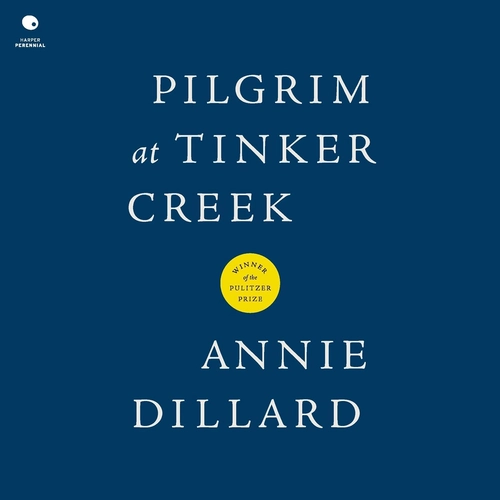
I tried to read Pilgrim at Tinker Creek once in my twenties. I gave up by page 30. The prose felt too dense, too full of bugs and blood and strange theological leaps. I put it on the shelf and forgot about it. Years later, I found myself standing by a small stream near my house, watching a spider repair its web after a rainstorm. I had no idea why I was so absorbed. I just couldn’t walk away. Then I remembered Dillard’s book and pulled it down again. This time, it didn’t feel dense. It felt necessary. The question I keep coming back to is this: What happens to a person who decides to see everything, without flinching?
The Woman Who Couldn’t Stop Looking
Dillard presents herself not as a nature writer exactly, but as a kind of witness. She is a person who lives alone in Virginia’s Roanoke Valley, and she spends her days walking, staring, and recording. The core conflict is not with other people. It is with her own capacity to pay attention. She watches a frog get drained by a giant water bug, its body dissolving from the inside. She describes it in precise, horrifying detail. She does not turn away. She does not moralize. She simply says, “I had been sitting on a sandstone ledge for an hour.” That is the whole confession. The suspense in this book is not about plot. It is about whether she will break. Whether her mind can hold the beauty and the violence together without going numb. I found myself holding my breath during passages about a simple cedar tree. Because Dillard makes you feel that looking too long at anything might burn a hole through your soul. She is a young woman who chose solitude, not because she was peaceful, but because she needed to test something. The book asks: Can you love a world that eats its own children?
The Light That Takes Your Eyes
The central imagery of the book is light itself. Dillard writes about sunlight hitting a creek, about shadows under sycamore trees, about the way a single ray can turn a patch of gravel into something ancient and sacred. But there is a subtle light at play here, too. It is the light of recognition. She watches a muskrat swim past her, and for a moment, they see each other. The animal acknowledges her existence. Then it is gone. That brief flicker of connection becomes a kind of proof. She writes, “The gap is the thing.” She means the space between the self and the world, the distance we can never fully close. The author’s craft lies in how she holds that gap open. She does not fill it with easy meaning. She lets it ache. She lets the reader feel the longing for a union that never quite arrives. She shows us a praying mantis eating its mate, and then she shows us a tree full of migrating monarch butterflies. The same energy, the same hunger, dressed in different costumes. What Dillard understands, and what her book teaches through sheer accumulation of evidence, is that attention is not a gentle hobby. It is a form of prayer. And like prayer, it costs something. You give up your comfort. You give up your innocence. You give up the idea that nature is a peaceful escape from human trouble. It is not. It is the original trouble.
The Gift You Did Not Ask For
I finished Pilgrim at Tinker Creek on a Sunday morning. I sat on my porch and watched a crow land on a telephone wire. I watched it for maybe fifteen minutes. I noticed how its beak was slightly open, how a piece of grass stuck to its foot. I noticed the way the light caught the blue-black sheen on its feathers. Before reading this book, I would have called that a waste of time. Now I am not so sure. The book’s resonance across eras comes from its refusal to offer comfort. Dillard does not tell us that nature is good, or that God is kind, or that life has a plan. She tells us that the world is wild and indifferent, and that our job is to show up anyway. The book has flaws. It can be repetitive. Some passages feel like a sermon that lost its thread. But I think that is the point. Attention is not always clean. It stumbles. It gets distracted. It comes back. The recommendation I would give is not for everyone. If you want a gentle walk through the woods, pick something else. If you want to sit with a book that will ask you how you are living your own days, and whether you are actually seeing them, then this is for you. It changed how I look at a single leaf on the sidewalk. That is more than most books can claim.
