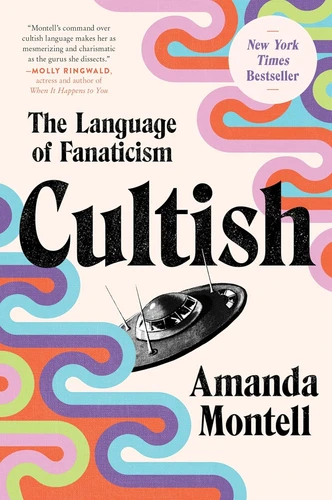
I went to a friend’s gym class recently. The instructor called us a “tribe.” She said we were “warriors” and that “the energy in this room was unstoppable.” I felt a warm rush of belonging. Then I remembered Amanda Montell’s book, Cultish: The Language of Fanaticism, and I felt a little creeped out. The question this book planted in my head is simple and unsettling: When does a shared vocabulary become a cage?
What Cultish Language Actually Does
Montell is a linguist, not a psychologist. That distinction matters. She doesn’t diagnose cult leaders as crazy. She shows how their words work. The central concept is “cultish” as a spectrum, not a binary. It’s not just about Jonestown or Heaven’s Gate. It’s about SoulCycle, multi-level marketing schemes, and even your workplace’s insistence on “synergy” and “disruption.” Montell argues that cultish language has three main functions: it creates an in-group (us), an out-group (them), and a shared reality that outsiders cannot access. Think of the jargon in a start-up: “pivoting,” “deep dive,” “moving the needle.” It sounds harmless. But it also subtly punishes anyone who uses plain English. You either speak the language, or you’re not a team player. Montell illustrates this with examples from Scientology, where members use acronyms for everything, making normal conversation feel foreign. She also examines the language of wellness culture, where terms like “toxins” and “clean eating” moralize food choices. The book’s weakness, I found, is that it spreads itself thin. It covers so many groups that no single case study gets truly deep. I wanted more on the specific linguistic mechanisms, less on the broader sociology. Still, the core idea stuck with me: the words we use are not neutral. They are the walls of our worlds.
The Imagery That Reveals the Trap
The most powerful image in Cultish is not a literal one. It’s the concept of “thought-terminating clichés.” Montell shows how cultish groups use short, catchy phrases to shut down critical thinking. “What would Jesus do?” “It is what it is.” “Trust the process.” These phrases don’t answer questions. They stop them. The author traces this back to political propaganda and advertising, showing how a simple slogan can bypass the brain’s logic centers. Another key idea is “the language of love-bombing.” New recruits are showered with adoring, possessive language: “You’re so special,” “We’ve been waiting for you,” “You’re finally home.” It feels like acceptance. But it’s a transaction. The language creates a debt of gratitude, making it harder to leave. Montell’s craft here is subtle. She doesn’t just describe the language. She shows how it feels from the inside, then pulls back the curtain to reveal the mechanism. This section left me feeling exposed, honestly. I started noticing these patterns in my own Facebook groups and dog-training classes.
What This Book Gives You
Cultish is for anyone who has ever felt a little too comfortable in a group. It’s for people who wonder why certain brands inspire fierce loyalty. It’s for managers who want to build healthy teams, not echo chambers. The book’s main limitation is its scope. Montell sometimes struggles to distinguish between genuinely dangerous cultish language and everyday corporate jargon. Not every “tribe” is a cult. But that’s also the point, I guess. The line is blurry. Montell doesn’t provide a simple checklist for spotting a cult. She provides something better: a lens. After reading this book, you will hear the architecture of belonging in every ad, every slogan, every team meeting. You will start to notice who is left out when someone says “we.” And you will ask yourself if the shared language you speak is a bridge or a wall.
I closed the book and looked at my phone. A notification from a group chat. “We are family,” the message read. I didn’t know if I believed it anymore. Maybe that’s the real gift of this book. It doesn’t take away belonging. It just makes you see the price of entry.
