I was sprawled on my couch, phone in hand, doom-scrolling past my bedtime. Then I saw a friend’s post: a screenshot of a colorful grid, a victim, a list of suspects. She said she solved it in ten minutes. I scoffed. I opened the book sample. I did not sleep until 2 AM.
That is the thing about Manuel Garand’s Murdoku: 80 Murder Mystery Logic Puzzles. It looks simple. A grid. Some icons. Names like Adam, Beth, Charles. But the moment you start placing suspects into empty cells, something clicks in your brain. Not a loud click. A quiet, addictive hum. It makes you ask: can a logic puzzle really feel like a proper investigation?
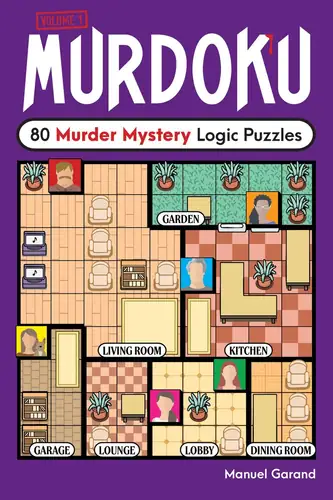
When a Grid Becomes a Crime Scene
Here is the basic setup. A victim lies dead in a room. You have a grid representing the crime scene: a kitchen, a library, a casino. Each suspect must occupy a unique row and column, like Sudoku. But instead of numbers, you use clues. “Beth stood next to the window.” “Adam was the only person on the sofa.” “The killer was in the same room as the victim.”
You place. You eliminate. You deduce. And after a few minutes of scribbling, one cell remains empty. That empty cell? That is the victim’s location. The suspect in the same row or column becomes the killer.
Garand starts you off easy. The first puzzles are almost insultingly simple. I finished them in under a minute each, feeling like Sherlock Holmes. But around puzzle 30, the difficulty jolts. Clues become layered. Grids expand. You start using the provided “scratch paper” section, making tiny marks, backtracking, catching your own mistakes. By puzzle 60, I was hunched over the book, muttering to myself like a mad detective.
What I love most is the physicality of it. You need a pencil. You need an eraser. You draw little letters in cells, cross them out, start over. It is not a passive experience. It is your hands and your brain working together, and when you finally circle the killer’s name, you feel a small, genuine victory.
The Humility of Erasing Everything
The core theme here is not murder. It is patience. Garand forces you to slow down. You cannot skip steps. Every clue matters. The key imagery is the grid itself: clean, colorful, almost childlike in its simplicity. A table icon. A rug icon. A plant. But these simple icons become anchors for your reasoning. “If Beth is on the rug, and only one person can be on the rug, then Adam cannot be on the rug.” It is basic logic, but it feels like building a case.
There is a moment around puzzle 45, set in a theater backstage, where I realized I had been staring at the same four clues for ten minutes. I had made an assumption six steps earlier that was wrong. I had to erase everything and start fresh. That moment of failure, of accepting my own mistake, was more satisfying than breezing through a dozen easy puzzles. Garand does not just teach you logic. He teaches you humility.
The book is not without flaws. Some puzzles have ambiguous wording in the hints, especially for non-native English speakers. The Portuguese translation issue mentioned by other readers is real. And honestly, the last ten puzzles are brutal. I used the hints in the back. I am not ashamed.
The Quiet Satisfaction of the Last Empty Cell
This book is for people who love Sudoku but want a story. It is for people who enjoy Clue but wish it had more structure. It is for anyone who has ever finished a crossword and thought, “I want something that makes me feel clever, not just well-read.”
It is not for people who want a novel. There is no character development here. No prose. No plot beyond the crime scene description. If you need emotional depth or beautiful sentences, look elsewhere.
But if you want a book that lives on your coffee table, that you pick up during commercials, that you bring on a flight and suddenly the flight is over and you have solved 22 murders and you feel like a genius, this is it.
The book’s description says it best: the truth is hidden in a cell. It is up to you to figure out which one. That is the whole experience, right there. A quiet, patient hunt for a hidden truth. And when you find it, you close the book, smile, and turn the page to the next murder.
