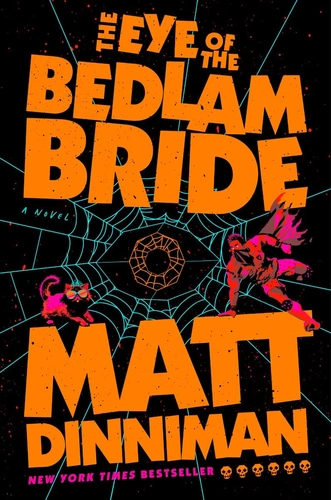
I was three days into a bad bout of insomnia when I picked up The Eye of the Bedlam Bride. I’d read the previous five books in the Dungeon Crawler Carl series, so I knew what I was getting into. Or I thought I did. I made tea, sat on the floor with my back against the couch, and started reading. By page fifty, I’d laughed out loud four times. By page two hundred, I’d stopped laughing. Something was different here.
The question I kept asking myself as I turned pages was this: can a book that features a crab whose sperm turns into soldiers, a sex doll head named Samantha who wants to kill everyone’s mother, and a cat who types in all caps actually make you feel something real? Or is it all just noise?
The Weight of Carrying Everyone
Carl is the main character. He is a man who didn’t ask to be here, dragged into a death game where most of humanity has already died. He starts book one as a guy with a cat and a vague sense of resentment. By book six, he has become something else entirely. He is a man who carries everyone. Not metaphorically. He carries items, plans, grudges, debts, and the emotional weight of people he cannot save.
The core conflict of this floor is deceptively simple. Each team must capture six legendary monsters and turn them into cards. The strongest monster in their area is Shi Maria, the Bedlam Bride herself. She is intelligent. She was married to a god who is now missing. Her special attack drives people insane.
What struck me most wasn’t the action—though there’s plenty of it—but how Carl approaches Shi Maria. He doesn’t see a monster to capture. Instead, he sees a woman abandoned by everything she loved. And he can’t stop trying to understand her, even when understanding her might destroy him.
I won’t tell you how that ends. But I will say this: I had to put the book down after that scene. My tea had gone cold.
The Eye That Blinds You
The core theme of this book is obsession. That is what the “Eye of the Bedlam Bride” really refers to. As one reader noted, it means “don’t become obsessed with something, lest you’re blinded to everything else.”
Matt Dinniman builds this theme through every single character. Carl is obsessed with saving everyone. Princess Donut is obsessed with being loved. Samantha is obsessed with revenge. The AI system is obsessed with feet, honestly, which is as ridiculous as it sounds. And Shi Maria is obsessed with a husband who is gone, a god who abandoned her so completely that she cannot even remember his face properly.
The key imagery is the eye itself. It is not a literal eye most of the time. It is the moment when you stare at something so hard that you stop seeing anything else. Dinniman uses this image sparingly, which makes it land harder when it appears. There is a scene where Carl looks at Shi Maria and sees not a monster but a mirror. He sees himself in ten years if he keeps carrying everyone and everything.
This is where the book earns its emotional weight. The absurdity is the shell. Underneath it, every character is asking the same question: what are you willing to lose by holding on too tight?
The Ending That Earns Its Weight
The Eye of the Bedlam Bride is not perfect. It is too long. There are stretches in the middle where the pacing drags, and the card-collecting mechanic feels more like a chore than a game. I found myself skimming some of the combat descriptions, which I never did in the earlier books.
But the ending. That ending. The final fifty pages are the best Dinniman has ever written. The epilogue in particular, a quiet scene between Carl and a character I will not name, hit me harder than I expected. It wasn’t loud or dramatic. Just two people acknowledging that they are both broken and still choosing to keep going.
Here is what I think. This book is for people who are tired of stories that pretend absurdity and sincerity cannot coexist. It is for people who want to laugh at a demon spawning inside a zombie seal and then immediately feel the weight of a woman who forgot her own husband. It is not for people who need their fiction to be tidy or tasteful. If you cannot handle a character named Dong Quixote, this is not for you.
What I gained from this book was permission. Permission to hold two things at once. The ridiculous and the real. The laughter and the grief. They aren’t opposites at all. They’re the same thing, just seen from different angles.
“Never stare into the blinding eye of the Bedlam Bride.”
I stared anyway. And I’m still not sure I looked away in time.
