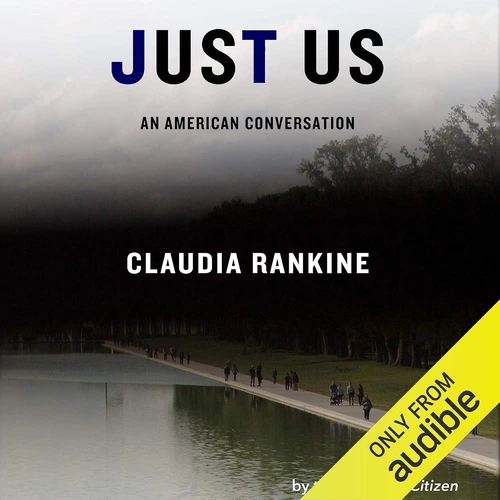
I was at a dinner party last month. Good food, good wine, good people. Then someone mentioned the local school board’s decision about a diversity program. The room went silent. People looked at their plates. Someone changed the subject so fast it gave me whiplash. I sat there thinking about Claudia Rankine’s new book, Just Us: An American Conversation, which I had just finished the night before. Rankine’s central question haunts me: Why is it so hard for us to talk about race, even with the people we love most?
She does not give us easy answers. She gives us something harder: a mirror.
The Protagonist: A Self Who Keeps Showing Up
Rankine puts herself in the room. She is the protagonist of this book, but not in a heroic way. She is a Black woman who flies across the country to give lectures. She sits next to white strangers on planes. She has drinks with white friends. She attends a poetry reading where a white audience member asks a question that lands like a slap. She does not walk away. She stays in the discomfort.
The core conflict is not between Rankine and some villain. It is between her and the gap between what people say and what they mean. A white friend says, “I don’t see color.” Rankine does not scream. She thinks. She writes. She tries to understand why that phrase, meant as a compliment, feels like an erasure. Another friend says, “But you’re different.” Different from what? The question hangs there, unanswered.
What makes this book so quietly powerful is that Rankine never claims to have figured it out. She is not a teacher handing down wisdom. She is a person, like us, stumbling through conversations that feel impossible. She shows us her own awkwardness, her own moments of saying the wrong thing, her own exhaustion. I found myself thinking: If she struggles with this, what hope is there for me?
And then I realized that was exactly the point.
The Metaphor of the Open Door
The central image of Just Us is the threshold. Rankine keeps describing doorways, edges, borders. The moment before you speak. The space between what you want to say and what you actually say. She includes photographs of white people she has encountered, their faces often turned away or half-hidden. These are not portraits of villains. They are people caught in the act of being themselves, which is sometimes uncomfortable to look at.
The craft here is extraordinary. Rankine blends essays, poems, images, and transcripts of real conversations. She includes footnotes that are not academic asides but raw, emotional additions. In one footnote, she confesses that she deleted a friend’s email response because it made her too angry. She shows us her own editing, her own choices about what to include and what to leave out. It feels less like reading a book and more like watching someone think aloud, in real time.
This is not a book that tells you what to think. It is a book that shows you how hard thinking actually is. Rankine is asking us to sit with the discomfort of not knowing, of being in process, of being unfinished. She is saying that the conversation about race is not a problem to be solved. It is a relationship to be lived.
The Work That Never Ends
I finished Just Us feeling something I did not expect: hopeful, but not in a bright, easy way. More like the hope you feel after a long, honest conversation with someone you love, where nothing is resolved but something has shifted. Rankine is not offering a solution. She is offering a practice. She is saying that the conversation about race is not a one-time event. It is a daily choice, a muscle you have to keep exercising.
This book is for anyone who has ever felt stuck in a conversation about race. For anyone who has said the wrong thing and wanted to take it back. For anyone who has stayed silent when they should have spoken. Rankine shows us that the discomfort is not a sign of failure. It is a sign that we are actually trying.
The limitation of the book, if I am honest, is that it can feel fragmented. The shifts between essay, poem, and image are sometimes jarring. I wanted more narrative flow at points. But maybe that is the point. Rankine is not giving us a smooth story. She is giving us the messy reality of living in a country where race touches everything, even the conversations we think are just about school boards or dinner parties.
So here is my question for you, after reading this: Who is the one person in your life you are avoiding a hard conversation with, and what are you waiting for?
