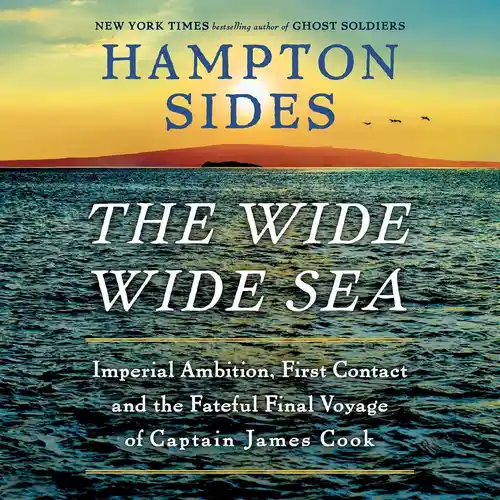
I was standing on a beach in Bali last summer, watching a local fisherman mend his net. A tourist walked up, pointed at the man’s catch, and started haggling without a word of greeting. The fisherman just smiled, silent. The tourist got frustrated, raised his voice. I felt something twist in my stomach. That small, ugly scene came back to me as I read Hampton Sides’s The Wide Wide Sea. Because what is Captain Cook’s final voyage, really, if not the grandest, most catastrophic version of that tourist? Two worlds, one man with a map and a gun, the other with a culture and a memory. And the question that haunted me through every chapter was this: when we say “first contact,” who is really blind?
The Man Who Saw Everything Except Himself
Captain James Cook was, by any measure, a genius of the sea. He charted coastlines that Europeans had only guessed at. He kept his crew alive on voyages that would have killed lesser captains. Sides gives us this Cook with respect, even awe. But he also gives us the other Cook. The one who, after years of successful encounters with Pacific Islanders, grew tired of diplomacy. The one who started seeing the people he met as props in his own story.
The book’s most gripping section is the final months in Hawaii. The Hawaiians, Sides shows, initially treated Cook as a god. Not because they were naive, but because their cosmology had a space for him. Cook, however, could not accept the role. He played along, then resented it. He wanted to be seen as a man, but he wanted the privileges of a god. This contradiction is the heart of the drama. You watch him make decision after decision that a wiser man would have avoided. He takes a chief hostage. He pushes. He assumes that his authority, which worked in Tonga and Tahiti, will work here. It doesn’t. The tension builds like a tide you can feel but cannot stop.
Sides never tells you what to think. He just shows you the details: the broken taboo, the stolen boat, the escalating anger on both sides. And then the beach at Kealakekua Bay. I won’t spoil how it ends, because you probably know. But the way Sides writes it, you feel the tragedy not as a clash of civilizations, but as a failure of empathy. Cook, for all his brilliance, could not read the room. He could read the stars, but not the faces around him.
The Shadow That Follows the Ship
The book’s core theme is not exploration. It is projection. Sides argues, quietly but insistently, that Cook’s fatal flaw was his inability to see the Islanders as equals with their own agency. He saw them as scientific specimens, as trading partners, as potential converts to Christianity or subjects of the Crown. But never as people who might have their own reasons, their own gods, their own right to say no.
The key imagery Sides uses is the sea itself. Calm, then violent. Reflective, then opaque. Cook’s ships, Resolution and Discovery, are like bubbles on that surface: fragile, temporary, carrying men who think they are masters of the ocean but are really just passengers. There is a moment when a Hawaiian priest predicts Cook’s death, and Cook ignores it. Sides lingers on that moment. The priest was not a magician. He was a man who understood the pattern. He saw the anger building, the disrespect accumulating. Cook saw only the horizon.
What Sides does masterfully is show how this pattern repeats. It is not unique to the 18th century. It is the story of every encounter between power and vulnerability. The tourist in Bali. The corporate executive in a foreign market. The politician who cannot understand why people are angry. We keep believing that if we just explain ourselves more clearly, the other side will see reason. But the other side is not confused. They see us perfectly. The problem is that we refuse to see them.
The Quiet Tragedy of Knowing Too Late
So what do we take from this book? Not a moral lesson about colonialism, though that is there. Not a condemnation of Cook, though his mistakes are clear. What Sides gives us is something harder to hold: the recognition that good intentions can coexist with disastrous blindness. Cook was not a monster. He was a man who, at the end, could not admit he was wrong. And that is far more frightening, because it is familiar.
I think about that fisherman in Bali. The tourist left, angry, muttering about rudeness. The fisherman went back to his net. He never said a word. Maybe he knew something the tourist didn’t. Maybe he saw that the tourist was the one trapped, not him. The Wide Wide Sea is a book about that kind of knowing. It is a book for anyone who has ever been the tourist, and anyone who has ever been the fisherman. It is a book for anyone who has ever wondered: what am I not seeing, right now, that will only become clear when it is too late?
Read it. Not for the adventure, though that is thrilling. Read it for the mirror. It is painful, but necessary.
