If you’ve scrolled through LinkedIn or Twitter recently, you’ve almost certainly run into the collective frustration surrounding modern communication.
Managers venting about team members who beat around the bush until minor issues turn into fires. Founders exhausted by sugarcoated updates that mask real risk. Couples trapped in a loop, having the exact same exhausting argument for the fifth time this month.
This isn’t just venting—it’s the friction of people who have critical things to say, but lack the tools to say them effectively. When the stakes are high, most of us default to two bad choices: passive silence or aggressive confrontation.
If you are facing a conversation you’ve been dreading, these 3 books offer distinct, battle-tested blueprints to tackle high-stakes dialogue with clarity, composure, and confidence.
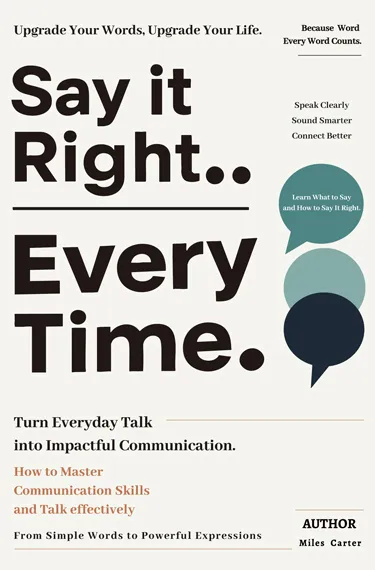
Say It Right Every Time by Miles Carter

You know precisely what you want to say. But the moment the pressure spikes, your words get twisted—or worse, disappear entirely.
You freeze during crucial interviews. You sound defensive when you simply meant to hold your ground. And you walk away from high-stakes meetings, replaying the conversation on an endless loop, thinking, “I should have said it differently.”
[Say It Right Every Time] addresses one hyper-specific, excruciating problem: how to articulate your thoughts with authority and poise when your anxiety is actively working against you.
Miles Carter doesn’t rely on generic advice. Instead, he uses side-by-side phrasing breakdowns, demonstrating how identical ideas yield radically different outcomes depending on your framing. At a critical juncture, a defensive snap and a masterfully framed invitation to dialogue trigger completely opposite reactions.
Rather than handing you scripted lines to memorize, Carter equips you with a rapid mental filter—a real-time strategy to process your thoughts before speaking so you never walk away regretting what came out of your mouth again.
From tense salary negotiations and difficult performance reviews to high-stakes interviews, this is the ultimate playbook for capable professionals who have great ideas, but struggle to command the room under pressure.
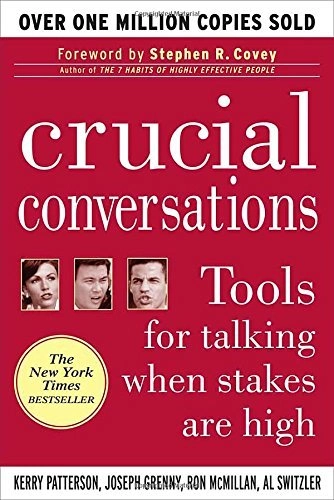
Crucial Conversations by Patterson, Grenny, McMillan, and Switzler
Some conversations are high stakes, high emotion, and high disagreement. Asking for a raise. Telling a team member their performance is slipping. Confronting a partner about a recurring issue. These are the conversations we tend to avoid or handle badly because the cost of getting it wrong feels enormous.
This book gives you a structured framework for exactly those moments. It introduces the concept of “start with heart.” Before you open your mouth, check what you really want. Do you want to win? Do you want to avoid conflict? Or do you actually want a resolution that works for everyone? This small step changes everything about how the conversation unfolds.
When people feel unsafe, they shut down or lash out. The book gives you specific techniques to restore safety in the middle of a tense conversation, like stepping back and acknowledging what the other person might be feeling before you continue making your point.
One of the most useful tools is the “STATE” framework. It walks you through how to state your views without sounding rigid, how to tell your story without making it sound like the only story, and how to turn a confrontation into a dialogue.
If you tend to avoid hard conversations because you are afraid they will blow up, this book is your playbook. It is for managers, leaders, and professionals in their late twenties to fifties who regularly have to deliver tough messages.
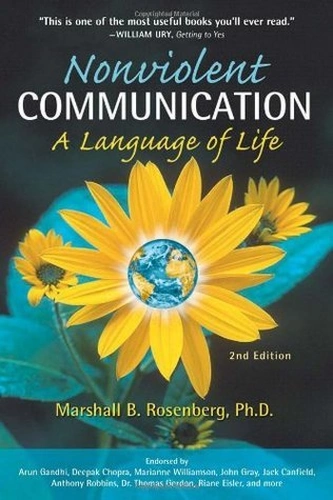
Nonviolent Communication by Marshall Rosenberg
Most of us are trained to judge first and understand second. Someone says something we do not like, and we immediately label them. “That was rude.” “They are selfish.” “They never listen.” The problem is, labels do not help you connect. They just make the other person defensive.
Rosenberg offers a different way. He teaches you to separate observation from evaluation. Observation is what happened. Evaluation is your story about what happened. Most conflicts come from treating evaluations as facts.
The book gives you a four-part model. State what you observe without judgment. State how you feel about it. State the need behind that feeling. Make a request, not a demand.
For example, instead of saying “You never help around the house,” you say “I noticed the dishes were left in the sink after dinner. I feel frustrated because I need some help with cleanup. Would you be willing to handle dishes tonight?” You are not accusing. You are sharing your experience and inviting a conversation.
This book is not about winning arguments. It is about being heard and hearing others in return. It is for anyone in close relationships who keeps having the same argument, and for leaders in long-term teams where trust matters more than short-term wins.
These three books tackle conversation skills from different angles. Carter gives you language patterns to use when you are nervous. Patterson gives you a structured playbook for high-stakes moments. Rosenberg helps you rewrite the underlying script of how you talk about conflict.
Which one to pick depends on where you usually get stuck. If you freeze in the moment, start with Carter. If you avoid the hard talks, start with Patterson. If you keep saying the same thing and getting nowhere, start with Rosenberg.