The ceiling stared back at me. Three in the morning, and I was replaying a conversation from work that happened six days ago. I said the wrong thing. I should have phrased it differently. She probably thinks I’m incompetent now.
My brain was a hamster wheel, and I couldn’t find the off switch.
If you’re reading this, you know the feeling. You’ve googled “best books to stop overthinking” because you’re exhausted. Not physically tired, though that too. You’re tired of the noise in your head. The constant replay. The second-guessing. The what-ifs that never lead anywhere useful.
Here’s what I found after reading way too many books on this topic. Some of them are genuinely helpful. Others are just… words. Pretty words that don’t do anything when the spiral starts at 2am.
I’m going to share the ones that actually worked for me, and one newer book that surprised me.

Why Does My Mind Keep Replaying the Same Scenes?
I used to think overthinking was a discipline problem. Like if I just tried harder, I could stop. But that’s not how it works. The brain doesn’t respond to force. It responds to understanding.
Let me tell you what I learned about my own loops. They always came from the same place. Fear of getting something wrong. Fear of being judged. Fear that if I didn’t think about a problem enough, something terrible would happen.
The funny thing is, all that thinking never prevented anything. It just made me tired and anxious.
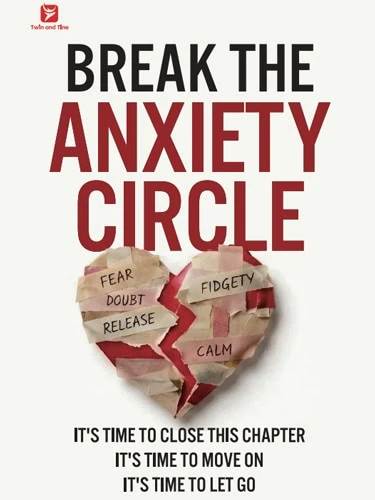
One night, after another sleepless round of mental gymnastics, I picked up a book that had been sitting on my shelf for months. It was called “Break the Anxiety Circle” by Miles Carter. I almost didn’t read it because I assumed it would be like the others. Abstract concepts. Big words. Nothing I could actually use.
I was wrong.
The book doesn’t lecture. It walks you through the moment when the loop starts and shows you where the exit is. Not by suppressing thoughts, but by understanding them. Carter talks about how overthinking is often a way of avoiding something else. The thinking feels productive. It feels like problem-solving. But it’s actually a shield.
That idea stuck with me. My overthinking wasn’t a flaw. It was a habit that once served a purpose. Now it was just running on autopilot.
Best Books to Stop Overthinking for Real, Not Just in Theory
Let me be honest with you. There’s no magic book. No single read that flips a switch and turns off the mental chatter forever. If someone promises that, they’re selling something.
What the best books do is give you a new way to relate to your thoughts. They don’t stop the thinking. They change what you do with it.
Here’s what worked for me, in no particular order.
“Break the Anxiety Circle” by Miles Carter is one of them. It’s a practical guide that covers the full range of internal struggles. Overthinking, anxiety, indecision, self-blame. It doesn’t just tell you what’s wrong. It shows you what to do about it. Each chapter addresses a specific struggle and gives you something concrete to try.
What I appreciated most was the tone. Carter writes like someone who’s been there. Not a guru on a mountaintop. He shares real experiences and pairs them with methods you can actually apply. There’s no pressure to be perfect. Just small steps toward a quieter mind.
The book also includes these short, thought-provoking quotes throughout. I found myself underlining half the book. Lines like the one about reconciliation with the past. I’d never thought about it that way before. That maybe my overthinking about old mistakes was a form of refusing to forgive myself.
Another book that helped me was one I read years ago. It’s not specifically about overthinking, but it touches on how we attach to thoughts. The author talks about how we believe everything our mind tells us. But the mind is not always accurate. Sometimes it’s just repeating old patterns.
I’m not going to name that one because honestly, it was dense. It took me three tries to finish. The ideas were good, but the execution wasn’t accessible. That’s the problem with a lot of books in this space. They’re written by academics for other academics. The rest of us are just trying to get through the day without spiraling.
The 3-Second Pause Trick That Changed My Evenings
Here’s a specific tool I picked up that actually made a difference. I call it the 3-Second Pause, and I use it every single night.
When I notice the overthinking starting, usually right when I turn off the lights, I don’t try to argue with the thoughts. That never works. Arguing with a thought is like wrestling a ghost. You can’t win.
Instead, I pause. I take three seconds. Just three. And in those three seconds, I ask myself one question: “Is this thought useful right now?”
Not “is this thought true?” Not “what if it’s real?” Just “is this useful at 11pm when I should be sleeping?”
The answer is almost always no. And that little moment of clarity is enough to break the spell. The thought doesn’t disappear. But it loses its grip. It becomes background noise instead of the main event.
I read about something similar in “Break the Anxiety Circle.” The book talks about how we can’t control which thoughts show up, but we can control how much attention we give them. That distinction was huge for me. My problem wasn’t that I had thoughts. My problem was that I treated every thought like it demanded a response.
Some thoughts don’t need answers. They just pass through.
What About Overthinking During the Day?
Nighttime is one thing. But what about when you’re at work, or with friends, and your mind starts spinning?
I used to think I was present when I was with people. Then I realized I was only half there. The other half was replaying something from yesterday or rehearsing something I wanted to say tomorrow.
The same pause works during the day. It just looks a little different. When I catch myself drifting into a loop, I do a quick check. Am I actually solving a problem, or am I just spinning? If I’m spinning, I give myself permission to stop. I tell myself the thought will still be there later if I need it. But right now, I’m choosing to focus on what’s in front of me.
This took practice. The first few times, I couldn’t even catch myself in the act. I’d be deep in a spiral before I realized what was happening. But it got easier. Like any skill, it’s about repetition, not perfection.
When Overthinking Feels Like It’s Part of Who You Are
There was a period in my life when I thought my overthinking was just my personality. That I was a “deep thinker” and that was that. I built my identity around it. Every decision was weighed. Every conversation was analyzed. I felt smart because I noticed things others missed.
But I also felt miserable. Constantly. Because noticing things others missed also meant noticing every possible failure, every potential rejection, every hidden danger.
I had to unlearn that. Being thoughtful and being anxious are not the same thing. One is a choice. The other is a reflex.
What helped me was reading about how overthinking is often a way to feel in control. If I think about a problem enough, maybe I can prevent something bad from happening. But that’s an illusion. Thinking about something doesn’t control it. It just makes me feel like I’m doing something.
I’m not doing anything. I’m just suffering in advance.