You have a big conversation coming up. You want to prepare. But the advice you find pulls you in two different directions: learn the right words, or work on yourself first.
Two books represent these approaches perfectly. One gives you language patterns for high-pressure moments. The other builds the emotional foundation that makes all communication work. Both are useful, but they solve different problems. Here is what each one actually offers.
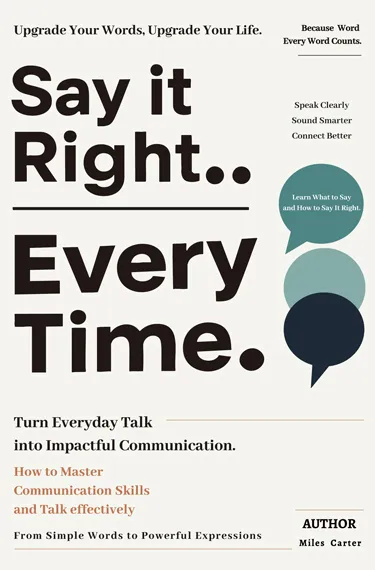
Say it Right..Every Time.
Miles CarterPractical communication tools for the moments that matter — say what you mean, calmly and confidently.
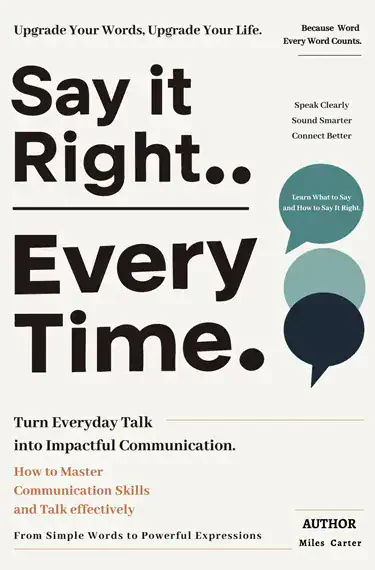
Say It Right Every Time by Miles Carter
This book is for people who already know what they want to say—but cannot say it when it matters.
You have good ideas. You know the material. But when the pressure hits, your words come out wrong. Or they do not come out at all. You sound defensive when you meant to sound firm. You ramble when you meant to be concise. You walk away replaying the conversation, thinking “I should have said that differently.”
Carter’s book gives you language patterns that work when your nerves are working against you. It is built around before-and-after comparisons that show you how the same idea lands completely differently depending on how you phrase it. One version escalates tension. The other diffuses it. One version puts the other person on the defensive. The other invites them into your perspective.
The book covers job interviews, salary negotiations, difficult conversations, and team meetings. It teaches you to build a quick mental filter before you speak. It does not ask you to change who you are. It asks you to change what you say.
This book is for you if:
- You freeze in high-pressure conversations
- You constantly replay conversations thinking “I should have said that”
- You have good ideas but struggle to express them clearly
- You want practical language patterns you can use immediately
Where it works best:
Job interviews, salary negotiations, tough feedback conversations, team meetings, and any moment where you need to say something important under pressure.
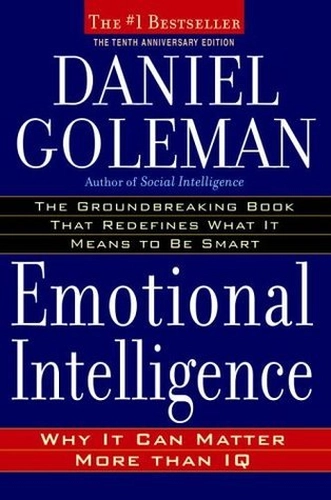
Emotional Intelligence by Daniel Goleman
This book is for people who understand the words but cannot control the emotions behind them.
You know what the right response is. You know what you should say. But when the conversation gets tense, your emotions take over. You get defensive. You get angry. You shut down. You say things you do not mean, or you freeze entirely. The problem is not that you do not know the words. The problem is that your emotions are driving the conversation.
Goleman’s book is about the underlying ability that makes all communication work: emotional intelligence. He breaks it down into five components: self-awareness, self-regulation, motivation, empathy, and social skills. These are the capacities that determine how well you manage your own emotions and read the emotions of others.
The book draws on decades of research to show why emotional intelligence matters more than IQ in most areas of life—especially communication. It explains what is happening in your brain during high-stakes interactions and how you can improve your ability to stay present, listen deeply, and respond rather than react.
Goleman does not give you scripts. He gives you a framework for understanding yourself better. And once you understand yourself, the words come more naturally.
This book is for you if:
- You know what you should say but cannot say it because your emotions take over
- You get defensive or shut down in difficult conversations
- You struggle to read other people’s emotions
- You want a deeper understanding of how communication actually works
Where it works best:
Relationships, leadership, negotiation, conflict resolution, and any situation where emotional dynamics matter as much as the words being said.
The Same Conversation, Two Different Approaches
Imagine you are about to give a presentation. You have prepared for days. You know the material cold. But five minutes before you go on, your heart is racing, your palms are sweating, and your mind starts to go blank.
Carter’s approach: you have a few ready-to-use phrases in your back pocket. “Let me take a moment to think about that.” “That is a great question, here is how I would approach it.” You do not have to be calm. You just have to have the right words to say when your brain freezes.
Goleman’s approach: before you go on, you take a breath. You notice your heart rate. You name the feeling—”I am nervous, and that is normal.” You remind yourself that your body is preparing you for a challenge, not a threat. You shift from reacting to your anxiety to accepting it. By the time you start speaking, you are present enough to let the words come.
Both approaches work. But they operate at different levels. Carter gives you the words. Goleman gives you the presence to deliver them.
Where They Overlap
Both books care about communication. Both are grounded in research. Both give you practical tools you can use immediately. Both recognize that communication is not just about words—it is about how you show up.
But beyond that, they are very different books for very different problems.
Where They Diverge
Level of intervention.
Carter’s book operates at the level of language. It gives you external tools—phrases, frameworks, mental filters. The change happens in what you say.
Goleman’s book operates at the level of the person. It gives you internal tools—self-awareness, self-regulation, empathy. The change happens in who you are when you speak.
Time horizon.
Carter’s tools work immediately. You can read a chapter, learn a phrase, and use it the same day. The results are quick and visible.
Goleman’s tools take time. Emotional intelligence is a capacity you build over months and years. The results are deeper but slower.
Scope of application.
Carter’s book covers specific situations: interviews, negotiations, difficult conversations. It is targeted and practical.
Goleman’s book applies to every interaction you will ever have. It is broader but less immediately actionable.
Role of emotions.
Carter acknowledges that emotions get in the way—and gives you workarounds. If you are nervous, here is what to say anyway.
Goleman puts emotions at the center. He argues that understanding and regulating your emotions is the foundation of all communication. Without that foundation, no amount of phrasing will save you.
There is no single right answer. The right book depends on where you are right now.
If you are preparing for a specific conversation and need practical language patterns you can use immediately, Say It Right Every Time is the better choice. It gives you a toolkit you can apply today.
If you find yourself repeating the same communication patterns and want to understand why—if you keep getting defensive, shutting down, or struggling to read others—Emotional Intelligence addresses the root cause. It takes longer to show results, but the results are more lasting.
Read both if you can. They are not competitors. They are two layers of the same problem. Carter gives you the words. Goleman gives you the state of mind to deliver them. One helps you say the right thing. The other helps you be the right person when you say it.
You are not bad at communication. You may just be focused on the wrong layer. If you need better words, start with Carter. If you need a better foundation, start with Goleman. Both will make you better than you were yesterday.