The Email Was Two Words. Your Mind Wrote the Rest.
At 9:14 on a Monday morning, someone receives a message from their manager: “Can we talk?”
That is all.
Within minutes, the possibilities start multiplying. Maybe there is a problem with the latest project. Maybe they made a mistake. Maybe their manager is unhappy. Maybe the conversation will lead to something much worse.
Nothing else has happened, but the body is already reacting as though the worst outcome is on its way.
This is how catastrophizing often begins. It rarely starts with a huge event. More often, one uncertain detail becomes the starting point for an entire chain of imagined consequences.

The Mind Is Trying to Protect You
Catastrophizing can feel strangely convincing because it often comes with the promise of preparation. If you think through every possible disaster, maybe you will be ready when something goes wrong.
The problem is that your mind does not necessarily stop once it has considered the useful possibilities. It keeps going. One possibility creates another, and the scenario becomes more frightening with every step.
The original fact may be very small, while the emotional reaction becomes enormous.
Separate What Happened From What Your Mind Added
A practical way to interrupt catastrophizing is to divide the situation into facts and predictions.
Suppose your manager sends a short message. The fact is that your manager wants to talk. Everything else—anger, disappointment, job trouble, a major mistake—is interpretation or prediction.
That does not mean the worst outcome is impossible. It means it should not automatically be treated as though it is already happening.
When you make that distinction, you can ask a more useful question: What do I actually know right now?
Do Not Argue With Every Fear
People sometimes respond to catastrophic thinking by trying to prove that nothing bad will happen. But that can become another form of overthinking.
“What if this happens?”
“No, it probably won’t.”
“But what if it does?”
Soon you are having another long conversation with your own fear.
A better approach is to stop demanding certainty. Something could go wrong without meaning that you need to mentally experience the entire disaster in advance.
Break the Anxiety Circle by Miles Carter
This is one of the patterns Break the Anxiety Circle by Miles Carter is well suited to address. The book looks at the way anxiety can turn uncertainty into increasingly threatening mental scenarios, especially when overthinking and self-doubt are already habitual.
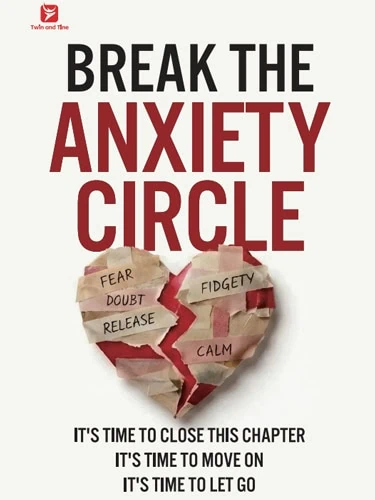
Rather than focusing only on the final catastrophic thought, Carter encourages readers to notice where the process begins. A small trigger leads to an interpretation, the interpretation creates an emotional reaction, and the emotional reaction makes the original interpretation feel even more believable.
The book’s approach connects catastrophizing with broader patterns such as anxiety loops, fear of uncertainty, self-doubt, regret, and the need for reassurance. That bigger picture matters because catastrophizing is often not an isolated habit. It can be part of a larger tendency to search for certainty whenever something feels unclear.
Readers are encouraged to recognize when they have moved from useful preparation into repetitive prediction. The goal is not to convince yourself that nothing bad can happen. It is to stop rehearsing every possible disaster simply because the future is uncertain.

Break the Anxiety Circle
Miles CarterA mental reset for people trapped in the overthinking loop. Understand why your mind won’t stop racing — and how to break free from anxiety, people-pleasing, and emotional exhaustion.
The book also explores emotional regulation and self-worth, which can make a noticeable difference when a small event feels disproportionately threatening. If every mistake feels like a reflection of your value, even ordinary uncertainty can trigger a much stronger reaction.
For someone searching for a book on how to stop catastrophizing, Break the Anxiety Circle provides a practical framework for identifying the mental chain before it runs all the way to the worst possible ending.
Ask What the Next Real Step Is
Once you notice the catastrophic story, bring the situation back down to the next concrete step.
Maybe you need to ask a question, wait for more information, correct something, or simply continue with your day. You do not need to solve the entire imaginary future before taking that one step.
This is where catastrophizing begins to lose some of its power. You are no longer trying to guarantee that everything will be okay. You are reminding yourself that whatever comes next can be handled when it actually arrives.
The Worst-Case Scenario Does Not Need Your Full Attention
You can take a concern seriously without mentally living inside it.
The more familiar you become with the difference between facts and fearful predictions, the easier it becomes to recognize when your mind has moved too far ahead of the evidence.
Break the Anxiety Circle helps readers work on exactly that kind of awareness, so uncertainty can remain uncertainty instead of automatically becoming a crisis.
If you found this helpful, these books go deeper into the same themes.



Break the Anxiety Circle
$19.90

From Debt to Wealth
$19.90

