For years I thought my marriage had a love problem. It didn’t. It had a words problem. I would say one thing, my partner would hear another, and by dinner we were both exhausted over something neither of us meant.
If you are searching for books about communication in relationships, you probably know this feeling. There are three books that genuinely shifted how I speak. Not summaries. Just what actually changed at my kitchen table.
Quick answer: How do I communicate better in my relationship?
You learn a few better sentences, practice listening before you respond, and stay calm enough to use both when your heart is pounding.
Here are three books about communication in relationships. One gives you actual words to use. One teaches you to listen. One helps you stay calm while you do both.
Why Does the Same Meaning Turn Into a Fight?
Here is what I slowly understood. Most of us learned to talk about feelings the way we learned to ride a bike. Badly. And then we just kept going.
We say “you never listen” when we mean “I feel alone right now.” We say “fine, whatever” when we mean “that hurt.”
The gap between what we feel and what we say is where the fighting lives. Every good communication guide attacks that same gap, just from a different angle.
| What we say | What we mean |
|---|---|
| “You never listen” | “I feel alone right now” |
| “Fine, whatever” | “That hurt” |
| “I don’t want to” | “I’d prefer that you didn’t” |
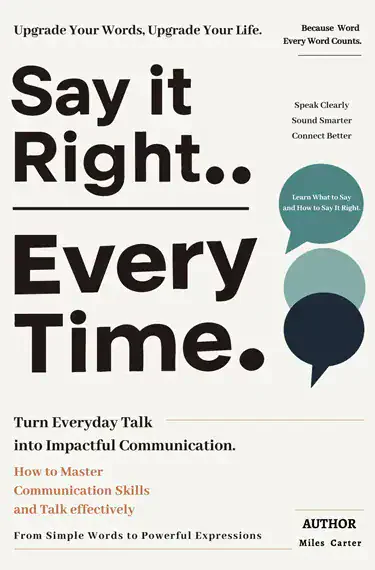
Say It Right Every Time
By Miles Carter
This is the most practical of the three. The whole book is built on side-by-side comparisons. A basic way to say something. A more mature way to say the same thing. You read them and think, oh. That is what I should have said.
What makes this book different:
The core idea is that it is not what you say. It is how you say it. Small wording changes do the heavy lifting.
What you get:
- Scripts for everyday conversations, conflict, and boundaries
- How to say no without over-explaining
- How to pause before you react
- How to handle rude comments without losing your temper
- A section on workplace conversations that applies everywhere
Phrases I now use without thinking:
| Instead of… | Try… |
|---|---|
| “You never listen to me” | “I feel unheard when I’m talking” |
| “Sorry I’m late again” | “Thanks for waiting for me” |
| “I don’t want to” | “I’d prefer that you didn’t” |
That second one surprised me the most. Swapping an apology for a thank-you removes this low, guilty energy from my voice. My partner noticed before I did.
Best for: Anyone who knows what they mean but cannot get it out right.
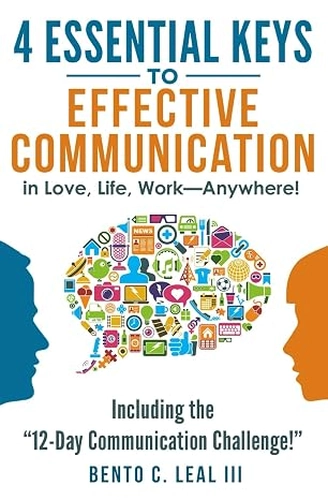
4 Essential Keys to Effective Communication
By Bento C. Leal III
This book addresses the part I struggled with most. I was so busy preparing my reply that I missed what my partner actually said.
What makes this book different:
It opens with a line that stopped me cold. Most relationship problems are not caused by a lack of love. They are caused by misunderstandings, assumptions, and poor communication.
What you get:
- How to treat listening as a skill you practice, not a personality trait
- Common listening blocks that make us tune out
- Small exercises to catch yourself before you stop listening
- A 12-Day Communication Challenge at the end, one skill per day
I did the challenge with my partner over coffee each morning. Some days we failed. We still laughed about it.
Best for: Anyone who realizes the problem is not what they say, but that they are not really hearing their partner.
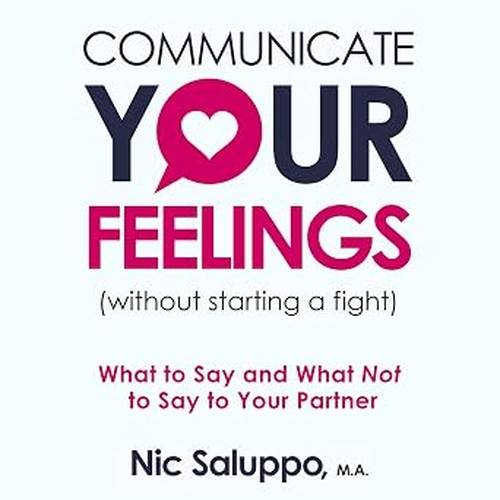
Communicate Your Feelings (Without Starting a Fight)
By Nic Saluppo
This is the book I reach for when I can feel myself about to blow up over something small.
What makes this book different:
The author uses a swimming metaphor I keep coming back to. Being in a relationship without knowing how to share your feelings is like jumping into a pool without knowing how to swim. You can flail all you want, but it will not keep you afloat.
What you get:
- How to share your feelings without triggering a fight
- How to receive your partner’s feelings without getting defensive
- 13 techniques for avoiding escalation
- Tools for both sides of the conversation
The techniques about avoiding escalation have saved more evenings than I can count.
Best for: Anyone who knows the right words but loses them when emotions run high.
How These Books Work Together
| Book | What it gives you |
|---|---|
| Say It Right Every Time | The words |
| 4 Essential Keys | The listening skills |
| Communicate Your Feelings | The calm to use both |
Reading them together, I started to notice something. Every single one keeps returning to the same quiet idea. You can be kind and strong at the same time. You can set a boundary without a fight. You can say what you mean without sounding harsh.
That reframing, more than any single technique, is what changed my relationship. I stopped treating honesty and gentleness as opposites. They were never opposites. I just did not have the words yet.
Final Thought
One line from Carter’s book stays with me. Say it right every time by speaking with clarity, calm, and respect, for yourself and the other person.
I do not always manage it. Last Tuesday I definitely did not. But I have noticed something small and real. When I pause before I speak, even for two seconds, my partner’s shoulders drop. He stops bracing. And that tiny pause, learned from a book I almost did not buy, has done more for us than any long conversation ever did.
Start with one book. Try one technique. See what happens.
References
Carter, Miles. Say It Right Every Time.
Leal, Bento C., III. 4 Essential Keys to Effective Communication in Love, Life, Work, Anywhere! Relationship Skills Series.
Saluppo, Nic. Communicate Your Feelings (Without Starting a Fight): What to Say and What Not to Say to Your Partner.

