You know someone like this.
A coworker who criticizes everything but offers no solutions. A family member who turns every conversation into a fight. A friend who drains your energy after five minutes. Someone who is always right, always defensive, always impossible to please.
You have tried reasoning, ignoring, and walking away. Nothing works.
Why are they like this? More importantly, what can you do about it? The three books below give you the answers.
How to Read Someone’s Mind by Miles Carter

Imagine a meeting. A colleague tears apart your proposal. No solutions, no alternatives—just harsh criticism delivered with a smirk.
You feel attacked. Your instinct is to defend yourself or shut down. But what if that criticism is about something else entirely? What if they are feeling threatened, insecure, or territorial?
Carter teaches you to read the signals beneath difficult behavior. The crossed arms, the dismissive tone, the refusal to engage—these are not just rudeness. They are clues. Behind every difficult person is a hidden need: control, validation, protection. Once you see what they actually need, you stop reacting to the surface behavior and start responding to what is really driving them.
“Difficult people are not difficult for no reason. Their behavior is a signal. Your job is to decode it.”
When you learn to decode the signal, the same person becomes less intimidating. You stop taking it personally. You stop getting dragged into their drama. You start choosing responses that actually work—rather than reacting in ways that only make things worse.
For anyone tired of being drained by someone they cannot seem to handle.
The Laws of Human Nature by Robert Greene

Why do some people seem impossible to work with? Greene argues that beneath every difficult behavior is a deeper human drive—insecurity, status anxiety, a need for control. Most of us never see these forces at work because we are too busy reacting.
Greene breaks down the hidden patterns: why people lie, why they manipulate, why they resist change. Understanding these drives shifts everything. When a colleague is territorial, it is not about you—it is about their fear of irrelevance. When a partner is controlling, it is not about you—it is about their fear of losing you.
“Difficult people are driven by forces they often do not understand themselves. When you see the laws, you stop being a victim of them.”
This book gives you the framework to see the hidden patterns behind human behavior. It does not teach you to manipulate others—it teaches you to protect yourself from manipulation.
For anyone who wants to understand what is really driving the difficult people in their life.
Crucial Conversations by Kerry Patterson, Joseph Grenny, Ron McMillan, and Al Switzler
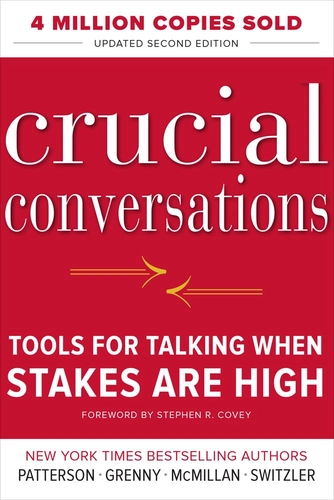
Sometimes you cannot avoid the difficult person. You have to talk to them. And every attempt ends in frustration.
This is the book for those moments. It gives you a step‑by‑step system for handling high‑stakes conversations with people who are defensive, aggressive, or impossible to reason with.
The core idea: when conversations become difficult, people stop listening. They get defensive. They attack, withdraw, or shut down. The key is to create psychological safety—so the other person stops defending and starts hearing.
“The goal is not to win. The goal is to be heard—and to hear. Without safety, neither happens.”
The book gives you tools to stay calm, express your needs without blame, and handle someone who deflects or turns the conversation back on you. It is practical, actionable, and full of scripts for real‑life situations.
For anyone who wants to say something honest to a difficult person without making things worse.
If you want to decode what is really driving difficult behavior, read Carter. If you want the big picture on human psychology and hidden drives, read Greene. If you need to have a specific conversation with someone impossible, read Crucial Conversations.
