You Keep Having the Same Communication Problems
Maybe people misunderstand your tone. Maybe you have trouble explaining how you feel. Maybe you talk yourself out of saying something important because you are worried about how it will sound.
None of these problems seems especially serious on its own. But when they keep happening, communication starts becoming tiring. You think about conversations before they happen, analyze them afterward, and sometimes avoid them altogether because it feels easier than dealing with another misunderstanding.
At that point, “I need to communicate better” is a useful realization, but it is still very broad. The next step is figuring out what better communication would actually look like for you.

Communication Is a Two-Way Skill
It is easy to focus on speaking because that is the part you can hear yourself doing. But communication also depends on what happens after you speak.
Are you giving the other person enough information to understand your point? Are you listening to their response, or only waiting for a chance to explain yourself again? Are you noticing when they look confused or frustrated, or are you assuming that if you said the sentence clearly, the conversation should already be working?
These questions matter because communication is not simply transferring information from one person to another. It is an interaction, and both people affect what happens next.
The Book for People Who Want Clearer Everyday Communication
Say It Right Every Time by Miles Carter focuses on the practical problems that make everyday communication harder than it needs to be.

The book explores how people express ideas, opinions, feelings, and needs, but it also pays attention to the details that can change how those messages are received. A thought that sounds perfectly clear in your head may become vague once you put it into words. A sentence that feels honest to you may come across as unnecessarily harsh to someone else.
That is the kind of gap the book helps readers notice.
Instead of teaching communication as a collection of formal rules, it gives readers a more useful way to examine their own habits. You start noticing when you are being too indirect, when you are overexplaining, when you are assuming instead of asking, and when your emotions are affecting the way you speak.
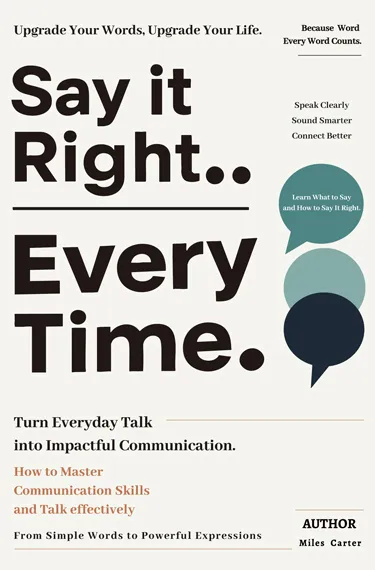
Say it Right..Every Time.
Miles CarterPractical communication tools for the moments that matter — say what you mean, calmly and confidently.
One of the Biggest Improvements Is Simply Being More Direct
A lot of weak communication comes from avoiding the actual point.
You want something, but you hint at it. You disagree, but you speak around the disagreement. You are upset, but you say “It’s fine” because you do not want to make the situation uncomfortable.
The other person then has to guess.
Direct communication does not require harshness. You can be considerate while still being specific about what you mean, what you need, or what you would like to change. In many cases, that is actually kinder because the other person does not have to decode the message.
Better Communication Can Make Relationships Feel Lighter
When people communicate poorly for long enough, small issues start carrying extra weight.
A missed message feels like rejection. A disagreement becomes a question about whether someone respects you. A simple request turns into a discussion about everything that has been frustrating you for months.
Clearer communication cannot solve every relationship problem, but it can stop some unnecessary tension from building in the first place.That is particularly valuable in close relationships, where people often assume that the other person should already know what they are thinking. They should not have to guess.
You Also Need to Know When to Stop Talking
Improving communication is not the same as becoming more talkative.
Sometimes the problem is actually that you keep adding words after the important part has already been said. You explain your reason, then explain the reason behind the reason, then try to make sure the other person knows you are not upset. The original message slowly gets buried under all that extra information.
Knowing when to stop is a communication skill too.
Say It Right Every Time helps readers become more aware of that balance. The goal is not to make every sentence as short as possible. It is to make sure the amount of explanation matches what the conversation actually needs.

Listen for What Is Not Being Said Clearly
Good communication also means noticing uncertainty.
Someone says they are “fine,” but their tone suggests otherwise. A colleague says they can “probably” meet a deadline, but their answer sounds hesitant. A friend agrees to a plan without enthusiasm.
You do not need to assume what those signals mean. You can ask.
That habit of checking instead of guessing can prevent a lot of unnecessary confusion. It also creates a healthier communication pattern because both people become more comfortable clarifying what they actually mean.
The Changes Become Visible in Small Moments
You may notice yourself becoming more direct when asking for something. You may stop rewriting a message ten times because you are worried about how it will be interpreted. You may become better at listening through disagreement instead of immediately preparing your defense.
None of these changes sounds dramatic. That is exactly why they are useful.
Communication is part of almost every relationship and nearly every working day. Improving a few small habits can therefore have a much wider effect than you might expect.
A Better Communicator Is Not a Perfect One
There will still be awkward conversations. You will still say something poorly from time to time. Someone will misunderstand you, and you will occasionally misunderstand them.
The difference is that you become better at noticing what went wrong and doing something about it.
That is what makes Say It Right Every Time a worthwhile communication book for everyday readers. It does not promise that every conversation will suddenly become easy. It helps you become clearer, more intentional, and more capable of handling communication when it does not go perfectly.