You Are Already Thinking About What You Want to Say
A meeting moves on, and only afterward do you realize you had something important to add. Maybe you noticed a problem with the timeline, disagreed with a decision, or had an idea that could have improved the project. You considered speaking up, but you were not sure how the comment would sound, whether someone more senior would challenge it, or whether it was worth interrupting the conversation.
This can become surprisingly frustrating. You may know your job well and have plenty to contribute, yet still hesitate at the exact moment when your input would be useful. Afterward, it is easy to tell yourself that next time you will speak up. Then the same situation happens again.

Confidence Helps, but Wording Matters Too
People often treat workplace confidence as though it is a personality trait you either have or do not have. In reality, part of the difficulty is much more practical. When you are unsure how to phrase a disagreement, question, or suggestion, even a good idea can feel risky to put into the room.
Clear communication gives you something concrete to work with. Instead of trying to sound impressive, focus on making the point understandable. What did you notice? Why does it matter? What would you suggest doing differently? Once those pieces are clear in your own head, speaking becomes much easier.
Say It Right Every Time
Say It Right Every Time by Miles Carter is a natural fit for people whose biggest workplace communication problem is getting their thoughts across clearly. The book looks at the practical details that shape how a message is received, including wording, expression, and the way ideas are presented.
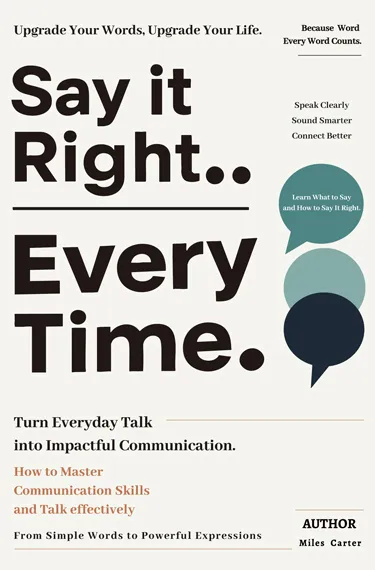
Say it Right..Every Time.
Miles CarterPractical communication tools for the moments that matter — say what you mean, calmly and confidently.
That matters because people do not respond only to the idea itself. They respond to how you frame it. A useful concern can sound like criticism if it is phrased carelessly, while a difficult question can feel constructive when the speaker is clear about what they are trying to solve.
The value of the book is that it helps readers work on that gap between what they mean and what other people actually hear. For someone who regularly leaves a meeting thinking, “I should have said it differently,” that is a very practical problem to work on.
You Do Not Need to Sound Certain About Everything
There is another habit that can make speaking up harder: trying to remove every trace of uncertainty before saying anything. People add disclaimers, apologize for asking questions, or spend so long qualifying a point that the main idea gets buried.
You do not need to pretend you are always right. You can say that you have a concern, explain what led you to it, and invite discussion. That sounds more credible than either extreme: acting completely certain about everything or making yourself sound unsure before you have even finished the first sentence.

A Disagreement Is Not Automatically a Personal Challenge
The moment someone disagrees with you, it can be tempting to defend the original point more strongly. In some workplaces, people become so focused on proving their position that they stop listening to the discussion itself.
A better habit is to stay with the issue. You can change your mind when someone brings better information, or you can explain why you still disagree. Neither outcome requires you to turn the conversation into a battle over who is smarter or more competent.
When the stakes are higher, Crucial Conversations can be a useful additional read because it focuses on conversations where emotions, disagreement, and consequences are all significant. But for everyday workplace communication, especially the challenge of expressing yourself clearly, Say It Right Every Time is the more direct starting point.
Start Speaking Before You Have a Perfect Sentence
You probably will not find the perfect wording every time. The goal is not to eliminate awkward moments or make every comment sound polished. It is to become comfortable enough with your own communication that a useful thought does not disappear simply because you were worried about how it might be received.
That change often begins with very ordinary moments. Ask the question while it is still relevant. Raise the concern before it becomes a bigger problem. Share the idea even if someone else may disagree. With enough practice, speaking up stops feeling like a special performance and starts feeling like part of doing your job well.
Say It Right Every Time can support that process by helping you become more intentional about the way you express your ideas, concerns, and opinions. The result is not necessarily becoming the loudest person in the room. It is becoming someone whose useful thoughts actually make it into the conversation.