At work, Lauren often noticed the same thing happening. A coworker would ask for help when her own workload was already full, and instead of saying she could not take on anything else, she would reply, “Sure, I’ll see what I can do.” At home, she did something similar with friends and family. She knew what she needed, but saying it out loud felt uncomfortably close to being demanding.
A lot of people are not actually bad at knowing what they need. The harder part is communicating those needs without adding an apology, a long explanation, or a fear of how the other person might react.
Books about communication can be especially useful here because they approach the problem from different angles. Some focus on language, some on boundaries, and others on the beliefs that make direct requests feel uncomfortable in the first place.
Start With the Need, Not the Apology
When you have spent a long time accommodating other people, it is easy to build a sentence around their comfort instead of your own need.
You might say, “I hate to ask, and I know you’re busy, but if there’s any chance you could maybe give me a little more time…”
In many situations, the message can be much simpler:
“I need another day to finish this properly.”
That does not mean your tone should become cold. It simply means the request gets to exist without being wrapped in an apology.
The same applies in personal relationships. “I need some quiet tonight” is clearer than pretending everything is fine and hoping someone notices that you are overwhelmed.
Be Specific About What Would Help
One reason needs are difficult to communicate is that people sometimes describe their frustration without explaining what they actually want.
“I feel like you don’t support me” tells the other person that something is wrong, but it does not tell them what they can do differently.
“Could you check in with me before making plans for the weekend?” gives them something concrete.
Specific requests are easier to understand and easier to respond to. They also reduce the chance that the other person will have to guess what you meant.
Do Not Assume They Already Know
People who spend a lot of time thinking about other people’s needs can make an odd assumption: if someone cares about them, that person should already know what they need.
Unfortunately, that is not how most relationships work.
Your partner may not realize that you need more notice before plans change. Your coworker may not know that you need uninterrupted time to finish a task. A friend may not understand that you would rather hear an honest answer than a polite one.
Saying it directly gives the other person a fair chance to respond. Silence may feel safer in the short term, but it leaves everyone working from guesses.
A Clear Request Can Still Be Flexible
Expressing a need does not mean demanding that everything happen exactly as you imagined.
You can say, “I need some time to think about this. Can we talk tomorrow?” and still be open to the other person’s response. You can ask for help while recognizing that the other person may not be available. You can explain what matters to you without insisting that there is only one acceptable solution.
This balance is useful because some people avoid direct communication precisely because they associate it with being controlling. A clear request gives the other person information; it does not remove their ability to answer.
Three Books That Can Help You Find the Words
1. Say It Right Every Time by Miles Carter

Say It Right Every Time focuses heavily on situations where people know what they want to communicate but struggle to put it into words without creating tension. The book covers respectful requests, expressing honest opinions, communicating boundaries with calm confidence, and saying no without guilt.
It also looks at the habit of people-pleasing and the difficulty of owning your voice when you are worried about another person’s reaction. That makes it particularly relevant for readers who understand their own needs but often soften them until the original message becomes unclear.
Another practical strength is its attention to real conversations. Rather than stopping at “be more direct,” the book focuses on how a request, boundary, or opinion can actually sound when you say it out loud.

Say it Right..Every Time.
Miles CarterPractical communication tools for the moments that matter — say what you mean, calmly and confidently.
2. Set Boundaries, Find Peace by Nedra Glover Tawwab

Set Boundaries, Find Peace focuses on understanding and communicating personal boundaries in everyday life. Nedra Glover Tawwab discusses boundaries in relationships, work, family, and other situations where people can become uncomfortable about stating what they need.
The book is useful for readers who tend to over-explain their limits or feel responsible for other people’s reactions. It gives more structure to questions such as when a boundary is needed, how to communicate it, and why guilt can show up even when the request itself is reasonable.
For someone whose main difficulty is not finding the words but feeling entitled to say them, this perspective can be particularly helpful.
3. Nonviolent Communication by Marshall B. Rosenberg
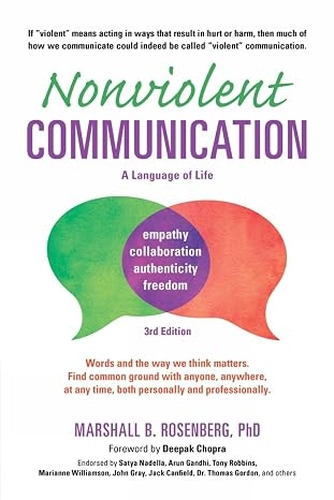
Nonviolent Communication offers a more structured approach to expressing observations, feelings, needs, and requests. Marshall B. Rosenberg’s framework is designed to help people discuss emotionally charged situations without relying on blame or personal attacks.
This can be especially helpful when the need itself is connected to frustration. Instead of telling someone what kind of person they are, you can describe what happened, explain how it affected you, and then say what you are asking for.
The approach takes practice, but it offers a useful way to turn a vague feeling such as “I’m not being heard” into a conversation with a much clearer direction.
Pay Attention to the Moment Before You Speak
One small habit can reveal a lot about your communication style: notice what happens in your head right before you make a request.
Do you start worrying that you are being difficult? Do you immediately think of three reasons why the other person might say no? Do you begin explaining why your need is not really that important?
That internal conversation often shapes the sentence that comes out.
Before speaking, try reducing the message to three parts: what you need, why it matters if context is necessary, and what you are asking the other person to do. The cleaner the message, the less likely you are to lose your original point while trying to make it easier for someone else to accept.
Your Needs Do Not Become More Reasonable Because You Hide Them
Being considerate is a valuable part of good communication. But consideration does not require pretending you need nothing.
You can care about another person’s feelings while still saying, “I need more time.” You can value a relationship and still say, “That does not work for me.” You can want to help and still say, “I can’t take that on right now.”
The books above approach this skill from different directions, but all of them make the same basic challenge easier to understand: clear communication begins when you allow your own needs to be part of the conversation, instead of treating them as an inconvenience that must be disguised.
Did this article help you see things differently? Our books turn helpful ideas into practical tools you can return to anytime.




Imagine The Other Half
$24.99

