The best books on stress management do not hand you a list of breathing exercises and send you on your way. I have read enough of them to know the difference. Some sit on my shelf like a decoration. A few changed how I move through my week.
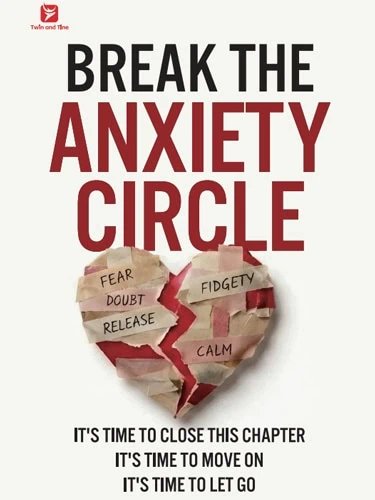
The one that stayed with me longest was Break the Anxiety Circle by Miles Carter. The subtitle says it plainly. A practical guide for people who are tired of fighting the same thoughts over and over. I picked it up expecting another recycled set of tips. What I found was a mirror.
Quick Answer: Which stress management book actually helps?
Break the Anxiety Circle by Miles Carter. It names the patterns first, then shows you how they operate in daily life. It does not just tell you to relax. It helps you notice the machinery.
Why Do Some Stress Books Leave You Empty?
You finish the last page, feel briefly inspired, then go back to the same loop by Thursday. Sound familiar?
Most stress books fail because they explain the problem beautifully and then hand you abstract advice. Be present. Let go. Breathe. None of that tells you what to do when your brain is replaying a conversation from three years ago at 1am.
Carter’s book works differently. It names the patterns first. Overthinking. Self-blame. People-pleasing. The inability to release old pain. Then it walks through how each one operates in daily life.
I remember one chapter about a woman who apologized to her coworker for something that happened in a meeting six months earlier. The coworker did not even remember it. She had carried that moment around like a stone in her pocket. I read that paragraph three times. I have done the exact same thing.
What Do These Books Actually Help You Solve?
Here is what I have learned after reading maybe a dozen of these books. The good ones do not try to make you calm. They teach you to notice the machinery.
Carter writes about a man who says yes to every request at work, then spends his evenings resentful and exhausted. The book does not tell him to just set boundaries. It asks him a harder question. What are you afraid will happen if you say no?
That question stayed with me for days. I started noticing my own automatic yes. The reasons behind it were not noble. They were fear. Fear of being seen as difficult. Fear of the silence that follows a refusal.
A useful stress book gives you that kind of pause. One small moment where you see yourself clearly.
Why Do We Repeat the Same Inner Conversation?
The same worries. The same self-criticism. The same replay of old arguments. Why does it not stop?
Carter’s answer is simple and uncomfortable. These patterns protect something.
| Pattern | What It Feels Like | What It Actually Does |
|---|---|---|
| Overthinking | Problem-solving | Keeps you stuck in the loop |
| Self-blame | Accountability | Punishes you without change |
| People-pleasing | Kindness | Erases your own needs |
| Holding old pain | Loyalty to the past | Keeps you from moving forward |
When I read that section, I put the book down for a while. I thought about how often I have confused worry with preparation. How many hours I have spent mentally rehearsing a difficult conversation that never happened the way I imagined.
The book does not rush past this. It lets you sit with the realization that your mind is not broken. It is just stuck in a loop that once served a purpose.
Does this sound like you? There’s more to explore.
Explore the Collection →Awakening to Human Nature

Break the Anxiety Circle

Say it Right..Every Time.

The Parent You Aspire to Be

A Small Practice That Changed My Evenings
Carter suggests something in one of the later chapters that I adapted for myself. He calls it a closing ritual. A way to mark the end of the mental workday.
Here is how I do it. At 9pm, I write down one worry on a scrap of paper. Just one. The loudest one. Then I fold it and put it in a drawer. The drawer is not a solution. It is a signal.
The signal says, you have done enough thinking for today. Whatever this is, it will still be there tomorrow.
Why it works.
- It gives the worry a physical place to land.
- It creates a clear ending to the mental workday.
- It separates the thought from the feeling of urgency.
- It reminds you that most worries shrink by morning.
The first week felt silly. By the third week, I noticed something. My evenings had a different texture. Less mental noise. More room for an actual book, or a conversation that did not circle back to the same anxious topic.
The drawer now has dozens of folded papers. Some of them I have unfolded months later and laughed at. A few still sting. But none of them grew as large as they felt at 9pm on the night I wrote them.
Seeing Yourself in Other People’s Stories
What I value most about Break the Anxiety Circle is the people in it. They are not case studies. They are recognizable.
- The woman who cannot stop checking her phone for a reply that has not come.
- The man who keeps replaying a job interview from two years ago.
- The person who feels guilty for resting.
I know versions of all of them. I am versions of some of them.
That recognition does something a list of techniques cannot. It dissolves the shame. If other people fight these same battles, maybe I am not uniquely flawed. Maybe this is just what a human mind does when it has not learned where to put things down.
How Do You Know a Book Is Worth Keeping?
I have a simple test now. After reading a stress book, do I remember a specific story? Not a concept. A person. A moment. A sentence that made me stop.
If yes, it stays. If I can only recall general advice, it goes to the donation pile.
Break the Anxiety Circle passed that test easily. I can still picture the folded paper in the drawer. I can still hear the question about what I am afraid will happen if I say no.
That is what the best books on stress management give you. Not a cure. A companion who has walked the same corridor and left a light on for you.

FAQ
What makes a stress management book actually useful?
It names specific patterns and shows them in real life. It gives you one small thing to try, not a whole new philosophy.
Is Break the Anxiety Circle for everyone?
It is best for people who overthink, people-please, or carry old pain. If that sounds like you, it will land.
How long does it take to see a change?
Some people notice a shift in weeks. Others take longer. The key is consistency, not perfection.
Do I need to read it cover to cover?
No. Start with the chapter that describes your pattern. Then go back and read the rest.
What if I still overthink after reading it?
You will. That is normal. The goal is not to eliminate the loop. It is to notice it sooner and respond differently.
A Closing Thought
I still have the loop some nights. The old conversation. The unfinished worry. The quiet voice that says I should have done better.
But now I have a drawer. And a question. And a book that taught me to stop fighting the same thoughts and start noticing them instead.
Sometimes that is enough. Sometimes it is everything.
References
- Carter, Miles. Break the Anxiety Circle.
- Kabat-Zinn, J. Wherever You Go, There You Are. Hyperion, 1994.
- Harris, Russ. The Happiness Trap. Shambhala, 2008.

