Books to Build Inner Peace for Overthinkers
I spent three years convinced my brain was broken.
Every night, I’d lie in bed replaying conversations. That thing I said at work. The text I should not have sent. The future I could not control. My mind was a loop, and I was stuck inside it.
Then a friend handed me a book. She said, “This one is different. It does not just tell you to calm down.”
She was right. Books to build inner peace are everywhere, but most of them made me feel worse. They assumed I could just “choose happiness.” I could not. I was too tired.
So when did things start to change? When I stopped looking for a magic answer and started looking for a practical one.
Why Do Books to Build Inner Peace Feel So Hard to Apply?
Here is what I learned about myself. I did not need more inspiration. I needed a different way of thinking.
Most peace books tell you to meditate. Or journal. Or breathe. I tried all of it. I sat on a cushion. I downloaded apps. I wrote morning pages. And I still felt the same knot in my chest.
The problem was not the techniques. The problem was the loop itself. I was overthinking about the overthinking. I was anxious about being anxious. That is a trap with no visible exit.
I remember one afternoon, sitting at my kitchen table. My daughter was painting. I was staring at my phone, reading a thread about world events. My shoulders were up near my ears. I was not even breathing properly.
She looked at me and said, “Mama, your face is doing a thinking thing.”
That stopped me cold. A six-year-old could see it. I was physically present, but mentally somewhere else entirely. I had no idea how to come back.
What I needed was a reset. A way to interrupt the loop before it swallowed the whole day.
How One Book Finally Helped Me Break the Overthinking Cycle
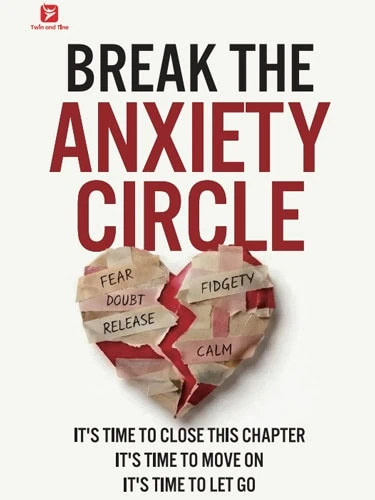
The book my friend gave me was Break the Anxiety Circle by Miles Carter.
I almost did not read it. The title sounded like a workbook. But I opened it one evening, and the first chapter was about exactly what I had been doing at the kitchen table.
It described the overthinking loop. Not as a flaw. Not as a weakness. As a habit the mind developed to feel safe. That landed differently for me.
Carter does something I had not seen before. He gives each struggle a concrete, named solution. Not vague advice. Not “just breathe.” He walks through what to do when your mind starts spinning.
For example, one method is about separating facts from stories. I had never thought of it that way. The fact was: my boss did not reply to my email. The story was: she is angry at me and I am getting fired. Those are two completely different things, and I was living in the second one.
The book helped me catch myself in the middle of those stories. Not to judge myself for it. To notice it and step out.
What surprised me most was the tone. There is no pressure. No “you should be further along.” Just a steady voice saying, “Here is how one person handled this. Maybe it works for you.”
The 5-Minute Mental Reset Ritual
The tool I still use every single day came from this book. I call it the 5-Minute Mental Reset.
Here is how it works. When I catch myself spiraling, I stop. I set a timer on my phone for five minutes. Then I do three small things.
First, I name the loop out loud. “I am rethinking the parent meeting.” Saying it aloud breaks the spell. The thought becomes smaller when it leaves my head.
Second, I ask one question: “Is this a fact or a story?” Most of the time, it is a story. And I can let a story go.
Third, I stare at something physical. The steam from my tea. My daughter’s hair. The crack in the ceiling. That brings me back into the room.
The whole thing takes five minutes. It is not deep. It is not spiritual. It just works.
I have started doing it with my daughter too. When she is upset about something small, I sit with her and say, “Let us do the reset.” We name the problem together. We decide if it is a fact or a story. Then we blow out a long breath.
She thinks it is a game. I think it is a lifeline.
What the Book Covers Beyond Anxiety
Break the Anxiety Circle is not only about anxiety. It covers a wide range of internal struggles. Indecision. Self-blame. Overthinking. People-pleasing. Unhealthy emotional attachment.
I was surprised by how much of it applied to my life. I thought I was just “an anxious person.” But the book helped me see how many smaller habits were feeding that anxiety.
I was saying yes to things I did not want to do. I was replaying old regrets. I was letting other people’s moods become my responsibility. Each of those habits drained me a little more.
The book offers practical, actionable solutions for each issue. Not just abstract advice. Real things you can do the same day you read them.
There are also healing, thought-provoking quotes scattered throughout. I usually underline quotes. With this book, I filled the margins. My copy is covered in dog ears and small notes to myself.
Reconciliation, Boundaries, and Self-Love
The book centers on self-growth. It covers self-love. Reconciliation with the past. Emotional regulation. Living in the present. Setting healthy boundaries.
That last one hit me hardest. I did not even know I had no boundaries. I thought I was just “easygoing.” Turns out, I was letting people take pieces of me, and I never said a word.
Carter writes about how to protect your mental well-being. He shows you how to let go of past regrets. How to break free from emotional chains. How to stop draining relationships.
I had one relationship that was pure exhaustion. A friend who only called when she needed something. I never said no. After reading the chapter on boundaries, I finally did. She was not happy. I was. That trade was worth it.
The book also talks about embracing an imperfect life. That felt like permission. Permission to be a messy mom. Permission to have a loud house. Permission to not have everything figured out.
Who Should Read This Book
If you are trapped in overthinking, this book is for you.
If you struggle to make decisions because you are afraid of choosing wrong, this book is for you.
If you feel exhausted by other people and cannot figure out why, this book is for you.
If you want to build a stronger sense of who you are, apart from what others expect, this book is for you.
It is not a quick fix. No book is. But it gives you a direction. And sometimes, direction is enough to get you moving.
One Question to Ask Yourself Today
Here is the question that changed things for me. What would you do today if you did not have to carry the weight of every past mistake?
Sit with that for a moment.
I realized my answer was: I would be kinder to my daughter. I would not snap at her when she spills water. I would not sigh when she needs help finding her shoes. I would be present.
The book helped me see that my inner chaos was leaking into my parenting. My daughter did not cause my anxiety. But she absorbed it. That was not fair to her.
Since I started the 5-Minute Mental Reset, I am calmer. Not perfect. Calmer. And she notices the difference.
Last week, she climbed into my lap and said, “Mama, your face is doing a relaxed thing now.”
That was worth every page.
Where to Start
You do not need to read the whole book in one sitting. Start with the chapter that matches what you are struggling with most. For me, it was overthinking. For you, it might be indecision or self-blame.
The book is written in a straightforward, sincere tone. It shares real-life experiences and insights. It never talks down to you. It feels like talking to a friend who has been where you are.
If you want to escape overthinking, build your own identity, improve your relationships, or just regain some quiet, this book offers strength and direction.
It teaches you to reconcile with yourself. To maintain inner order in a complicated world. That is a skill I am still learning. But I am learning it.
One Last Thing
The night after I finished the book, I sat on the edge of my daughter’s bed. She was already asleep. I watched her chest rise and fall.
I thought about all the nights I wasted spinning in my own head. All the sleep I lost. All the peace I gave away.
I cannot get those nights back. But I can protect the ones ahead.
That is what inner peace is, I think. Not a permanent state. Just a place you can return to when you lose your way.
I found my way back. You can too.