I have a confession. I buy books to calm my thoughts, and then I never read them. They sit on my nightstand with perfect spines and good intentions. The irony is not lost on me. Here I am, a person whose brain sounds like a group chat with forty people all talking at once, buying more silence and then ignoring it.
Last month I finally broke the cycle. Not with willpower. Not with some complicated system. I just picked up one book and actually finished it. And then another. The difference was not the books themselves. It was the way I approached them.
What are books to calm your thoughts anyway? Are they self-help manuals? Are they novels that swallow you whole? Are they poetry collections you can read in five minutes? I think they are all of these. But I also think the real answer is simpler. They are books that give your brain something better to do than chew on itself.

Why Does My Mind Keep Racing Even When I Try to Relax?
Let me describe a typical Tuesday night in my house. The kids are finally asleep. The dishes are done. I sit down on the couch with every intention of relaxing. And within thirty seconds, my brain serves me a highlight reel of every mistake I made since 2017.
Why do we do this? Why does the quiet make it worse?
I asked my friend Dana about this, and she laughed. She said her mind does the same thing. It is like the brain is afraid of silence, so it fills the space with problems to solve. Conversations to replay. Emails to rewrite. Arguments you will never actually have.
The thing is, reading interrupts this loop. But not all reading does. Scrolling through my phone at night does the opposite. It feeds the noise. It gives my brain more material to obsess over.
A good book does something different. It demands your attention but does not trigger your alarm system. It lets you borrow someone else’s mind for a while. And that break, even for twenty minutes, is often enough to reset the whole evening.
I remember asking my therapist, years ago, why I could not switch off. She did not give me a clinical answer. She just said, “Your mind is trying to protect you. It thinks if it keeps thinking, it can prevent bad things from happening.” That made so much sense. It was not broken. It was overzealous. It was a guard dog that barked at everything, including the mailman and the wind.
What Is the Best Way to Use Books to Calm Your Thoughts Before Bed?
Here is what I learned through trial and error. The way you read matters more than what you read.
I used to think I needed to finish chapters. I would set goals. I would tell myself, “Read twenty pages tonight.” That pressure made reading feel like homework. And homework does not calm anyone down.
Now I read without goals. I read for ten minutes. Sometimes I read the same paragraph three times because my mind wandered, and that is fine. I read physical books, not my phone, because the phone is a trap. It glows. It buzzes. It reminds me of everything.
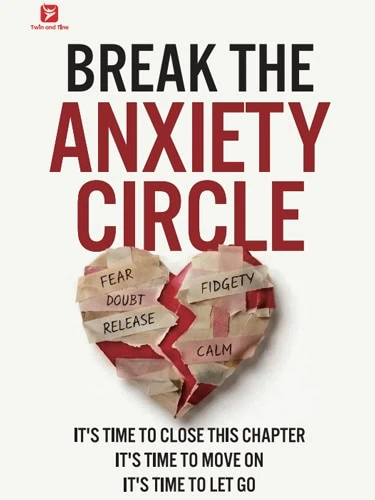
The book I have been reading lately is called Break the Anxiety Circle by Miles Carter. It is about the overthinking loop, that spiral where your mind keeps circling the same worries without landing anywhere. The book does not pretend to have magic answers. It just walks through practical ways to interrupt the pattern.
One idea stuck with me. Carter talks about how we replay past mistakes and worry about the future, and how that drains our energy. He asks a simple question. What would change if you stopped trying to control things that are already beyond your control?
I sat with that question for a while. The answer was: nothing would change. The things I worry about would still happen or not happen. But I would have more energy left for the things I can actually influence.
The book also covers people-pleasing. It made me think about how often I say yes when I want to say no. How many times I ignore my own feelings to keep the peace. Reading about it from the outside, I could see the pattern clearly. It was exhausting me.
I started a small ritual that works for me. I call it the Ten Page Reset. I pick a book, any book, and I read exactly ten pages. No more, no less. I do not check my phone. I do not think about tomorrow. I just read. When the ten pages are done, I close the book and lie in the dark. My mind is still active, but it is quieter. It is thinking about the story, not about my problems.
The One Page Rule for Overwhelming Days
Some days are worse than others. On those days, even ten pages feels like too much. My eyes scan the words and nothing goes in. I read the same sentence four times and still could not tell you what it said.
On those days, I use the one page rule. I tell myself I only have to read one page. That is the whole goal. One page.
And here is the strange thing. Once I read that one page, I usually want to read more. The hardest part is starting. The one page rule tricks my brain into starting. And starting is sometimes the whole battle.
I have a friend who swears by audiobooks for this exact reason. She listens to them while she folds laundry or drives carpool. She says it gives her mind something to do while her hands are busy. It keeps the worry loop from starting in the first place.
I tried it. I put on a book while I was washing dishes, and I was surprised by how much I enjoyed it. The dishes got done. My mind did not spiral. It was a small victory, but it counted.
What About Books for Kids Who Worry Too Much?
This matters to me because my oldest daughter is a worrier. She gets it from me. She lies in bed at night and her mind starts spinning. She asks questions about things that happened months ago. She worries about things that have not happened yet.
I wanted to help her, so I started looking for children’s books that address big feelings in gentle ways. Books about worry and calm and being present. Books that do not lecture but simply show a character going through something similar.
We read them together at bedtime. I noticed something. When we read together, she relaxes. Her breathing slows. She stops asking questions and just listens. The book gives her a break from her own thoughts, the same way it gives me a break from mine.
She has started asking to read before bed instead of asking for more screen time. That feels like a small parenting win. I will take it.
Can Fiction Calm an Anxious Mind Better Than Self-Help?
Here is a thought that surprised me. Sometimes fiction works better than books written specifically to calm your thoughts. A novel with a good story does not tell you how to feel. It just takes you somewhere else. You live inside another person’s life for a while. Their problems become more interesting than yours. And that is a relief.
I used to feel guilty about reading fiction. I thought I should be reading something productive. Something educational. But now I think that was wrong. A good novel gives your brain a vacation. And sometimes a vacation is the most productive thing you can take.
I asked my husband what he reads to wind down. He said he reads history books. Old battles and dead politicians. I thought that sounded boring, but he said it works for him. The point is not the genre. The point is finding something that engages your mind without activating your stress response.
Can You Actually Change Your Thinking Habits With Books?
I want to be honest here. A book will not fix your brain overnight. I have read plenty of books that promised transformation and delivered nothing but good intentions. But I have also read books that planted small seeds. Seeds that grew over time.
Break the Anxiety Circle is one of those books for me. It does not claim to be a cure. It just offers tools. Ways to recognize when you are overthinking. Ways to talk to yourself with more kindness. Ways to set boundaries without feeling guilty.
The author, Miles Carter, writes in a straightforward way. He shares real experiences, not just abstract advice. He talks about self-love and reconciliation with the past. He covers emotional regulation and living in the present. And he does it without making you feel like you are broken.
I found myself nodding along while I read. Yes, I do that. Yes, I have said that to myself. Yes, that is exactly how it feels. There is comfort in knowing someone else has walked this path.
But I also had to do the work. The book gave me language for my struggles. It gave me ideas to try. But I had to actually try them. I had to put the book down and practice being kinder to myself. I had to notice when I was slipping into the overthinking loop and gently redirect myself.