You know the feeling. You say something and immediately wish you could take it back. Or you stay quiet because you are not sure how to say what you mean. Or you replay a conversation for hours, thinking about what you should have said instead.
Communication is not about being clever with words. It is about being understood. And for most of us, that does not come naturally. We react instead of respond. We rush instead of listen. We say too much or not enough.
Here is the good news. You can get better at this. It is not a personality trait you are stuck with. It is a skill. And like any skill, it improves with the right tools and practice.
Quick answer: How do I become a better communicator?
Slow down, think about how your words will land, match the other person’s tone, and adjust based on their reaction instead of sticking to a script.
Here are three books to improve communication that take different approaches. One gives you practical scripts for everyday situations. One teaches you how to handle high-stakes conversations. One explains the psychology behind why people say yes.
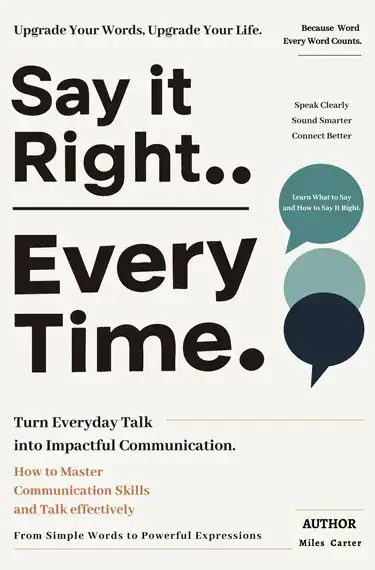
Say It Right Every Time
Practical tools for the moments that matter. Say what you mean, calmly.
This book by Miles Carter is not about theory. It is about what to say when you are on the spot. A job interview. A tough conversation with a coworker. Telling someone no without feeling guilty. Giving feedback that actually helps instead of hurts.
Here is how it works. Carter shows you a bad way to say something. Then he shows you a better way. Side by side. You see the difference immediately.
For example, instead of “That is not my job,” you say “I can help with this part, but I need to check with my manager on the rest.” One shuts things down. One keeps things moving.
The book covers daily conversations, workplace interactions, and emotional connections. You learn to handle conflict without making enemies. You learn to set boundaries without sounding harsh. You learn to ask for what you want without coming across as demanding.
Each chapter gives you real-life scenarios with specific scripts. No fluff. Just words that work. You stop second-guessing yourself. You start saying the right thing in the moment.
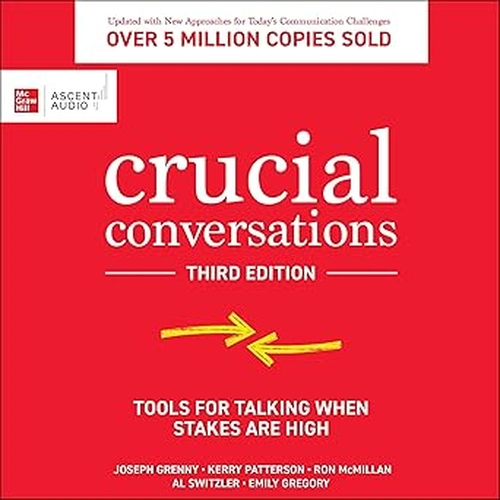
Crucial Conversations
Tools for talking when stakes are high.
Joseph Grenny, Kerry Patterson, Ron McMillan, and Al Switzler wrote this book for the conversations that make your stomach drop. Giving difficult feedback. Addressing a problem with a coworker. Talking to your partner about something sensitive.
When stakes are high and emotions run strong, you have three choices. Avoid the conversation and suffer the consequences. Handle it poorly and suffer the consequences. Or use the tools in this book and get better results.
The book teaches you to stay calm when others blow up or clam up. It shows you how to be persuasive without being abrasive. It helps you get back to productive dialogue even when the other person is defensive.
The new edition also covers digital communication and how to handle crucial conversations across email, text, and video calls.
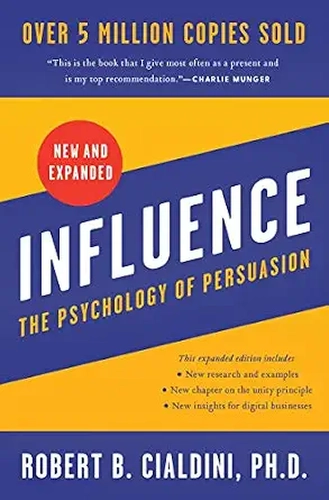
Influence
The psychology of why people say yes.
Robert Cialdini wrote this classic book to explain why people agree to things. He spent years studying persuasion. He found that certain principles consistently influence human behavior.
Reciprocation. Commitment and consistency. Social proof. Liking. Authority. Scarcity. Unity. These are the triggers that make people say yes. Cialdini explains each one with stories and examples.
This book is useful for two reasons. First, you learn to be more persuasive. Second, you learn to defend yourself against manipulation. Understanding how influence works helps you spot when someone is using it on you.
The updated edition includes new research and a new principle: unity. It is the most comprehensive guide to persuasion you will find.
Which Book Should You Read First?
If you need practical scripts for real situations right now, start with Say It Right Every Time. It gives you exact words to use in specific moments.
If you struggle with difficult conversations and high-stakes discussions, pick up Crucial Conversations. It gives you tools to stay calm and get results.
If you want to understand why people say yes and how to be more persuasive, go with Influence. It explains the psychology behind persuasion.
Many people read all three. Each one offers something the others do not.
Frequently Asked Questions
Can I really improve my communication skills?
Yes. Communication is a skill, not a personality trait. With practice and the right guidance, anyone can get better.
Which book is best for workplace communication?
Say It Right Every Time gives you scripts for interviews, feedback, and coworker interactions. Crucial Conversations is great for high-stakes workplace discussions.
I have read communication books before and they did not help. Why?
That probably means they were too general. This list gives you specific, practical tools you can use immediately, not just theories.
How long does it take to see improvement?
It depends. Some people notice a difference after one chapter. Others take weeks of practice. The key is to actually use what you learn.
Final Thought
You do not need to be a natural communicator. You just need to be willing to learn. One small change in how you say something can change the whole conversation. And better conversations change relationships. They change how people see you. They change how you see yourself.
Start with one book. Try one technique. See what happens.