I still remember the knot in my stomach before a performance review last spring. My manager asked why a project slipped. I said something vague about timing issues and watched her face close like a door. Later that night, I wondered why I could never find the right words in the moment. That question sent me looking for books to improve communication skills at work. Not the fluffy kind. The ones with real sentences you can borrow when your mind goes blank.
This article is about one thing. Why you mean well and still say the wrong thing. And one book that actually helps.
Quick Answer: Which book actually improves communication at work?
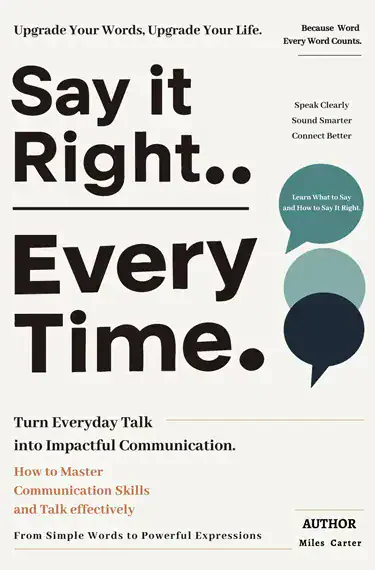
Say It Right Every Time by Miles Carter. It gives you real phrases for real moments, side by side, so you can see the difference between what sounds stiff and what sounds clear.
Why Do We Say the Wrong Thing?
Most of us were never taught how to say hard things. We learned grammar. We learned manners. Nobody sat us down and showed us how to tell a coworker their work needs fixing without starting a war.
I used to think communication was a personality trait. Either you are a natural, or you are not. Then I watched a quiet colleague handle a tense meeting. She did not raise her voice. She said, “I want to make sure I understand your concern before I respond.” The room softened. That was a skill. Skills can be learned.
Where does the belief come from? Probably from being praised as the easy one growing up. We mistake silence for maturity.
Why Say It Right Every Time Stands Out
There are hundreds of communication books out there. Most repeat the same advice. Be assertive. Listen actively. Use I statements. All true. None of it helps when your mind goes blank in the moment.
Say It Right Every Time by Miles Carter does something different. It does not just tell you to be assertive. It puts two versions of the same sentence side by side. The basic version sounds stiff or apologetic. The mature version sounds calm and clear. You read the pair and something clicks.
It covers the moments that actually matter. Asking for a raise. Saying no to a project. Handling a coworker who takes credit for your work. Setting a boundary with someone who keeps pushing. Each one comes with real words you can borrow, not theory you have to translate.
What I liked most is that it treats communication as a skill, not a personality trait. You are not born good at this. You practice it. And practice needs phrases, not principles.
How to Actually Use What You Read
Reading is easy. Using it the next morning is hard. Here is what worked for me.
I pick one phrase a week. Just one. That week, I practice it in low-stakes moments. The person at the coffee counter. A quick message to a teammate. By Friday, the phrase sits in my mouth more naturally.
One phrase that changed a lot for me. “Let me think about that and get back to you by tomorrow.” Before, I would either agree on the spot or stumble into a maybe. Now I have a pause button. Saying no slowly is still saying no.
The Two-Sentence Pause
I made this up for myself, and it has a name now in our house. The Two-Sentence Pause.
Here is how it goes. When someone says something that stings or surprises me, I say two sentences before I react. First sentence. Reflect back what I heard. “So you are saying the deadline felt unrealistic from the start.” Second sentence. Buy time. “I want to give you a real answer, so give me a minute.”
That is it. Two sentences. It sounds almost too simple. But it stops the spiral. My husband uses it now when the kids argue over the tablet. My daughter tried it on her little brother last week. She said, “So you feel like I always get the first turn.” He nodded. Crisis averted.
There is something mature in that pause. Not weakness. Control.
What to Say in Interviews and Meetings
Interviews scared me for years. I would rehearse answers and then forget every word. What helped was preparing phrases, not scripts. A script breaks when reality shifts. A phrase bends.
For interviews. “That is a great question. Let me walk you through how I handled something similar.” It gives your brain two seconds to catch up.
For meetings when you disagree. “I see it a little differently. Can I share where I am coming from?” Nobody feels attacked. You still get to say your piece.
For a coworker who keeps interrupting. “I want to finish this thought, then I would love to hear yours.” Firm. Not rude. I practiced this one in the mirror for a week. It felt awkward. Then it felt normal.
Why Is Saying No So Hard?
Because we confuse kindness with agreement. I did this for years. I said yes to extra projects, weekend calls, favors I did not have energy for. Then I would resent the person who asked. That is not kindness. That is a slow leak.
The shift came when I started saying, “I cannot take this on right now, but I can help you find someone who can.” Same no. Warmer delivery. My relationships did not break. Some of them got better.

How to Make These Habits Stick
Two things helped. First, I keep the book on my desk, not the shelf. Visible means used. Second, I write down one sentence after any conversation that felt hard. Just one. What did I say? What would I say next time? After a month, I had my own little phrasebook.
The goal is not to become a smooth talker. The goal is to stop losing yourself in the moment. To say what you mean, calmly, even when your heart is pounding.
A Closing Thought
That performance review came around again this year. Same manager. Same tight feeling in my chest. But this time I said, “Let me walk you through what happened.” She listened. The door stayed open. The words, it turns out, were there all along. I just needed someone to show me where to find them.

Say it Right..Every Time.
Miles CarterPractical communication tools for the moments that matter — say what you mean, calmly and confidently.

