When the Day Ends but Your Mind Keeps Going
You turn off the light and finally have no more work to do, yet your brain seems to become more active. You replay something that happened earlier, remember a task you forgot, start worrying about tomorrow, and then suddenly find yourself planning for problems that may not even happen.
At night, there are fewer distractions competing for your attention, so thoughts that felt manageable during the day can become much louder. A small concern can turn into a long mental conversation, and the more you notice that you are still awake, the more pressure you put on yourself to fall asleep.
That combination can make bedtime feel like another task you have to get right. Instead of resting, you are trying to force your mind to become quiet.

Why Racing Thoughts Get Louder at Night
A busy mind does not necessarily mean you have more problems at night. Sometimes you simply have more space to notice the thoughts that were pushed aside during the day.
The trouble starts when every thought feels urgent. You remember an unfinished task and immediately start planning tomorrow. You recall an awkward interaction and begin analyzing what the other person might have meant. One thought leads naturally to another until your brain is far away from the moment you are actually in.
Trying to solve everything from bed usually makes the situation worse. Your mind learns that nighttime is another opportunity to review, predict, and prepare.
What Helps When Your Thoughts Start Racing
There is no need to turn bedtime into another complicated productivity routine. A few simple shifts can make it easier to stop feeding the mental momentum:
- Notice the thought without opening another question. A worry can exist without becoming a full investigation.
- Write down something you genuinely need to remember. This can reduce the pressure to keep rehearsing it mentally.
- Separate tomorrow’s task from tonight’s responsibility. Not everything needs to be solved immediately.
- Stop checking whether you are calm yet. Monitoring your own sleep or anxiety can become another form of mental activity.
The important part is not forcing your brain to become empty. It is reducing the amount of attention you give to thoughts that do not require action at that moment.
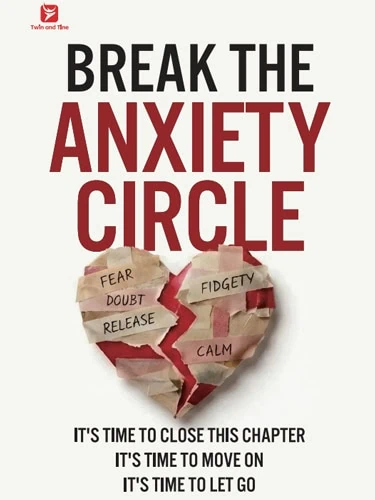
1. Break the Anxiety Circle by Miles Carter
Break the Anxiety Circle is especially relevant to racing thoughts because it focuses on the cycles that make ordinary worries feel difficult to put down. The book explores overthinking, anxiety loops, regret, self-doubt, people pleasing, emotional patterns, and difficulty letting go, all of which can become more noticeable when the distractions of the day disappear.
A useful part of the book is its emphasis on recognizing how a thought develops into a longer loop. You might begin with something small, such as remembering an unfinished task, and then move quickly into predicting consequences, criticizing yourself, and imagining what could happen tomorrow.
Carter’s approach is not simply to tell readers to “relax.” Instead, the book encourages you to understand why your mind keeps returning to the same patterns and what you can do once you notice them.
Its practical focus includes:
- Recognizing recurring nighttime triggers: Notice the themes that tend to appear when the day becomes quiet.
- Breaking repetitive analysis: Stop turning one concern into a chain of questions that cannot be answered at bedtime.
- Letting go of the day’s unfinished moments: Not every unresolved issue needs another hour of mental review.
- Reducing self-critical thinking: A difficult day does not need to become a case against yourself.
- Creating distance from uncertainty: You can allow tomorrow to remain partly unknown instead of trying to mentally prepare for every possibility.
The book’s broader value comes from connecting nighttime overthinking with patterns that also operate during the day. If you spend hours worrying about how people see you, revisiting decisions, or preparing for everything that could go wrong, your mind may simply continue that routine once you get into bed.

Break the Anxiety Circle
Miles CarterA mental reset for people trapped in the overthinking loop. Understand why your mind won’t stop racing — and how to break free from anxiety, people-pleasing, and emotional exhaustion.
Understanding that pattern changes the question. Instead of asking, “How do I force myself to stop thinking tonight?” you can start asking, “What keeps making my mind believe it has to solve this right now?”
2. The Sleep Fix by Diane Macedo
The Sleep Fix takes a more sleep-focused approach to the relationship between the mind and nighttime habits. It explores factors that can make sleep more difficult and offers strategies for building better conditions around bedtime.
For someone whose racing thoughts are mixed with inconsistent routines or anxiety about sleep itself, that broader perspective can be useful. Sometimes the mental struggle is intensified by the pressure to fall asleep immediately, creating another layer of frustration once you are in bed.
The book can help readers think about sleep as a pattern rather than a nightly test they either pass or fail.
3. Chatter by Ethan Kross
Chatter focuses on repetitive inner dialogue and the way self-talk can become louder and more negative when you are stuck with your own thoughts.
That makes it relevant to nighttime overthinking, especially when the mind starts replaying conversations, mistakes, or uncertain situations. The book explores ways to create some psychological distance from that internal commentary rather than automatically following every thought to its conclusion.
For readers who notice that their nighttime problem is less about a busy schedule and more about an extremely active inner conversation, this can offer another useful perspective.
You Do Not Need to Solve Tomorrow From Bed
One of the hardest changes is accepting that some uncertainty can wait until morning. The unfinished email, awkward conversation, and decision you are still thinking about will probably be easier to handle when you are rested.
Break the Anxiety Circle is helpful here because it does not separate nighttime worry from the broader patterns that keep anxiety active. The same mind that spends the afternoon checking whether a decision was correct can spend the evening replaying it again.
Once you recognize that pattern, you have a better chance of letting the thought stop at the point where action ends. Tomorrow can have tomorrow’s problems.
A Quieter Night Starts With a Different Relationship to Thought
Racing thoughts may not disappear every night, and the goal is not to become someone who never thinks about the past or future. What changes is whether each thought automatically turns into another round of analysis.
The Sleep Fix approaches the problem through sleep habits, Chatter looks at repetitive inner dialogue, and Break the Anxiety Circle connects nighttime overthinking with the wider anxiety patterns that can keep the mind constantly active.
For readers searching for books to stop racing thoughts at night, the most useful starting point is often the book that helps explain not just how to calm down, but why your mind keeps deciding that bedtime is the perfect time to solve everything.
If you found this helpful, these books go deeper into the same themes.



Break the Anxiety Circle
$19.90

From Debt to Wealth
$19.90

