I remember the first time panic hit me in the cereal aisle. My toddler was screaming, my phone was dead, and my chest felt like it was wrapped in a tight band. I stood there, frozen, convinced everyone was staring. That was the moment I realized I needed deep breathing exercises for anxiety, not just in a yoga class, but in the middle of a Tuesday meltdown.
Why Does Deep Breathing Feel So Hard When You Are Anxious?
Here is what I learned the hard way. Anxiety tricks your body into thinking you are in physical danger. Your shoulders creep up. Your breath gets shallow. It lives right at the top of your chest, fast and feathery. That shallow breathing sends a signal to your brain that something is wrong, even when nothing is.
So you try to take a deep breath, and it feels like you are swallowing air. Or worse, it makes you feel more panicked. I used to think I was bad at breathing. I was not. I was just trying to force it.
The fix is not forcing. The fix is slowing down the exhale. When your out-breath is longer than your in-breath, your heart rate actually drops. That is the whole game. You are not fighting the anxiety. You are just telling your body, gently, that the threat is gone.
I spent months reading about this, testing it on myself during nap time, and failing a lot. But I found one technique that worked every single time. It takes five minutes. You can do it standing in that cereal aisle, sitting in your car, or lying on your bedroom floor while your kids watch cartoons.
How Can You Do Deep Breathing Exercises for Anxiety in 5 Minutes?
The technique is called counted breathing, but I personally call it the “slow leak.” Because that is what it feels like. A slow leak of all the tension that has built up in your body.
First, find your position. You can stand, sit in a chair that supports your back, or lie on a bed or yoga mat on the floor. Make yourself as comfortable as possible. If you can, loosen any clothes that restrict your breathing. I always unbutton my jeans. That is not a joke. Tight pants make shallow breathing worse.
If you are lying down, place your arms a little bit away from your sides, with the palms up. Lie with your legs straight or bend your knees so your feet are flat on the floor. If you are sitting, place your arms on the chair arms. If you are sitting or standing, place both feet flat on the ground. Whatever position you are in, place your feet roughly hip-width apart.
Now, here is the part I kept messing up. You do not force the breath. You let it flow as deep down into your belly as is comfortable. Try breathing in through your nose and out through your mouth. Breathe in gently and regularly. Some people find it helpful to count steadily from 1 to 5. You may not be able to reach 5 at first. I could only reach 3 when I started. My lungs felt like they had forgotten how to expand all the way.
Then let it flow out gently, counting from 1 to 5 again, if you find this helpful. Repeat this for at least 5 minutes. The first two minutes feel pointless. You will want to check your phone. Do not. Around minute three, something shifts. Your jaw unclenches. Your hands stop being fists. That is the signal that it is working.
The “Belly Reset” Ritual for Panic Moments
I needed a tool I could name, something my anxious brain could grab onto when the spiral started. I call it the Belly Reset. It is ridiculously simple, which is exactly why it works.
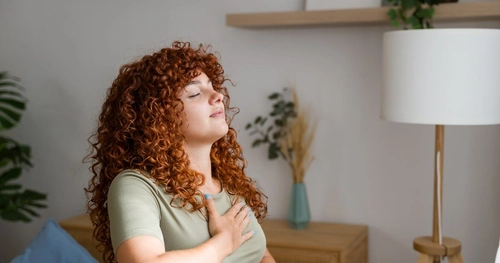
The Belly Reset has three steps. First, you put one hand on your chest and one hand on your belly. Second, you breathe in through your nose for a count of 3, aiming the air at the hand on your belly. You want the bottom hand to rise, not the top one. Third, you breathe out through your mouth for a count of 5, like you are blowing through a straw.
The exhale being longer than the inhale is the entire secret. I have used this in the parking lot before a school meeting. I have used it in the bathroom at a family gathering. I have used it at 3am when my brain decides to replay every awkward conversation from the past decade.
Here is a tip that changed everything for me. Do this breathing exercise every day, not just when you are panicking. You will get the most benefit if you do it regularly, as part of your daily routine. Think of it like brushing your teeth for your nervous system. If you only brush when your teeth are already covered in cavities, it is too late. Same with breathing. If you practice the slow leak when you are calm, your body remembers how to do it when the anxiety hits.
What If You Feel Dizzy or Worse When You Breathe Deeply?
I have to be honest with you. When I first tried deep breathing exercises for anxiety, I felt lightheaded and a little more anxious. I thought I was broken. But here is what I figured out. If you have spent years breathing shallowly, your body is not used to getting that much oxygen. It can feel strange at first.
The fix is to slow down even more. Do not try to fill your lungs completely. Just take a normal breath, maybe slightly deeper than usual. And if you feel dizzy, stop. Sit down. Let your breath return to normal. Try again later with a shorter exhale, like a count of 3 instead of 5.
Does this work for everyone? Honestly, no. Some people find deep breathing counterproductive. If it makes you feel worse no matter what you try, that is okay. It does not mean you are failing. It just means your body needs a different approach. Maybe movement helps more, like walking or stretching. Maybe cold water on your wrists. The point is not to force one technique. The point is to find what helps your body feel safe again.
How Can You Make Deep Breathing Exercises for Anxiety a Daily Habit?
You will not remember to do this when panic hits if you have never practiced it when you are calm. That is the truth. So attach it to something you already do every day. I pair my breathing practice with making my morning coffee. While the water boils, I stand at the counter and do my five minutes.
Another trick is to use your child’s bedtime as your cue. After you tuck them in, sit on the floor of their room for a few minutes and breathe. It models calm behavior for them, and it gives you a few minutes of quiet.
Some people set a phone reminder. Some people put a sticky note on their bathroom mirror. Some people do it in the car while waiting for school pickup. I know a mom who does her breathing exercises in the pick-up line every single afternoon. She says it is the only way she survives the transition from work to parenting.
The key is repetition. The more you do it, the more automatic it becomes. One day, you will catch yourself taking a slow exhale in the middle of a stressful moment without even thinking about it. That is the goal. Not to never feel anxious, but to have a tool that actually works when the anxiety shows up.
Why Do Deep Breathing Exercises for Anxiety Take Practice Before They Work?
Here is the thing nobody tells you. The first few times you try counted breathing, it will feel fake. It will feel like you are performing calmness while your heart is still racing. That is normal. You are teaching an old nervous system a new trick. It takes more than one try.
When my daughter was two, she had a phase where she would scream for an hour before bed. Nothing I did helped. I would sit outside her door, doing my slow leak breathing, trying not to lose my mind. I felt ridiculous. There I was, counting my breaths, while my child was having a full meltdown on the other side of the door.
But over time, something shifted. My body started responding to the count. The familiar rhythm of 3 in, 5 out became a signal. My shoulders would drop. My jaw would relax. I was not performing calmness anymore. I was actually calming down. It just took weeks of practice for my body to trust the pattern.
So if you try this once and it does not work, try it again tomorrow. And the day after that. Your nervous system is not going to rewire itself in one session. But it will rewire. I promise you that.
References:
- Brown, R. P., & Gerbarg, P. L. (2005). Sudarshan Kriya yogic breathing in the treatment of stress, anxiety, and depression. Journal of Alternative and Complementary Medicine.
- Ma, X., et al. (2017). The effect of diaphragmatic breathing on attention, negative affect and stress in healthy adults. Frontiers in Psychology.
- Zaccaro, A., et al. (2018). How breath-control can change your life. Frontiers in Human Neuroscience.