A few months ago I sat in my car in the grocery store parking lot, staring at a receipt that made no sense. Forty-seven dollars. I had come in for milk, bread, and bananas. What I walked out with included two scented candles, a fancy cheese I cannot pronounce, and a magazine I never read. The milk was somewhere in the bag too, I think.
I laughed, honestly. Then I did not.
That night I added up the month. The number was ugly. Not catastrophic, just quietly awful, the kind of total that builds from a hundred small decisions nobody watches. My savings account had been sitting at the same balance for almost a year.
That was the week I started figuring out how to develop financial discipline. Not the motivational-poster version. The real, boring, repeatable version.
Quick Wins to Try Today
- Move 10 percent of your paycheck to a separate account the day it lands.
- Delete saved card details from your favorite shopping apps.
- Write down every purchase for one week, even the vending machine ones.
- Pick one subscription to cancel right now. Just one.
- Tell one person your savings goal out loud.
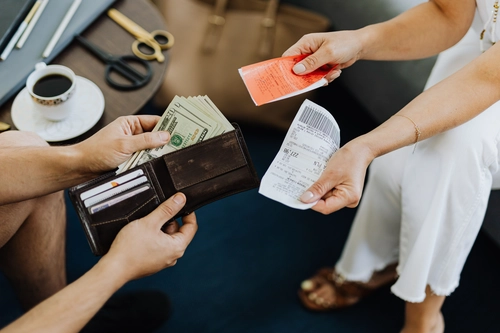
Why Does Financial Discipline Feel Impossible at First?
Here is what nobody tells you. Discipline is not a personality trait you either have or do not. It is a setup problem.
When I finally looked honestly at my spending, I noticed something embarrassing. Nearly every impulse buy happened in the same three situations: I was tired, I was bored, or I was scrolling in bed. The purchases were not decisions. They were reactions.
Have you ever bought something and felt a tiny drop of regret before the confirmation email even arrived?
One idea that helped me: think about what the purchase actually costs in work time. If you take home roughly twenty dollars an hour, that forty dollar throw pillow is two hours of your life. Two hours of your boss, your commute, your meetings. Would you trade that pillow for two free hours? Sometimes yes. Often no.
It also helps to picture your future self as a real person you are taking care of. Mine is a sixty-five-year-old version of me with bad knees and a garden. She would very much like the younger me to stop buying scented candles.
How Do You Actually Build Financial Discipline Step by Step?
The system that finally worked for me had four moving parts. None of them are clever. All of them are repeatable.
1. Save before you see the money.
On payday, an automatic transfer moves a set amount out of my checking account. I never touch it. I do not carry the card for that account. I barely check the balance, and that is on purpose. This is sometimes called paying the future first. You can start with five percent. Ten feels better. The amount matters less than the automatic part.
2. Track everything for one month.
Yes, everything. The coffee. The parking meter. The app purchase. It is tedious, and that is the point. Tedium makes you see patterns. My pattern was food delivery on Wednesdays. Every single Wednesday. Once I saw it, I could plan for it instead of pretending it was not happening.
3. Give every category a number.
Not a strict budget with a spreadsheet that shames you. Just a number. Groceries get a number. Fun money gets a number. When fun money hits zero, fun waits until next month. This is not punishment. It is a fence around a yard so you can actually relax inside it.
4. Add friction to your weak spots.
If online shopping is your leak, remove the saved card. If the drive-thru is your leak, change your route home. If the mall is your leak, do not go to the mall on a Saturday afternoon with nothing to do. You are not fighting your character. You are rearranging your environment so the easy choice is the good one.
Here is a simple comparison that helped me see where I stood:
| Habit | What It Feels Like Now | What It Builds in 3 Years |
|---|---|---|
| Auto-save 10% | Slightly annoying | A real emergency fund |
| Tracking spending | Tedious | Awareness that sticks |
| One-day pause on wants | Mild frustration | Fewer regret purchases |
| Weekly cash limit | Restricted | A natural spending ceiling |
A One-Day Pause That Works
This is my favorite tool, and it costs nothing to start.
When you want something that is not a need, you do not buy it. You write it down. Then you wait one full day before deciding.
That is it. One day.
Why does this work so well? Because most impulse purchases do not survive a night. The wanting fades. What is left is either a real desire or nothing at all.
I keep a note on my phone called Maybe Later. Last month it had eleven items. I bought two of them. The other nine I cannot even remember now, which tells me everything about how much I actually needed them.
When a purchase is still on your mind after a day, ask yourself three questions:
- Do I want this, or do I want the feeling I think it will give me?
- What am I giving up to have it?
- Would I buy it again at full price next week?
If the answers come back strong, buy the thing. Guilt-free. The rule is not about never spending. It is about spending on purpose.
One more tip that sounds silly but works. Say it out loud to someone. My husband and I have a deal: anything over fifty dollars that is not a bill gets mentioned first. Not approved. Just mentioned. Half the time, saying it out loud is enough to hear how unnecessary it is.

How Do You Stay Consistent When Motivation Fades?
Motivation is a terrible long-term employee. It shows up late and quits without notice.
What lasts is a goal you actually care about. Not save more money. That is a fog. Something like three months of expenses in the bank by next summer or pay off the car before the baby starts school. Specific. Dated. Yours.
I also reward myself on purpose. Every six months, if the savings goal is on track, I take a small slice and spend it on something purely fun. No guilt. This matters more than people admit. A system with zero pleasure gets abandoned by month three.
And when you slip, and you will, because I still do, do not turn it into a story about who you are. A slip is data. Look at what happened, adjust the fence, move on.
FAQ
Q: How long does it take to develop financial discipline?
A: Most people notice real change in two to three months of consistent tracking and auto-saving. The habits feel strange at first, then neutral, then normal.
Q: Can I develop financial discipline if my income is low?
A: Yes, and the starting amount matters less than the consistency. Even five dollars a week builds the habit and the cushion. Small and steady beats big and sporadic.
Q: What is the fastest way to stop unnecessary spending?
A: Add friction. Remove saved cards, use cash for discretionary spending, and apply the one-day pause to anything that is not a bill or a basic need.
Q: Does tracking every expense really help develop financial discipline?
A: It did for me. Seeing the numbers turns vague guilt into clear information, and clear information is what makes the next decision easier.
One Last Thing
That grocery receipt is still in my glove box. I kept it on purpose. Not as punishment, just as a marker of the week things shifted.
The candles are gone. The savings account is not sitting still anymore.
You do not need a dramatic overhaul. You need one boring habit, repeated on a Tuesday when you are tired and the checkout page is already open. Start there.
References
- American Psychological Association. (n.d.). Speaking of psychology: The psychology of money. Retrieved from apa.org.
- Vohs, K. D., & Faber, R. J. (2007). Spent resources: Self-regulatory resource availability affects impulse buying. Journal of Consumer Research, 33(4), 537–547.
- Consumer Financial Protection Bureau. (n.d.). Financial well-being and building savings habits. Retrieved from consumerfinance.gov.

