A team meeting is moving toward a decision you believe will cause problems. You have a reason to disagree, but the moment you begin speaking, you worry about sounding negative or challenging someone more senior. You might stay quiet and hope the issue resolves itself, or you might push your point too hard after finally finding the courage to speak. Neither response helps the group understand what you see differently.
Disagreeing respectfully means being honest about your position without treating the other person’s opinion as a personal failure. You can question an idea, explain a concern, and stand by your reasoning without making the conversation about who is smarter or who gets the final word. For readers who want to improve this skill, Say It Right Every Time by Miles Carter offers practical approaches to expressing opinions, handling disagreement, and responding calmly under pressure.

Why Disagreement Can Feel So Uncomfortable
The difficulty is often less about the opinion itself and more about what you fear might happen after you express it. You may worry that a friend will take your comments personally, a partner will interpret them as rejection, or a manager will see you as difficult to work with.
That fear can lead to two unhelpful habits. One is avoiding disagreement entirely, even when an important concern deserves attention. The other is preparing so many arguments that you enter the conversation ready to defend yourself rather than understand the other person’s reasoning.
A more constructive approach begins with separating the person from the idea. Disagreeing with a suggestion does not mean you disrespect the person who made it. Equally, listening to someone’s explanation does not require you to abandon your own judgment.
How to Express a Different Opinion Without Escalating Tension
You do not need to disguise every disagreement with excessive praise or pretend that you agree when you do not. Instead, make your position clear, explain the reason behind it, and invite a discussion about the issue itself.
For example, suppose a colleague suggests rushing a project to meet an earlier deadline. Rather than saying, “That’s a bad idea,” you could respond, “I understand why we want to finish sooner. My concern is that we may miss important details if we shorten the review period. Could we look at which parts can be completed earlier without skipping that step?”
This response acknowledges the goal while explaining the risk. It also gives the conversation a practical next step.
When you need to express a different opinion, try to:
- Start with the actual point of disagreement. Avoid making the other person guess what you mean.
- Explain your reasoning. One relevant example or concern is often more useful than listing every possible objection.
- Ask questions before making assumptions. You may discover that the other person is working with information you do not have.
- Avoid personal labels. Discuss the decision, behavior, or idea instead of describing someone as careless or unreasonable.
- Know when to stop repeating yourself. Once you have explained your position, continuing to argue may not add anything useful.
Respectful disagreement does not guarantee agreement. It creates a better opportunity for both people to understand the issue and decide how to move forward.
What to Do When the Other Person Pushes Back
Even a calm disagreement can become uncomfortable when someone reacts defensively. They may interrupt, dismiss your reasoning, or insist that their view is the only sensible one. If you respond to every sharp remark with another sharp remark, the original issue can disappear beneath a growing argument.
Try to slow the exchange down. You can clarify your intention without withdrawing your position: “I’m not trying to dismiss your idea. I see a risk we haven’t discussed yet, and I’d like us to consider it before deciding.”
If the conversation becomes too heated to be productive, it is reasonable to suggest returning to it later. You do not have to settle every disagreement in one sitting, and taking a break is not the same as conceding.
It also helps to recognize when a discussion has reached its limit. You can respect another person’s right to hold a different view while making your own decision based on the information available to you.
A Practical Book for Difficult Conversations
Say It Right Every Time by Miles Carter focuses on the words people can use when ordinary communication becomes challenging. Its 115 scripts and 15 frameworks address mature expression, disagreement, requests, boundaries, and calm responses, helping readers prepare for situations in which emotions or social pressure make it harder to speak clearly.
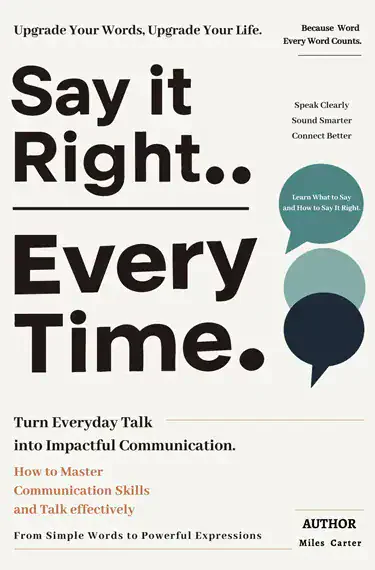
The book is useful for readers who tend to stay silent to keep the peace, as well as those who become overly defensive when challenged. Its practical examples offer starting points that can be adapted to conversations with partners, friends, family members, and colleagues.
The aim is not to win an argument. It is to express your reasoning clearly, listen to what the other person has to say, and avoid turning a difference of opinion into an unnecessary personal conflict.

Say it Right..Every Time.
Miles CarterPractical communication tools for the moments that matter — say what you mean, calmly and confidently.
Speak Honestly Without Turning Every Difference Into a Fight
The next time you disagree with someone, focus on the point you want them to understand rather than the response you hope to defeat. Explain your concern, remain open to new information, and allow the other person to make their own judgment.
You can be respectful without pretending to agree. Say It Right Every Time provides practical scripts and frameworks to help you communicate that balance more confidently, whether the disagreement happens in a meeting or during a conversation with someone close to you.

