I was talking to a friend a few weeks ago who had just landed her first full-time job with a real salary. She was proud, and she should have been. But then she asked me something that caught me off guard. She said, “I want to be smart with my money. Where do I even start?” I sat there for a second because I remembered being exactly where she was. I also remembered how awkward it felt to admit I had no idea what I was doing.
Talking about money is weird. Nobody teaches us this stuff in school. We learn algebra and the parts of a cell, but not how to grow a dollar into something bigger. So most of us just wing it, or we avoid the topic entirely and hope it works out.
Quick Answer: How do I grow money slowly and safely?
You grow money slowly by investing a small amount automatically every month, leaving it alone for years, and letting compound interest do the heavy lifting.
Why Saving Alone Will Not Make You Rich
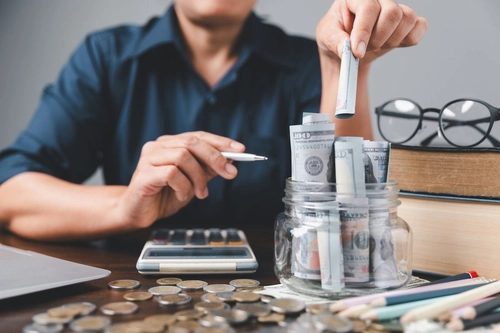
Here is the hard truth I figured out in my early twenties. Saving money does not grow money. If all your cash sits in a checking or savings account, it earns almost nothing. Meanwhile, inflation is quietly eating away at what it is worth. So if all you ever do is save, you are actually losing ground.
That does not mean savings are useless. You need a rainy day fund. Three to six months of living expenses, easy to reach, in case life throws something at you. But a bank account should not be the only tool in your kit.
My friend Marcus learned this the hard way. He spent his twenties stuffing money into a savings account because it felt safe. By thirty-five, he had a decent pile, but it had barely grown. He was not wrong to save. He was just missing the next step.
How Money Actually Makes More Money
The magic is called compound interest. And even when you understand it, it still feels a little like cheating.
Here is the idea. Your money earns a return. That return earns its own return. Then that earns a return. Over time, the growth feeds itself. It is not fast. But it is steady.
Historically, the market has averaged around 10 percent per year. I plan for 7 percent to be safe. That means my money roughly doubles every ten years. Not because I am smart. Because I did not touch it.
Let me show you what that looks like with real numbers.
If you start with $100 and invest $100 a month, after 40 years you would have about $250,000. That is from $100 a month. In 50 years, it would be over $500,000. You put in $60,000. You got back half a million.
Now imagine $1,000 a month. After 40 years, you would have around $2.5 million. After 50 years, over $5 million. You put in $600,000. The rest is time doing its job.
My friend Dana started at 27 with just $50 a month. She is 45 now and has about $30,000. It is not millions. But it is $30,000 she did not have before, and she never felt it leave her account.
Why You Do Not Need to Pick Stocks
I have never been interested in picking stocks. I do not watch the market. I do not buy low and sell high. Honestly, I only vaguely understand how that works.
What I do is buy ETFs. Funds that hold a large mix of stocks and bonds. They are lower risk than individual stocks, and they are easy to manage. I check mine maybe four times a year, usually out of curiosity. The rest of the time, I forget about them.
The trick is automation. Every month, money leaves my account automatically and goes into my investments. I do not see it. I do not miss it. It just happens. That is what “set and forget” actually means.
In my head, that monthly money is not mine to spend now. It is mine to live on later.

How to Figure Out What to Invest
Here is the order that worked for me.
Pay off high-interest debt first. Credit cards, car loans, anything with a rate that would eat your returns. It makes no sense to invest at 7 percent while paying 22 percent on a card.
Build a buffer. Three to six months of living expenses in a separate account. Not for investing. For emergencies. This one thing reduced my money stress more than anything else.
Keep your life affordable. I do not follow a strict budget. I just try to live a little below my means. I still get coffee with friends. I still travel sometimes. I just do not spend everything.
Invest what is left. That is my number. Whatever remains after bills, savings, and living. Because my income changes, I take a yearly average and adjust.
Never invest money you cannot afford to lose. This one matters. Investing has risk. Only put in what you can leave alone for a long time.
What About the FIRE Movement?
I know a lot of people love the idea of retiring at 30. I get it. But most regular folks cannot save that kind of money that fast. And honestly, I do not mind working a reasonable amount each week. The goal for me is not to stop working forever. The goal is to worry about money less.
That is what wealth means to me. Not billions. Not a private island. Just enough. Enough to cover my needs, feel comfortable, and eventually live off what my money earns. So I can choose what I do with my time instead of having to.
One Last Thing
I am not a financial expert. I am just someone who started small and kept going. If you are at the beginning, that is the best place to be. You do not need much. You do not need to be clever. You just need to start, automate it, and leave it alone.
Time does the rest. Slowly. Quietly. That is the whole secret.
References
- Jarvis, Paul. “How to Build Wealth Slowly.” Fathom.
- U.S. Securities and Exchange Commission. “Compound Interest and the Power of Time.”
- Consumer Financial Protection Bureau. “Building a Rainy Day Fund.”