I remember the exact moment I realized I was doing it all wrong. I was sitting on my bedroom floor at 6 a.m., eyes squeezed shut, trying to force calm into my body. My heart was racing. My mind was screaming about a work email I had sent the night before. And I was getting angrier by the second.
Why was meditation making me feel worse?
I was using meditation like a fire extinguisher. Grab it when things are already burning. Spray it everywhere. Hope the flames stay down. That was my first mistake.
Quick Anxiety Relief Today
If you’re in the middle of it, try these:
- Sit down and close your eyes, no special pose needed.
- Focus on your natural breath, the one already happening.
- When a scary thought arrives, notice your breath speed up.
- Do not try to slow it down. Just watch it.
- Watch the breath settle back down on its own.
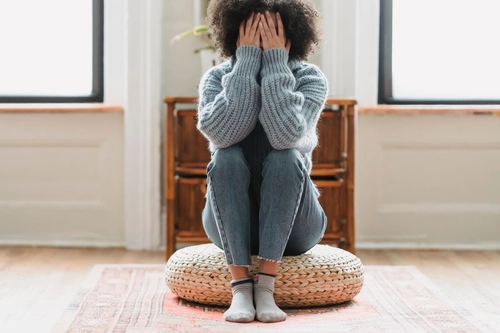
Why Does My Breath Speed Up When I Get Anxious?
Here is what nobody told me. Your breath reacts to thoughts before you even realize a thought arrived. It is the canary in the coal mine. The first signal.
I was sitting there one morning, and a random memory popped up. Something embarrassing from college. And I felt my inhale get shorter. Just slightly. My chest tightened a fraction of a second before I even knew what I was thinking about.
That is your nervous system talking. It recognizes a familiar threat pattern. And it prepares you for fight or flight before your conscious brain catches up.
The instinct is to fight it. To take a big, deep, controlled breath. To push the anxiety down. To fix it.
What if you did nothing instead?
The Itch Experiment: How to Meditate for Anxiety Without Fighting It
Think about an itch on your arm. If you scratch it immediately, what happens? It gets more intense. It demands more attention. You scratch again. It spreads. But if you just sit with it and observe it without scratching, it fades on its own. Every single time.
Anxiety works exactly the same way.
The sensation arrives. Your instinct is to react. To check. To google. To call someone. To do something. Anything. But if you watch it the way you watch that itch, it passes. Not immediately. But it passes.
Because sensations are not permanent.
I tested this for the first time on a Tuesday morning. I was dreading a meeting. My stomach was in knots. And instead of rehearsing what I would say, I just sat with the knot. I felt it. I watched it. I did not try to breathe it away.
It took about four minutes. But the knot loosened. Not because I did anything. Because I stopped doing everything.
This is where people get stuck. They hear “watch your thoughts” and they think they need to be a Zen master. They think observing means analyzing. It does not. Observing means noticing without narrating. Not “why am I thinking this?” Just “oh, there is a thought.” And back to the breath.
A Simple Morning Practice That Broke My Anxiety Loop
Here is the ritual that changed everything for me. I call it the Morning Watch.
Sit down. Close your eyes. Focus on your natural breath. Not a controlled breath. Not a counted breath. Just the breath that is already happening. Feel it come in. Feel it go out. That is your anchor.
When a scary thought arrives, you will notice something. Your breath speeds up. Just slightly. But you can feel it.
Do not slow it down. Do not control it. Just watch it.
Watch the breath speed up. Watch the thought that caused it. And then watch what happens when you do absolutely nothing.
The breath slows down on its own.
This was the thing that changed everything for me. I did not have to fight the thought or replace it or reason with it. I just had to watch it and let my body do what it naturally does when it is not being interfered with.
The breath is the proof that you do not have to do anything. It regulates itself the moment you stop panicking about it.
What If the Thought Does Not Go Away?
I understand this question because it happened to me too. Here is what I learned.
The thought does not need to leave. You need to stop feeding it.
Think of anxiety like a conversation. The thought arrives and says something scary. Normally, you respond. You argue. You reassure yourself. You try to solve it. That is the fuel. That is what keeps the conversation going.
When you just watch, you stop responding. The thought keeps talking for a while. But without a response, it loses energy. It repeats itself a few times. Then it starts to fade. Like a radio that is still on but no one is listening.
The thought might come back tomorrow. That is okay. You are not trying to get rid of thoughts. You are trying to change your relationship to them.
How Long Does It Take to See Results?
Give it three weeks. Do it every day. Not just when things are bad. That consistency is everything.
| Week | What to Expect |
|---|---|
| Week 1 | You will feel more anxious. This is normal. You are noticing things you used to ignore. |
| Week 2 | You will catch your breath speeding up in real life. Not just on the cushion. |
| Week 3 | You will feel a gap. A tiny space between the thought and your reaction. That gap is freedom. |
I remember the first time I felt that gap. I was in traffic. Someone cut me off. And I felt the rage rise. And then I felt something else. A small voice saying “there it is.” And just like that, the rage deflated. Because I was watching it instead of being it.
That was three years ago. I still meditate every morning. Not because I am anxious anymore. Because I like who I am when I watch instead of react.
What About Physical Anxiety Symptoms?
What if your heart is pounding? What if you feel like you cannot breathe?
Here is the counterintuitive part. Do not try to fix it. Watch it.
Your heart is pounding. Watch it pound. Your chest is tight. Watch it be tight. Your hands are shaking. Watch them shake.
This sounds counterintuitive. It feels wrong. Your entire body is screaming at you to do something. But doing something is exactly what keeps it going.
The reaction is the fuel. The watching is the extinguisher.
I am not saying this replaces professional support. Some anxiety needs more than self-guided practice. But for the everyday spiral, the one that wakes you up at 3 a.m., this approach works.
The Real Goal Is Not Calm
Here is the biggest misunderstanding about meditation for anxiety. It is not about feeling calm.
It is about becoming a master observer. Someone who watches thoughts and sensations arrive without being pulled into them. Not a reactor. An observer.
Calm is a side effect. Not the goal. The goal is the gap. The space between stimulus and response. The place where you get to choose instead of react.
FAQ
Q: How to meditate for anxiety when my mind will not stop racing?
A: Let it race. Do not try to stop it. Just watch the breath speed up and slow down behind the racing thoughts. The thoughts are the weather. The breath is the ground.
Q: How long should I meditate for anxiety each day?
A: Ten minutes is enough. Some days you will only manage five. That is fine. Consistency matters more than duration. Every day beats once a week for an hour.
Q: Can meditation for anxiety make things worse at first?
A: It can. You are noticing things you used to push away. That is uncomfortable. It is also progress. Stick with it for three weeks before judging.
Q: What if I fall asleep during meditation?
A: That is your body telling you it is exhausted. Sleep is not failure. Try sitting up straight or opening your eyes slightly next time.
Q: What if I try this and still feel anxious?
A: That is okay. Some days are harder than others. Meditation is not a cure—it is a tool. If the anxiety persists, consider talking to a professional. You are not failing; you are learning what works for you.
One Last Thing
I still remember that morning on my bedroom floor. The frustration. The hopelessness. The feeling that I was broken because I could not even meditate correctly.
I was not broken. I was just trying to control something that was never meant to be controlled.
The moment I stopped fighting and started watching, everything shifted. Not overnight. Not dramatically. But steadily. Like the tide going out.
Your breath knows what to do. Your body knows what to do. You just have to get out of the way.
That is what meditation for anxiety actually is. Not a battle. A surrender. Not a fight. A watch.
Sit down. Close your eyes. Watch the breath. Watch it speed up. Watch it slow down.
You have got this.
References
- Kabat-Zinn, J. (2013). Full Catastrophe Living: Using the Wisdom of Your Body and Mind to Face Stress, Pain, and Illness. Bantam Books.
- Yates, J., Imahara, M., & Graves, M. (2017). The Mind Illuminated: A Complete Meditation Guide Integrating Buddhist Wisdom and Brain Science for Greater Mindfulness. Hay House.
- American Psychological Association. (2023). Mindfulness Meditation: A Research-Proven Way to Reduce Stress.
