When One Small Problem Becomes the Worst Possible Outcome
A missed message can suddenly make you wonder whether someone is upset with you. A mistake at work can turn into thoughts about losing your job. A strange physical sensation can send your mind toward the most frightening explanation before you have any real information.
That is what catastrophizing can feel like. One uncertain detail becomes the starting point for a chain of increasingly serious possibilities, and each possibility makes the next one seem more believable. By the time you notice what is happening, your mind is reacting to a future that has not actually happened.
The difficulty is that catastrophizing often feels like preparation. You may tell yourself that you are simply being realistic or thinking ahead, when in reality you are repeatedly rehearsing outcomes that may never occur.

Why Telling Yourself to “Think Positive” Is Not Enough
When your mind jumps straight to the worst-case scenario, forcing yourself to think positively can become another struggle. Part of you is still convinced that something is wrong, so replacing the thought with a cheerful statement may feel unrealistic.
A more useful step is to slow down the chain itself. What actually happened? What are you assuming? Which part is supported by evidence, and which part has your mind added on its own?
This creates some space between the original event and the story that quickly grows around it. You do not need to convince yourself that everything will turn out perfectly. You need to stop treating the worst possible outcome as though it is already the most likely one.

Notice the First Jump
Catastrophizing usually has a starting point, even when the final thought seems completely unrelated to it. It might begin with a short email, a change in someone’s tone, an unexpected expense, or a mistake you made earlier in the day.
The earlier you notice the shift, the easier it is to interrupt the pattern. Watch for moments when your thinking suddenly moves from a specific problem to broad conclusions about everything that could go wrong.
A useful check is to separate the situation into three parts:
- What actually happened
- What you are predicting
- What you can realistically do next
That simple distinction can bring your attention back to the present problem instead of the imagined chain of consequences.
Break the Anxiety Circle by Miles Carter
Break the Anxiety Circle focuses heavily on the kind of thought patterns that make catastrophizing so exhausting. Miles Carter examines how anxiety can turn uncertainty into a series of increasingly threatening interpretations, especially when overthinking and self-doubt are already part of your daily habits.
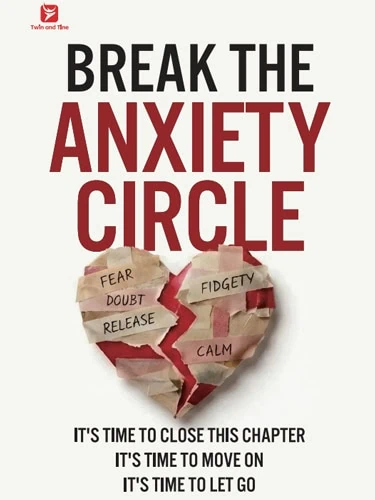
The book encourages readers to notice the early signs of an anxiety loop instead of waiting until the thoughts have completely taken over. Rather than arguing with every frightening possibility, it helps you understand how the loop gains momentum and where you can interrupt it.
Several themes are especially relevant to catastrophizing:
- Recognizing recurring anxiety patterns: Notice how one small trigger can quickly turn into a much larger mental scenario.
- Separating possibility from probability: Just because something could happen does not mean your mind should treat it as the expected outcome.
- Breaking repetitive thought loops: Step away from the urge to keep analyzing the same uncertainty in search of complete reassurance.
- Managing emotional reactions: Create more space between an anxious thought and the response that follows it.
The book also connects catastrophizing with other patterns that often appear at the same time. When self-worth depends heavily on outside approval, for example, a small mistake can feel much more threatening. When you have difficulty letting go of the past, one uncomfortable event may trigger regret about many others.
That broader perspective is what makes Break the Anxiety Circle useful beyond a single technique. It looks at the habits underneath the thought, so you can begin dealing with the pattern rather than simply trying to suppress each new worst-case scenario.

Break the Anxiety Circle
Miles CarterA mental reset for people trapped in the overthinking loop. Understand why your mind won’t stop racing — and how to break free from anxiety, people-pleasing, and emotional exhaustion.
Replace the Worst-Case Story With the Next Useful Step
You do not need to predict the future perfectly to feel more grounded. Once you notice yourself catastrophizing, bring your attention back to what can actually be handled today.
Maybe the next step is asking a question, checking a fact, having a conversation, making a plan, or simply waiting for more information. Taking one practical action is often more helpful than mentally rehearsing ten possible disasters.
With practice, the mind can learn that uncertainty does not automatically require a crisis response. The goal is not to eliminate every fearful thought, but to stop giving each one enough attention to become a full story.
If you found this helpful, these books go deeper into the same themes.



Break the Anxiety Circle
$19.90

From Debt to Wealth
$19.90

