Have you ever felt that someone’s smile didn’t quite match their words, but you couldn’t point to a single thing they did wrong? That quiet unease is not imagination—it’s your brain picking up signals you haven’t learned to name. If you’ve looked for books on reading people, you’ve probably seen these two titles come up again and again.

How to Read Someone’s Mind by Miles Carter
Carter also talks about body language, but he does not organize it by body part. He organizes it by the order you actually observe a person in a real conversation. Face first. Then body. Then voice. Then you put everything together in context.
Same scene. A colleague touches their nose during a meeting. Someone who read Navarro might think: “Touching the nose could mean they are hiding something.” Someone who read Carter would pause and ask a few questions first. Does this person normally touch their nose when they talk? Is their speaking speed faster or slower than usual today? Is their tone relaxed or tight? Are they leading in this meeting or being challenged? Put all of that together, and the nose touch finally gets a specific explanation.
Carter dedicates a whole chapter to context. The same person, the same action, in a meeting room, at a dinner table, or in a bedroom, can point to completely different things. Making a judgment without looking at the scene is not reading people. He also spends time on an emotion that is easy to overlook: contempt. Contempt does not yell. It does not argue. It often shows up as just a brief flicker in the eyes, a slight pull at the corner of the mouth. But it appears earlier than arguments do, and it tells you more about where a relationship is heading. Learn to spot it, and you will see things before they become obvious.
After reading this book, you will not walk away remembering dozens of signal definitions. What you actually take with you is a habit. In your next conversation, you will automatically notice whether this person’s current state is different from how they usually are.
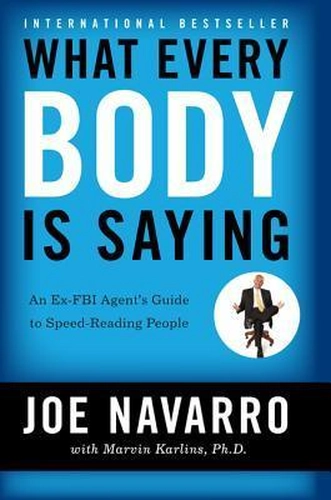
What Every BODY Is Saying by Joe Navarro
Navarro spent twenty-five years in the FBI doing counterintelligence. His daily job was sitting in interrogation rooms watching people. He turned those observations into a reference guide organized by body part. Feet, legs, torso, arms, hands, face. Each part comes with a set of signal explanations. Take feet. People point them up when they are happy and point them toward the exit when they want to leave. Take the neck. People under stress touch it subconsciously, and the location and pressure tell you how much stress they are under. Take the palms. Facing up signals submission, facing down signals dominance. Every point comes with real case examples. Every point comes from something he saw firsthand in interrogation rooms.
After reading this book, the biggest change is that your eyes get sharper. A colleague taps their fingers on the table during a conversation. A friend points their feet away while chatting. An interviewer touches the back of their neck. You used to miss all these details. Now you start seeing them. Navarro gives you a pair of glasses. He helps you see what was always there but you never noticed. But he does not help you judge whether that colleague is tapping out of impatience or just a habit. He tells you what the signal is. The rest is up to you.
The Core Difference
The core difference between these two books comes down to one sentence. Navarro’s book tells you “what this is.” Carter’s book tells you “what this means.” Navarro gives you a dictionary. He lets you see details you never saw before. Carter gives you a coach. He teaches you how to connect those details into a story. One is a parts manual. The other is an assembly guide.
Final Thoughts
If you are starting from zero and have never paid attention to body language before, Navarro is the easier entry point. His content is concrete and easy to remember. You can use it right away. But you will quickly run into an awkward situation. You do start seeing more. But once you see it, you are not sure what to do with it. If you are already at that stage, Carter is the book you need. He tells you what comes next.
You can read both. Which one you pick first depends on where you are right now. If you are not seeing any signals yet, start with Navarro. If you are already seeing some but cannot interpret them, skip straight to Carter.
