Struggling with relentless hitting and pushing between your kids? Learn how to stop siblings from hitting each other with gentle but firm strategies that build trust and kindness in your home.
I heard the thump before the cry. The kind of hollow, skull-meets-floor sound that makes your stomach drop. I dropped the laundry and ran. My four-year-old was on the living room rug, sobbing, red mark blooming on his forehead. My two-year-old stood over him, her tiny fist still clenched, face a storm of frustration. She’d pushed him off the couch because he wouldn’t share the remote. Again. I wanted to scream. I wanted to grab her and demand an explanation. Instead I just stood there, heart pounding, thinking: How did we get here? And how do I make it stop without making everything worse?
Quick Stop Sibling Hitting Today
- Physically but gently separate the children the moment you see or hear hitting.
- Turn toward the victim first. Check for harm, offer comfort, name what happened.
- Take a slow breath before speaking one word to the hitter. Your calm is the intervention.
- Say, “I won’t let you hit. I’ll help you find another way.” No lecture in the heat of it.
- Later, when everyone’s regulated, practice what to do instead: “You can say, ‘I’m not done with that toy.'”
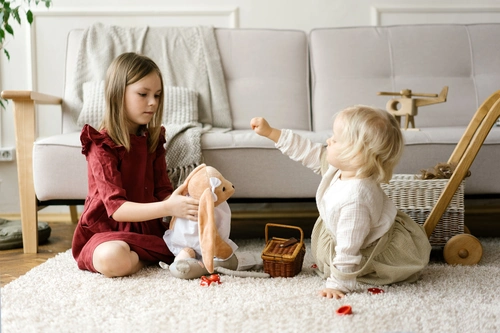
Why Does My Toddler Keep Hitting His Older Sister? (And Other Root Causes)
I used to think my daughter’s hitting was a sign of something broken in me as a parent. Maybe I wasn’t strict enough. Maybe I was too gentle. The guilt was heavy. But then I started watching differently, not to catch her in the act, but to understand what came right before the hit. I noticed she didn’t have the words. She wanted a turn and had no idea how to get one. She’d try a grunt, then a grab, then a swing. It wasn’t meant to harm. It was more a protest, a plea—an attempt to communicate without the words for it.
When my younger one pushes my older one to tears almost daily, it’s rarely about malice. Often she’s overwhelmed by big feelings she can’t name. Jealousy when her brother gets a laugh and she doesn’t. Exhaustion at 5 p.m. when her brain is soup. A need for connection that comes out sideways. Many parents find that toddler-on-big-kid aggression spikes with transitions, hunger, or after a new baby arrives. It felt like a loud, painful signal.
Research backs this up: a study tracking physical aggression from 8 to 26 months found that hitting, biting, and kicking are surprisingly common in toddlerhood, with aggression typically increasing from age 2 to 3 before beginning to decline around age 4. In one study of 1,159 children, researchers found that kicking, biting, hair pulling, and pinching as early as 8 months were the first steps on pathways leading to physical aggression at 24 months. In other words, what I was seeing wasn’t a sign of a “bad” kid—it was a normal, albeit painful, part of early development.
What about when the older sibling is the hitter? A four-year-old who pokes her baby brother in the eye then lies about it? That hits differently. That’s harder. I’ve seen that too. After my second was born, my oldest lashed out when no one was looking. She didn’t hate the baby. She was just figuring out her new place in the family, and hitting got the fastest reaction. The lying was protection. Understanding that didn’t excuse the behavior, but it made my response less about punishment and more about repair.
How to Stop Siblings from Hitting Each Other Without Relying on Punishment Alone
The first few times I put my toddler in time-out, she sat there with this blank confusion, then hit again thirty minutes later. It wasn’t working. I’d been reading that with young children, time-out didn’t seem to help in our case. So I tried something different. I stopped making consequences the headline and started with connection. When I saw the hit about to happen, I’d catch her hand and say, “I see you’re so frustrated. I can’t let you hit. Come with me.” I’d pick her up, walk to the couch, hold her while she screamed, and just sit.
For the victim, I changed the order. I used to rush to the hitter: “Why did you do that? Say sorry!” Now I go to the child who’s crying first. I kneel down. “Ouch, that scared you. I’m here.” My older son, sensitive and unwilling to fight back, needed to see that I would protect his body. That alone built his confidence. Once he felt safe, he stopped shrinking away.
Then I turn to the hitter. Not with a scolding face but a firm, soft one. “You wanted the train. It’s so hard to wait. Hitting hurt your brother. Let’s check on him together.” Who gets comfort first matters more than I realized. In my home, my partner used to coddle the toddler after a hit, and my sensitive older child got scolded for being upset. That doubles the injury. If you have a partner who does this, you might need to lead the physical response when you’re present and talk about it calmly later. You can’t control the other adult. You can model a better way.
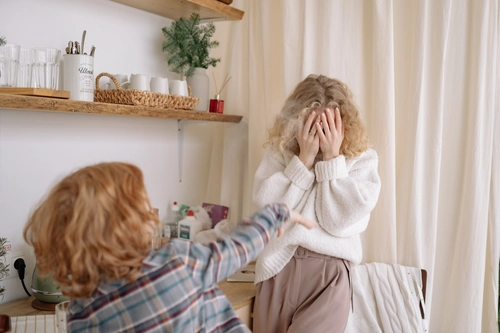
There’s a reason this connection-first approach works. Psychiatrist Daniel J. Siegel, author of No-Drama Discipline, argues that effective discipline isn’t about controlling behavior through fear or punishment, but about understanding what’s happening in a child’s developing brain and responding in ways that foster connection and growth. When I stopped treating each hit as a disciplinary crisis and started treating it as a communication breakdown, everything shifted.
One afternoon, after yet another push, I sat both kids on the floor and taught them a script. For the hitter: “You can say, ‘I’m mad!’ and stomp your foot.” For the child who gets hit: “You can put your hand up like a stop sign and say, ‘No! I don’t like that.'” I had my four-year-old practice that over and over, even though he’s gentle. He needed a voice, not a fist. That’s how we walk the line: honoring the victim’s right to stand up without hitting back.
What to Do When Your Older Child Won’t Defend Himself (and the Younger Keeps Hitting)
My son is big for his age, but his heart is tender. When his sister would hit him, he’d crumple and cry and look at me with these pleading eyes, as if to say, “Why won’t you stop her?” I wanted him to have backbone, not to hit, but to assert himself. So we wrote a short script together. He memorized: “I am not for hitting. Move back.” At first, he whispered it. I stood behind him, my hand on his back. That was enough to give him a little steel. Over weeks, his voice grew stronger. He learned that standing up for himself didn’t mean hurting her back; it meant a firm boundary. We also agreed that if she didn’t stop, he could walk away and find me immediately. That gave him power without violence.
And for the younger one? We stopped the “coddle after hitting” cycle that was happening when my partner intervened. I had to have a tough conversation: “When we comfort the hitter first and scold the older one for being upset, we’re teaching her that aggression gets her love and that his feelings are wrong.” I said it gently and without blame. It took weeks, but we eventually aligned. If you’re the only one holding the boundary, just do your part consistently. Change happens in front of your eyes, one intervention at a time.
When You Catch Your Child Hitting a Baby: Steps That Help Immediately and Later
The CCTV moment from another parent hit me hard. The shock of seeing your four-year-old poke your three-month-old in the eye, then lie about it, is a special kind of hell. I had a similar moment with my oldest when the baby was new. I walked in on her pressing a blanket against his face, not hard enough to hurt, but there. My first instinct was rage. There were days I just yelled before I could think. But I kept trying.
Immediately, I lifted the baby, checked him, and held him. Then I sat down and pulled my daughter onto my lap, not for punishment, but for containment. “You hurt the baby. That wasn’t safe. I’m going to help you be safe.” I named the feeling: “You wanted him to look at you. You wanted Mama’s eyes on you.” She burst into tears. That’s when we addressed the lie later, not at the same moment. “You told me you didn’t do anything. I think you were scared I’d be angry. I am angry about the hitting, and I love you. We will work on this.” There was no long scolding. Then we practiced gentle hands on a doll, again and again. It felt silly, but it worked.
The “Check-In and Repair” Ritual That Transformed Our Afternoons
After a thousand hitting incidents, I needed something predictable. Something that didn’t rely on me being perfectly calm every time. So I built a ritual we call “Check-In and Repair.” It’s not fancy. It’s just a sequence we follow every single time there’s physical aggression, no matter who hit first or whose toy it was. I didn’t always get this right, but I stuck with it.
Step one: I separate physically, saying, “Stop. Bodies are for helping, not hurting.” Step two: I check in with the hurt child. “Where did it hurt? Show me. What does your heart feel like?” I stay there until the crying slows. Step three: I invite the hitter over. If they’re too upset, they sit nearby with a stuffed animal until they’re ready. Step four: Repair. The hitter doesn’t have to say a hollow “sorry.” Instead, they do something: bring an ice pack, draw a picture, give a gentle high-five if the victim wants it. Doing something together teaches more than saying “sorry” ever did. Step five: redo. We replay the moment without hitting. “Let’s try again. You want the toy. Show me what you can say.” This whole thing takes maybe four minutes. Over time, my kids started initiating it on their own. The hitting didn’t vanish. It shrank, and the recovery sped up.
Frequently Asked Questions
Q: What do you do when siblings hit each other constantly?
Start keeping a tiny log for three days. Write down time, situation, and what happened right before the hit. Patterns emerge: maybe it’s always before dinner, or when one child is building something. Then you can anticipate and step in with a redirection, like “I see you want the blocks. Let’s get your own basket.” In many families, prevention alone can make a noticeable difference.
Q: How do I stop my 4 year old from hitting the baby?
First, never leave them alone together, not even for one minute. Next, give your four-year-old a positive role: “Can you bring the diaper? You’re such a helper.” When the baby is awake, praise gentle touches loudly. If hitting happens, calmly remove the older child and say, “I won’t let you hurt the baby. We’ll try again when your hands are gentle.” Then later, fill their cup with one-on-one time so they don’t compete for attention.
Q: Why is my 2 year old hitting his older sibling even when he’s not provoked?
Two-year-olds hit for reasons that make no sense to us. Sometimes it’s sensory: the impact feels interesting. Sometimes it’s a bid for connection that comes out completely wrong. Instead of asking “why,” offer an alternative that meets the need: “You want to play rough. Let’s hit this pillow together.” Then find times to wrestle safely, like on the bed, to give that sensory input.
Q: Can sibling hitting be a phase that passes on its own?
It can ease with brain development, but ignoring it usually makes it worse. Kids need to be taught what to do with their hands when they’re angry. The phase gets shorter when you consistently show them, “When you’re mad, you can tear this paper or squeeze this ball, not hurt your sister.” Many families see a drop in hitting around age four or five, but only if boundaries are held and new skills are practiced.
One last thing
The other night, both kids were on the couch. My daughter grabbed the remote. My son looked at me, put his hand up like a stop sign, and said, “I’m not done with my turn. Please wait.” She paused. She didn’t hit.
References
Early childhood aggression study (Pediatrics, 2004)
No-Drama Discipline – Daniel J. Siegel
Sibling aggression & child development study (2013)
