I stood in the kitchen at 11pm, staring at the fridge. Not hungry. Just… stuck. My mind was replaying a conversation from three days ago. The one where I said the wrong thing at work. Again. My husband walked in and said, “You’re doing that thing again.” He was right. I was trapped in a loop, and I couldn’t find the off switch.
That night, I started hunting for best books for overthinking. Not clinical textbooks. Not dense psychology manuals. I needed something that felt like a friend sitting next to me, saying, “Hey, I’ve been there too.”
Here’s what I found, and honestly, it changed how I live inside my own head.
Why Do I Keep Replaying the Same Worries in My Head?
Overthinking feels productive. That’s the trap. Your brain tells you that if you just analyze the problem one more time, you’ll find the solution. But you won’t. You’ll find more problems.
I remember sitting in my car after dropping my daughter at school. She’d been quiet that morning. Not sad, just quiet. And I spent the entire drive home convincing myself she was being bullied, or that I was failing as a parent, or that she was going to drift away from me. None of it was true. She was tired. That’s all.
But the spiral doesn’t care about truth. It cares about momentum. One worry feeds the next, and suddenly you’re not thinking about your daughter being tired. You’re thinking about her college application in twelve years.
The best books for overthinking understand this. They don’t tell you to stop worrying. That’s impossible. They show you how to notice when the spiral starts, and how to step out of it before it takes hold.
What Is the Most Practical Book to Stop Overthinking?
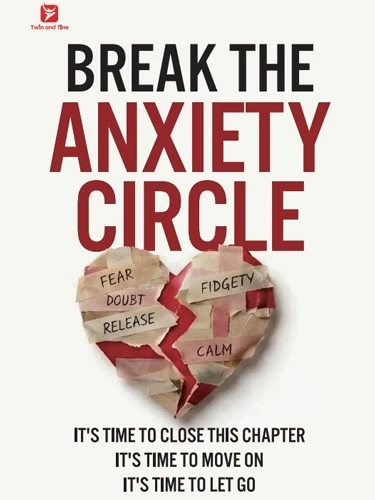
Let me be direct. The most practical book I’ve read on this is Break the Anxiety Circle by Miles Carter. I know, the title sounds like a self-help cliché. I almost skipped it. But a friend insisted, and I’m glad she did.
This book does something different. It doesn’t just explain why you overthink. It gives you a framework. A step-by-step process you can actually use at 2am when your brain won’t shut up.
The framework is built around five actions:
- Notice your thoughts
- Choose your response
- Challenge your thinking
- Accept the reality of how life is
- Face your fears
That’s it. Simple, but not easy. The book walks you through each one with prompts and exercises. Not the kind you skip. The kind that make you pause and actually write things down.
One exercise that stuck with me: when you catch yourself spiraling, write down the worry in one sentence. Then ask yourself, “Is this a fact, or is this a story I’m telling myself?” Most of the time, it’s a story. And once you see it as a story, you can decide whether to keep telling it.
The book’s core message is powerful: the cure for overthinking is breaking the cycle itself. You don’t need to suppress the anxious thoughts. You need to recognize the moment your mind starts to spiral and intervene before the doom spiral takes hold.
I’ve read my fair share of books on this topic. Some are too academic. Some are too fluffy. This one sits in the middle. It respects your intelligence and your struggle. It doesn’t promise you’ll never worry again. It promises you’ll know what to do when the worry shows up.
The 60-Second Thought Check: A Simple Tool That Works
Let me share a tool I developed after reading the book. I call it the 60-Second Thought Check. It’s not in the book, but it’s based on the book’s principles.
When I catch myself overthinking, I set a timer for sixty seconds. Then I ask myself three questions:
- What am I actually worried about right now?
- Can I do anything about it in this moment?
- If not, what’s one thing I can do to comfort myself?
That’s it. Sixty seconds. Then I move on. Sometimes I have to repeat it ten times in a night. But each time, the spiral gets weaker. It’s like muscle memory for my brain.
I taught this to my husband, and he uses it too. His version is simpler. He just says, “Am I solving a problem or rehearsing one?” That question stops him cold. Because most of the time, he’s rehearsing. Not solving.
The point isn’t to eliminate worry. The point is to change your relationship with it. You’re not the thoughts. You’re the one noticing the thoughts. And once you notice them, you have a choice.
What Age Group Benefits Most From These Overthinking Books?
Honestly, this is for anyone with a functioning brain. But I’ve noticed different ages struggle in different ways.
Teenagers overthink about social situations. Did I say the wrong thing? Does she still like me? Why didn’t they invite me? The stakes feel enormous because their world is small.
Young adults overthink about identity and direction. Am I on the right path? Is this the right job? Should I move back home? These are big questions with no clear answers.
Parents, like me, overthink about our kids. Are they happy? Are they safe? Am I doing enough? The worry is relentless because the love is relentless.
Older adults overthink about legacy and regret. Did I make the right choices? What would have happened if I’d taken that other path?
The book works for all of them because the framework is universal. The specific worries change. The spiral doesn’t.
How Is This Book Different From Other Self-Help Guides?
Most self-help books tell you to think positive. That’s like telling someone with a broken leg to just walk it off. It’s not helpful.
Break the Anxiety Circle doesn’t do that. It acknowledges that some worries are legitimate. You might be worried about your health, your finances, or your relationships. Those are real concerns. The book doesn’t dismiss them.
What it does is help you distinguish between productive worry and unproductive rumination. Productive worry leads to action. You worry about money, so you make a budget. That’s healthy. Unproductive rumination leads to paralysis. You worry about money, and you stare at your bank account for three hours without doing anything. That’s the trap.
The book gives you the tools to notice the difference and act accordingly. It also includes personalized prompts. Not generic journaling prompts like “What are you grateful for?” but specific questions that target your personal thought patterns.
One thing I appreciated: the author clearly has personal experience with this. He doesn’t write from an ivory tower. He writes like someone who has spent sleepless nights in his own doom spiral and figured out a way out.
Can Reading a Book Really Change How I Think?
I was skeptical too. But here’s the thing. You don’t read this book once and get cured. You read it, then you practice. Every day. The book is a guide, not a magic pill.
I’ve been using the framework for about three months now. I still overthink. But the episodes are shorter. They’re less intense. And I recover faster. That’s the goal, right? Not to never worry again, but to not let the worry run my life.
Last week, I caught myself spiraling about my daughter’s math test. She’s seven. It’s a math test. But my brain was building a future where she fails all of school and ends up working at a gas station. I stopped, did my 60-second Thought Check, and realized I was being ridiculous. Then I made her a snack and we watched cartoons.
That’s the win. Not the absence of worry. The ability to see it for what it is and choose something else.
Frequently Asked Questions
How long does it take to see results from reading best books for overthinking?
Everyone’s different. Some people notice a shift in a few days. Others need a few weeks of consistent practice. The key is to actually do the exercises, not just read them.
Is Break the Anxiety Circle suitable for people with severe anxiety?
This book is a resource, not a replacement for professional help. If your overthinking is severely impacting your daily life, please talk to a doctor or mental health professional. The book can be a helpful supplement, but it’s not a cure for clinical conditions.
What is the best book for overthinking for someone who has never read self-help before?
Break the Anxiety Circle is a solid starting point. It’s accessible, practical, and doesn’t assume you know anything. The language is clear, and the exercises are easy to follow.
Can these overthinking books help with nighttime rumination?
Yes. The framework works whenever the spiral starts, including at 2am. One tip from the book: keep a notebook by your bed. If a worry shows up, write it down, then tell yourself you’ll address it in the morning. The act of writing it down often reduces the urgency.
One Last Thing
That night in the kitchen, I couldn’t see a way out. My mind was a hamster wheel, and I was the hamster. But now, months later, I look back at that version of me with compassion. She didn’t know there was a door. She just kept running.
If you’re in that kitchen right now, if you’re reading this at 1am because your brain won’t shut up, I want you to know something. You’re not broken. You’re not weak. You’re just stuck in a loop that you haven’t learned to break yet.
The tools exist. The framework exists. Someone else has walked this path and left markers for you. Pick up the book. Do the exercises. Give yourself a few weeks. And when the spiral starts, remember: you are not the thoughts. You are the one noticing the thoughts.
And that noticing? That’s where your freedom begins.