The chair. It was always the chair.
One blue chair by the kitchen window. My son would plant himself on it like a tiny king. My daughter would see him sitting there and instantly decide that chair was the only place in the house she could possibly rest her body.
Screaming. Pushing. Name calling. Then me, stomping in, yelling at both of them to just stop it.
By 4 PM I had sent them to separate rooms, taken away video games for a week, and sat on the stairs wondering where I went wrong.
If you are reading this, you are probably asking the same thing I was: why do siblings fight so much? And more importantly, how do I make it stop without losing my mind?
I do not have a perfect answer. But I have learned a few things.
Quick Sibling Fighting Fixes to Try Today
- Separate them into different spaces, not as punishment but as a reset.
- Skip the lecture during the fight. Wait until everyone is calm.
- Give each child ten minutes of one-on-one attention daily.
- Stop trying to figure out who started it.
- Lower your voice instead of raising it.
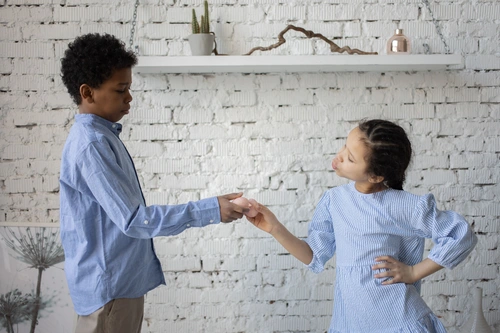
Why Do Siblings Fight So Much? The Real Reason Behind the Chaos
Here is what took me years to understand. My kids were not fighting because they hated each other. They were fighting because they were bored, tired, hungry, or craving my attention.
Think about it. When was the last time your kids had a full-on brawl during their favorite activity? Probably never. They fight when there is nothing else to do. When they are stuck inside. When they have been together for hours with no break.
I have noticed that winter makes it worse. Long months inside, everyone crammed together, and the same toys rotating on the floor. The kids have plenty of activities, but still way too much time in each other’s space.
So they fight.
Sibling conflict is actually practice. It is how kids learn to negotiate, compromise, and handle disagreement. Some research suggests that kids who work through minor squabbles with brothers and sisters develop better social skills later.
That does not make the screaming any easier to handle at 7 AM.
But it does reframe things. Your kids are not broken. They are learning. Loudly.
What Actually Works When Siblings Fight Over Everything?
I tried everything at first. Time outs. Taking away toys. The “I’m so disappointed” speech. Nothing stuck.
Then I started paying attention to what happened right before the explosion.
The pattern was almost always the same. One child would provoke. The other would react. Then it escalated. My son, being older, figured out exactly which buttons to push. He would work his sister up until she was screaming, then act shocked when she retaliated.
Here is what finally helped.
Stop intervening immediately. Unless someone is getting hurt, stay close but do not jump in. I know this feels wrong. But every time I swooped in to referee, I was teaching them that they did not need to solve anything themselves.
Wait for the cooldown. Talking to kids mid-fight is pointless. Their brains are flooded. Wait until things settle. Then have a calm conversation.
Use the replay method. After the dust settles, walk through what happened without blame. “I saw you take her toy. She grabbed it back. Then you pushed her.” Just facts. No accusations. Then ask, “What could you do differently next time?”
Separate without shame. Sending kids to their rooms does not have to be a punishment. I started calling it a reset. Everyone goes to their own space. Not because they are bad, but because everyone needs a minute.
Try a language game. When my kids were screaming over cleaning their shared room, I pointed at one and said, “You can only talk to your sister in Spanish.” Then to the other, “You can only talk to your sister in French.”
Silence. Then giggling. They spent the next hour using a translation app to insult each other in different languages. The fight turned into a game.
The Reset Ritual That Changed Our Evenings
We created something called the Three-Breath Reset.
It works like this. When I notice tensions rising, before it becomes a full fight, I call a reset. Everyone stops. We all take three deep breaths together. Then each child gets to say one thing they need.
“I need space.”
“I need a turn with the chair.”
“I need a snack.”
It sounds too simple. I thought so too. But it works more often than not. The key is catching it early. Once they are screaming, the reset will not land.
I have also tried a version of this with my kids sitting face to face in equal-height chairs. Each child explains their side while the other listens. Then I ask if they understand each other. Most of the time, the kids just want to feel heard.
That is true for adults too, is it not?
What About Punishments Like Taking Away Video Games?
I have done this. You have probably done this. Kid fights, video games disappear for a week.
Here is the problem. The punishment does not connect to the behavior. By day three, they have forgotten why the games are gone. They are just resentful.
If they are fighting over the video games, sure, take them. But if they are fighting over a chair, taking video games does not teach anything about chair-sharing.
Instead, try this: what happened right before the fight? Address that specifically. “You grabbed the chair from your sister. That is why you are taking a break from the chair for 20 minutes.”
Direct consequence. Clear connection.
When Should You Just Let Them Work It Out?
Some parents swear by staying completely out of it.
One approach is to let kids figure things out on their own, staying close for safety but not intervening. Over time, the loudest thing about their play becomes the play itself. Occasional scuffles, but rarely physical. They find a solution.
Sometimes fair. Sometimes not. But they learn.
I also think about how some adults were not allowed to fight growing up. That can condition them to let people walk all over them. They never learned how to stand up for themselves.
On the other hand, if you were the younger sibling who always gave in because your brother was physically stronger, you might still struggle with setting boundaries. Now when you see your daughter giving in, you want to jump in.
Where is the line?
Physical safety is the line. If someone might get hurt, step in. Otherwise, let them practice.
How Do You Deal With Siblings Fighting When You Are Exhausted?
This is the real question.
Because you can know all the strategies and still lose your patience when you have been breaking up fights since 6 AM.
One thing that helped me: lowering my voice instead of raising it. Counterintuitive, I know. But when I whisper, my kids have to get quiet to hear me. It breaks the cycle.
Another thing: giving each child ten minutes of one-on-one attention daily. Not together. Separate. I would do a LEGO kit with the older child while the younger played alone. Then I would switch. The fighting decreased dramatically.
Why? Because a lot of sibling fighting is a bid for attention. If they get it directly, they do not have to fight for it.
FAQ
Q: Why do siblings fight so much over nothing?
A: Often it is not about the object. It is about attention, boredom, fatigue, or a need for control. The chair is just the trigger. The real need is underneath.
Q: Should I punish my kids for fighting?
A: Punishment rarely teaches the skill they are missing. A consequence directly tied to the behavior works better. If they fight over a toy, that toy takes a break. If they fight over space, they get separate space to reset.
Q: How do I stop siblings from fighting when I am exhausted?
A: Lower your voice. Give each child ten minutes of one-on-one attention. And pick one battle at a time. You do not have to fix everything today.
Q: Is it normal for siblings to fight every day?
A: Yes, especially when they spend a lot of time together. It is developmentally normal. The goal is not zero conflict. The goal is helping them learn how to repair and move on.
Q: What if the fighting gets physical?
A: Physical safety is the line. Step in immediately. Separate them. Address the behavior clearly. If it keeps happening, talk to a pediatrician or family counselor. You do not have to figure it out alone.
One Last Thing
That chair by the kitchen window is still there. My kids still fight over it sometimes. But last week, I watched my son get up and offer it to his sister without being asked.
I did not say anything. I just watched. And I thought about all those afternoons I spent convinced I was failing.
They are learning. Slowly. Loudly. But they are learning.
References
- American Academy of Pediatrics. (n.d.). Sibling relationships. Retrieved from HealthyChildren.org.
- Faber, A., & Mazlish, E. (2012). Siblings Without Rivalry: How to Help Your Children Live Together So You Can Live Too. W. W. Norton.
- Nemours KidsHealth. (n.d.). Sibling rivalry: Strategies for parents. Retrieved from kidshealth.org.

