The Day Is Over, but Your Brain Has Started Another Shift
At 11:30 p.m., Mark finally puts his phone down. He is tired enough to know he should be asleep soon, but his mind suddenly starts working through everything he did that day. He remembers an unfinished email, wonders whether his manager sounded annoyed in the afternoon, thinks about tomorrow’s schedule, and then somehow ends up worrying about a conversation that happened three months ago.
Nothing new has happened. His environment is quiet, but his mind is not.
That experience is surprisingly common when your brain has become used to staying mentally active. You may feel as though there are always several tabs open in your head, even when there is nothing urgent that actually needs your attention.

Why Does the Mind Keep Finding Something Else to Think About?
A racing mind is not necessarily a sign that there are dozens of serious problems in your life. Sometimes it is the way your brain has learned to respond to uncertainty, unfinished tasks, emotional discomfort, or the feeling that something might go wrong.
One concern creates another. You think about tomorrow because of something unfinished today. Then you remember yesterday because tomorrow reminds you of a similar situation. Before long, your attention has moved through several unrelated worries without ever settling on one.
The constant movement can make you feel productive, but mental activity is not always useful thinking. Sometimes it is simply momentum.
Worry Can Become a Habit Without Feeling Like One
If your mind keeps racing, you may have become accustomed to using thought as a way to stay prepared.
You replay situations so you can understand them better. You imagine possible problems so you will not be caught off guard. You search for explanations when you feel uncertain. You check whether everything is okay because uncertainty itself feels uncomfortable.
The trouble is that this habit can keep reinforcing itself. The more you respond to every uncomfortable thought with more thinking, the more your brain learns that every thought deserves your attention.
Break the Anxiety Circle by Miles Carter
Break the Anxiety Circle is particularly relevant to the question “why is my mind always racing?” because the book looks at the cycle beneath the constant thinking rather than treating every thought as a separate problem.
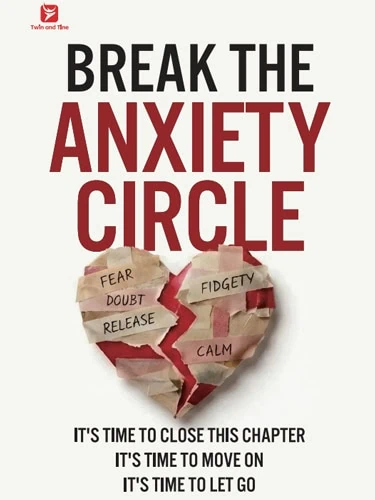
Miles Carter explores how anxiety, overthinking, emotional patterns, self-doubt, people pleasing, regret, and difficulty letting go can interact. A busy mind may look like a hundred unrelated thoughts, but underneath them there can be a much smaller number of repeating patterns.
For example, worrying about a work conversation may connect to fear of being judged. Thinking about a past mistake may connect to low self-worth. Planning every possible outcome may come from discomfort with uncertainty. Once these connections become visible, the racing thoughts start to make more sense.
The book focuses on helping readers recognize those patterns and create interruptions before they gather too much momentum. Its practical themes include:
- Spotting recurring triggers: Understand what situations tend to send your thoughts into overdrive.
- Breaking repetitive analysis: Recognize when thinking is no longer producing new information.
- Letting go of old mental loops: Stop reopening situations simply because they still feel emotionally unfinished.
- Reducing approval-driven thinking: Spend less energy trying to predict how everyone else feels about you.
- Strengthening emotional regulation: Create more space between a thought appearing and your automatic reaction to it.

Break the Anxiety Circle
Miles CarterA mental reset for people trapped in the overthinking loop. Understand why your mind won’t stop racing — and how to break free from anxiety, people-pleasing, and emotional exhaustion.
This makes the book useful for people who have tried distraction but still end up back in their own heads. Distraction may move your attention temporarily, but understanding the cycle can change what happens the next time the same type of thought appears.
You May Not Need to Silence Your Mind
Trying to force your mind to become completely quiet can create another problem: now you are monitoring whether you are calm enough.
A better goal is to reduce the amount of attention you automatically give every thought. A concern can appear without becoming an investigation. A memory can surface without turning into an hour of regret. A future possibility can exist without becoming a detailed prediction of everything that could go wrong.
This is an important shift because the mind will probably never stop producing thoughts. What can change is how quickly those thoughts pull you into another cycle.
Give Your Brain Fewer Problems to Solve at Once
When your mind feels crowded, it can help to separate things that require action from things that simply feel urgent.
If there is an email you need to send tomorrow, write it down. If a decision genuinely needs more information, identify what information is missing. If you are replaying an old conversation that cannot be changed, recognize that no new action is available there.
This kind of sorting does not make uncertainty disappear. It gives your attention somewhere more useful to go.
A Racing Mind Does Not Have to Run Your Life
Having a busy mind does not mean you are destined to feel mentally exhausted forever. The patterns that keep thoughts moving can become more noticeable, and once you see them, you have more opportunities to respond differently.
Break the Anxiety Circle is built around that process: understanding the loop, recognizing the emotional pressure underneath it, and creating enough distance to stop feeding the same thoughts automatically.
So when you ask why is my mind always racing, the answer may not simply be that you have too much to think about. Your mind may have learned to treat uncertainty, mistakes, and uncomfortable feelings as problems that require more thinking. Changing that habit can create something much more valuable than an empty mind: more room to actually experience the present one.
If you found this helpful, these books go deeper into the same themes.



Break the Anxiety Circle
$19.90

From Debt to Wealth
$19.90

