You know you have thought about the situation enough, yet your mind keeps returning to it. Maybe you are waiting for an important response, replaying something you said earlier, or wondering whether you made the right decision. You may even realize that worrying is making you feel worse, but that realization does not automatically make the thoughts disappear. This is one of the frustrating parts of anxiety: the mind can keep searching for certainty long after there is nothing new to discover. Understanding why this happens can make it easier to change the pattern instead of fighting against every thought.
Why Your Mind Keeps Returning to the Same Worry
Worry often begins with a reasonable purpose.
You want to solve a problem.
You want to avoid making a mistake.
You want to prepare for something uncertain.
You want to make sure everything will be okay.
The difficulty begins when the mind assumes that more thinking will always lead to more certainty.
It starts asking another question.
Then another.
Then another.
Eventually, the original concern becomes surrounded by dozens of hypothetical possibilities.
The Search for Certainty
An anxious mind often dislikes unanswered questions.
If you do not know what someone thinks of you, you may analyze their words.
If you do not know what will happen tomorrow, you may imagine different scenarios.
If you are unsure whether you made the right decision, you may repeatedly review the alternatives.
The problem is that many situations simply cannot provide complete certainty.
No amount of thinking can guarantee what another person will say or what will happen in the future.
When Reflection Turns Into Rumination
Thinking about a difficult experience is not necessarily harmful.
Reflection can help you learn.
The problem is when thinking stops producing useful insight.
Healthy Reflection
You might think:
“I handled that conversation badly. Next time, I can communicate my point more clearly.”
There is a conclusion.
There is something you can learn.
There may even be a specific action you can take.
Rumination
Rumination sounds more like:
“Why did I say that?”
“What did they think?”
“Maybe I should have said something else.”
“Did I make things worse?”
“What if they misunderstood me?”
The questions keep multiplying without moving toward a solution.
That is when thinking can become emotionally exhausting.
Anxiety Often Turns Possibilities Into Problems
One of the most difficult parts of anxious thinking is that the mind can treat possibilities as if they require immediate attention.
Something could happen.
So you start preparing for it.
Then you imagine another possible outcome.
Then another.
Before long, you are emotionally responding to situations that have not happened.
A Possibility Is Not a Prediction
The fact that something could go wrong does not mean it will.
You could make the wrong decision.
Someone could misunderstand you.
A plan could change.
But uncertainty is part of everyday life.
Learning to distinguish between what is happening and what might happen can reduce some of the emotional intensity surrounding anxious thoughts.
What to Do When Your Mind Gets Stuck
You do not need to solve every worry immediately.
Instead, try creating a little distance between the thought and your response.
Name What Is Happening
Instead of immediately following the thought, simply recognize it.
You might tell yourself:
“I am worrying about something I cannot know yet.”
That statement does not eliminate the worry.
It simply identifies it.
Awareness can make it easier to avoid automatically entering another round of analysis.
Ask Whether There Is an Action
A useful question is:
“Is there something I can actually do about this right now?”
If there is, identify the smallest useful action.
If there is not, recognize that more thinking may not change the outcome.
This helps separate problem-solving from mental repetition.
Bring Attention Back to the Present
Anxiety frequently pulls attention away from what is happening now.
Your body may be sitting safely in your room while your mind is imagining something that could happen next week.
Returning attention to your surroundings can interrupt that pattern.
You might:
- Take a short walk
- Focus on your breathing
- Do a simple physical activity
- Talk with someone you trust
- Concentrate fully on one practical task
The purpose is not to escape your thoughts.
It is to stop allowing them to occupy every moment.
Why Fighting Anxiety Can Make It Louder
It is natural to want uncomfortable thoughts to disappear.
But constantly telling yourself that you must not worry can sometimes make you pay even more attention to the worry.
You start checking:
“Am I still thinking about it?”
“Has the anxiety gone away?”
“Why am I still worried?”
Now the anxiety itself becomes another problem to analyze.
A more useful goal is not necessarily to eliminate every anxious thought.
It is to become less reactive to those thoughts.
Small Habits Can Change the Pattern
Recurring anxiety is often connected to everyday habits.
When you constantly consume information, stay mentally busy, avoid uncomfortable situations, or spend long periods alone with repetitive thoughts, anxiety can become easier to reinforce.
Small changes can create more opportunities for your mind to reset.
Create Space Between Stressful Activities
Do not move immediately from one demanding task to another whenever possible.
Even a few quiet minutes can give your mind time to transition.
Write Down Recurring Concerns
If the same worry keeps appearing, write it down.
Seeing it on paper can help you recognize whether it is a problem that requires action or simply a thought that keeps returning.
Reduce Constant Mental Stimulation
Notifications, social media, news, and endless digital content can make it harder to give your attention to one thing at a time.
Creating periods without constant stimulation can help you notice what your own mind is actually doing.
Practice Responding Rather Than Reacting
When something triggers anxiety, pause before immediately acting on the emotion.
Ask what you know.
Ask what you can control.
Then decide what response makes sense.
Over time, this can become a healthier automatic habit.
The Bigger Problem Is Often the Cycle
Anxiety is not always about the original situation.
Sometimes the bigger issue is the pattern that follows it.
A difficult conversation creates a thought.
The thought creates worry.
The worry creates more analysis.
The analysis creates more uncertainty.
The uncertainty creates another round of worry.
This is why simply solving one worry may not solve the larger problem.
If the pattern remains unchanged, another worry can take its place.
Learning to recognize the cycle itself can therefore be more valuable than trying to find the perfect answer to every individual concern.
Break the Anxiety Circle by Miles Carter

A book for understanding the cycle behind recurring anxiety
Break the Anxiety Circle by Miles Carter explores the patterns that can keep anxiety and overthinking going.
Rather than looking only at individual worries, the book focuses on the broader relationship between thoughts, emotions, and repeated mental patterns.
This makes it particularly relevant for people who often find themselves:
- Replaying conversations
- Questioning past decisions
- Expecting negative outcomes
- Struggling with uncertainty
- Thinking about the same problem repeatedly
The value of this perspective is that it shifts attention away from trying to control every thought.
Instead, it encourages readers to understand why certain thoughts become repetitive in the first place.
Once you can recognize the pattern, you may find it easier to interrupt it.
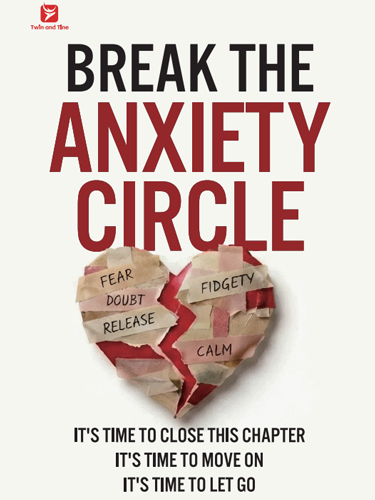
Break the Anxiety Circle
Miles CarterA mental reset for people trapped in the overthinking loop. Understand why your mind won’t stop racing — and how to break free from anxiety, people-pleasing, and emotional exhaustion.
A Calmer Mind Does Not Mean an Empty Mind
One misconception about emotional calm is that you should eventually stop having negative thoughts altogether.
That is unrealistic.
People will still worry.
Unexpected situations will still happen.
You will still make mistakes and face uncertainty.
The goal is not to create a mind that never experiences anxiety.
It is to develop a mind that can experience anxiety without immediately becoming trapped inside it.
You Can Notice a Thought Without Following It
A thought can appear without requiring an immediate response.
You Can Accept Uncertainty Without Solving It
Not every unanswered question needs an answer today.
You Can Experience Anxiety Without Letting It Define Your Actions
Feeling nervous does not automatically mean you need to avoid something or change your decision.
These distinctions can gradually create more emotional flexibility.
Final Thoughts
Recurring worry can make it feel as though your own mind is working against you.
But anxious thinking is often a pattern rather than a personal failure.
Once you begin noticing how the cycle works, you can start separating useful problem-solving from repetitive rumination, facts from predictions, and genuine risks from imagined possibilities.
Small changes in the way you respond to anxious thoughts can create meaningful differences over time.
If you want to understand the cycle behind recurring anxiety and overthinking in greater depth, Break the Anxiety Circle by Miles Carter is a worthwhile book to explore.