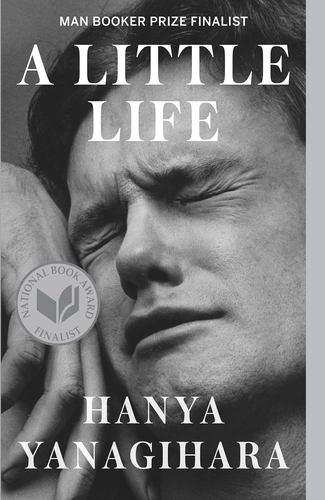
I read the last hundred pages of A Little Life in a bathtub, and the water went cold without me noticing. That is not a metaphor for anything. It is just what happened. Hanya Yanagihara’s novel is 700 pages of cumulative weight, and by the end I had stopped checking the temperature of anything, including my own feelings.
Can love actually heal a person, or does it only make the wound more visible?
The novel follows four friends who meet at a small Massachusetts college and move to New York together: Willem, a kind and steadily working actor; JB, a painter whose wit has teeth; Malcolm, an architect from a comfortable family; and Jude, a litigator whose past is the book’s gravitational center. Jude is the character this story orbits. He is brilliant and quiet, and he cannot accept kindness without flinching.

The Body as a Document He Cannot Revise
Yanagihara does not do subtle with Jude. She follows him across decades, through self-harm, through surgeries, through a childhood so brutal it reads like testimony. By midlife he is successful and still broken, and the novel refuses to pretend those two things cancel each other out.
I put this book down for three weeks somewhere around page 400. Not because it was bad. Because I knew what was coming and I did not want it to arrive.
The core of Yanagihara’s argument lives in one recurring image: Jude’s body as a document he cannot revise. He is a man who has been written on by other people, and the novel asks whether he can ever hold the pen. Every act of care from Willem or Harold or Andy runs into the same wall, which is that Jude does not believe he deserves it.
The strongest cage in this novel was never cruelty. It was Jude’s conviction that he was already ruined, and no amount of warm, golden affection from his friends could pry that conviction loose.
I understand why some readers throw this book across the room. I had that reaction too, somewhere near the end.
The Dinners and the Hospital Waiting Rooms
Yanagihara’s prose is plain and patient. She does not decorate. She just keeps going, one year after another, and the accumulation itself becomes the point. Trauma is not a plot twist here. It is weather.
The book is too long, and its commitment to suffering becomes almost mechanical. After a certain point, Jude’s pain stops surprising you. It starts to feel like the novel is proving something rather than discovering something. Readers who call this book manipulative are not wrong, even if I do not fully agree with them.
What the book gets right, and gets right better than almost anything I have read, is friendship. Not romance. Friendship. The slow, unglamorous work of staying with someone who keeps pushing you away.
The novel’s best sections are not the flashbacks. They are the dinners. The hospital waiting rooms. The phone calls where nobody says the important thing.
That is where the book earns its keep.
Who Should Read This, and Who Should Not
Readers who want a novel to take up residence in their life, who can handle graphic depictions of child abuse and self-harm, and who are willing to sit with a story that does not offer rescue, should read this.
Readers who need resolution, or who read primarily for pleasure, should stay away. This is not a book that rewards you. It taxes you.
Anyone currently in a fragile place should not read it. I mean that seriously. The trigger warnings are not decorative.
What I took away from A Little Life is not hope, exactly. It is something closer to permission. Permission to admit that some damage does not fully heal, that love is not a cure, and that showing up anyway is still worth something.
I still think about Jude. I think about him when I am kind to someone and they do not know what to do with it. I think about the bathtub, and the cold water, and the fact that I did not get out.
This book will not fix anything for you. It will not teach you how to grieve properly. It will not make you a better friend overnight. But it will make you slightly less certain that suffering has a solution, and slightly more willing to sit beside someone who is suffering anyway.
Isn’t that, in the end, the only thing any of us can actually offer?

