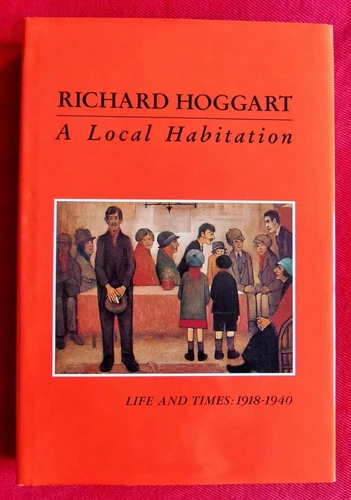
I picked up Richard Hoggart’s A Local Habitation expecting a classic rags-to-riches story – an orphaned boy from a working-class neighborhood who ends up a Cambridge professor and the father of cultural studies. I thought it would be inspiring in that predictable way. But the book refused to give me that comfort. Instead, Hoggart just sits you down and tells you what it actually felt like. Quietly. Without self-pity, without heroic speeches. And that honesty hit me harder than any success story could.
Hoggart lost his mother at seven and went to live with his grandparents at A Local Habitation in Leeds. The place was poor in that unapologetic, back-to-back housing kind of way. But what got to me wasn’t the poverty itself. It was how poverty leaves marks that never quite fade. Even after he won a scholarship, went to university, and became a professor, he still caught himself checking whether his clothes looked decent enough, whether his speech was proper enough, whether he had accidentally let some small sign of “where he came from” slip out. He writes about that nagging fear of being found out in such a calm, understated voice – and reading it, I felt like he was describing something I’ve never been able to put into words.
I recognized that feeling immediately. Growing up, money was always tight in my family. I learned early to calculate prices before buying anything, to say no to invitations I couldn’t afford, to keep my clothes clean even when they were cheap. Later I went to a good university in a big city, and later still I found a decent job. On paper, I had moved up. But the old habits never left. Even now, with a steady income, I catch myself checking price tags before I pick anything off a shelf, comparing delivery fees, feeling a small panic when a friend suggests an expensive restaurant. It’s not that I can’t afford it. It’s that my hands remember the arithmetic before my brain does.
What struck me most about Hoggart is that he never pretends those marks aren’t there. He doesn’t romanticize his working-class childhood, nor does he sneer at it. He simply admits that he ended up living in a strange in-between zone – no longer fully part of the neighborhood he grew up in, but never truly at home in the middle-class world he entered. That sense of floating, of belonging nowhere completely, is something I recognized in my own life. When I go back to my hometown for the holidays, relatives treat me like I’ve “made it” – but our conversations grow short and awkward. Meanwhile, when colleagues talk about their childhood piano lessons or family trips abroad at work, I quietly go silent. I don’t know how to say that my favorite toy as a kid was a ten-yuan plastic Transformer bought from a street stall. It’s not exactly shame. It’s just the awareness that you’re standing with one foot in two different worlds, and neither one feels entirely like yours.
But here’s what I finally understood after finishing Hoggart: that in-between place isn’t just a wound. It can also be a way of seeing. Hoggart didn’t try to scrub away his working-class accent or forget Newport Street. Instead, he used his double vision to found the Centre for Contemporary Cultural Studies and turn ordinary people’s lives into serious scholarship. He made his displacement into his strongest tool. That doesn’t erase the loneliness of it, but it does give it meaning.
I think that’s the real lesson of this memoir. Moving up in the world isn’t just gain. It’s also loss. You leave behind a part of yourself that you can never fully retrieve. But you don’t have to pretend that part never existed. You don’t have to thank poverty for making you “strong.” You just have to accept that it shaped you, and then decide what to build with that shaping. Hoggart built a whole field of study. The rest of us might only build a little more self-understanding. But that’s not nothing.
