With temperatures well below freezing and an Arctic cyclone howling outside, I sipped a cup of hot coffee and read The Book of Goose.
“You cannot cut an apple with an apple. You cannot cut an orange with an orange.”
TEST ONE H2
This is the very first sentence of The Book of Goose. Only after finishing the book and looking back did I realize that this sentence had already said it all—these two girls could never be separated, because they were, in fact, the same orange.
What truly strikes a chord in this book is how it captures that indescribable relationship—not friendship, not love, but a symbiosis of “did I make her, or did she consume me?” And this symbiosis is, at its core, a person splitting themselves in two.
TEST TWO H3
As I read, I began to feel that Agnès and Fabienne are, in fact, the same person.
Agnès is the conscious mind; Fabienne is the unconscious. Agnès is the prefrontal cortex—responsible for planning, obedience, and politeness; Fabienne is the animal brain—impulsive, raw, and resistant to discipline.
Why write? Because of these experiences. Why endure such pain? To write the next book. This cycle is the essence of their symbiosis: one is responsible for living through it, the other for writing it down.
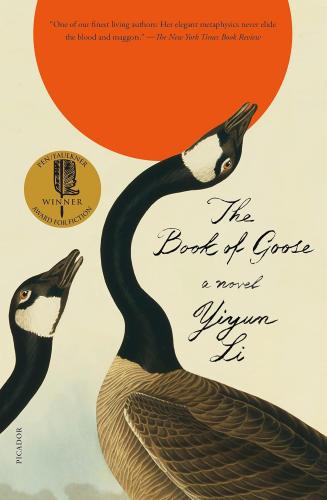
Who should be on the book cover? The question itself is a trap.
Using oranges and knives as metaphors, the author extracts an Agnès Morot from precise historical dates and nationalities—a process akin to the two girls fabricating a kind of truth to deceive the adults of the real world.
Agnès was determined to return to Saint-Rémy, unexpectedly putting an end to the fiction that had been driving the two further apart and shattering the potential stereotypical conclusion: Agnès leaving to find fame, while Fabienne, with whom she had lost touch, faded away, becoming a part of her.
At the story’s end, the two oranges remain two oranges. No knife—whether of fiction or reality—can cut them apart. Yet, conversely, they can no longer become one again.
This is the saddest truth of the entire book: they were once a single person, but they can never become one again.
The cover is the best proof. An upside-down goose, an upside-down life. Those two geese are Agnès and Fabienne. In the eyes of the world, they may seem “upside-down”: one possesses talent yet relinquishes fame, while the other gains renown yet bears the burden of lies; one is bound to her homeland yet possesses a free spirit, while the other ventures into the world yet feels deeply like an exile. The way they nestle together embodies the warmth of symbiosis and serves as their sole anchor against the entire “upright” world. Through this inverted posture, they carry out a silent rebellion against the scripted narrative.
It is no coincidence that Li Yiyun chose to tell the story from Agnès’s perspective. Unlike traditional novels that unfold through an omniscient perspective, this book unfolds through Agnès’s narrative. What she says is like a story told by a friend—not all of it is true. As readers, we must piece together the true story from the tales she tells and the actions she takes. This precisely echoes the idea that “two people are one”: Agnès is the “remaining narrator” after the split, while Fabienne is the other half she can never fully recount.
They betrayed Mr. Devaux—the adult who helped them turn their fiction into a published work. But Li Yiyun does not portray this as a clean act of rebellion. Mr. Devaux himself harbors psychological dark spots; his assistance was never entirely pure in motive, and was, in fact, rather unscrupulous. This makes the betrayal seem less than perfect.
Every time Agnès leaves—leaving Saint-Rémy, leaving Fabienne, leaving childhood—she moves one step closer to adult society and one step further away from Fabienne.
The two girls in the book who lost their legs after lying on the tracks are, in a sense, fortunate. They used their physical disabilities to refuse to grow up. Their shared scars severed them from adult society, allowing them to continue sharing each other. The loss of their legs ensured the continuity of their spiritual world.
Fabienne “died”—this was the price Agnès had to pay. A child’s spirit dissipates the moment she is labeled an adult.
Reading this, I was reminded of a childhood friend.
My best childhood friend would often spin fantastical tales for me. We’d pile colorful blankets into the shape of a cave, and the faint glow from a flashlight became patterns cast by moonlight. In the pitch-black cave, we excitedly invented our identities and backstories. We raced through the neighborhood on our bicycles, pretending to be dragon-slaying knights, and the snow-white, plump camellias that our neighbors had painstakingly cultivated became our spoils of war. We didn’t care about destruction or harm; in our world, there was only “us” and the world we had created. I hope this “alliance” will continue forever in my heart.
Looking back now, that game of make-believe was our way of conspiring to become “one person.” Only back then, we didn’t know that growing up meant learning to separate from ourselves.
The Book of Goose brought this to mind once again. It isn’t the story of two girls, but the story of everyone who has ever sought another version of themselves in fiction.
The bond between women cannot be summed up by the word “friendship.” We embrace the world’s pain together, feel the wounds carved by that sharp blade of suffering, and heal one another.
Words are the gentlest way. By writing them down, we make them visible to everyone. In the interplay of writing and pain, we find each other. We are the day, and we can also be the night. Together, we encompass all of time; we possess everything.
