Some relationship problems seem to repeat themselves no matter how much you try to handle them differently. One person wants more closeness, while the other keeps asking for space. One feels ignored and becomes increasingly anxious, and the other feels pressured and pulls away even more. After a while, both people can start wondering whether they are simply bad at relationships.
Attached by Amir Levine and Rachel Heller looks at these patterns through the idea of adult attachment. The book explores how people can have different ways of responding to closeness, conflict, uncertainty, and emotional needs, and how those differences can shape romantic relationships.
What makes the book particularly relevant is that it gives a name to experiences many people already recognize. Instead of treating every relationship problem as a matter of personality or compatibility, it asks readers to look at the emotional patterns underneath their reactions.
About the Book
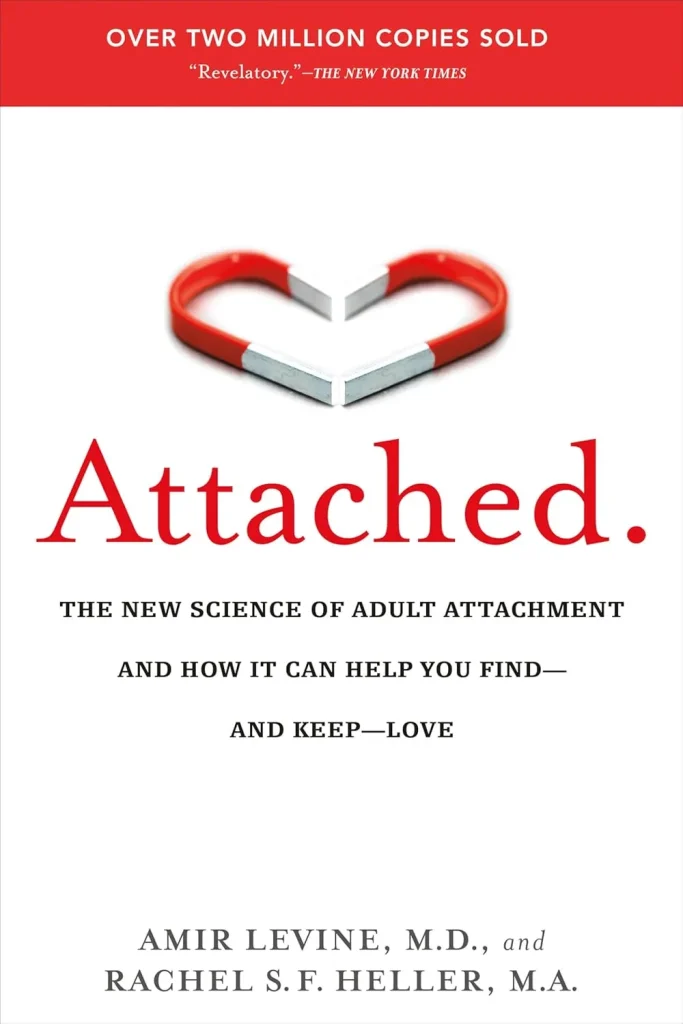
Attached is based on attachment theory, a psychological framework originally developed to explain the bonds formed between children and caregivers. Levine and Heller apply those ideas to adult romantic relationships and focus mainly on three attachment styles: anxious, avoidant, and secure.
The book explains that people do not all experience intimacy in the same way. Some feel most comfortable with a lot of closeness and reassurance, while others are more protective of their independence. Securely attached people are generally more comfortable with intimacy while still maintaining a healthy sense of independence.
The authors use these patterns to explain why certain relationship dynamics can become so emotionally exhausting. A person’s behavior may make much more sense when viewed as part of an attachment pattern rather than as a deliberate attempt to cause problems.
When You Need Reassurance But Keep Getting More Anxious
One of the most recognizable patterns in the book is anxious attachment. People with stronger anxious tendencies may become highly alert to changes in a partner’s behavior. A slower reply, a different tone, or a canceled plan can create a lot of uncertainty, especially when there is no clear explanation.
The difficult part is that reassurance may only help for a short time. Once the immediate worry goes away, another question can take its place. You start checking again, wondering whether something has changed, and looking for clues that the relationship is still safe.
This can become a cycle of overthinking that feels impossible to switch off.
Attached does not present this simply as being “too needy.” Instead, it explains how a person’s attachment system can become activated when they sense distance or uncertainty. Seeing the pattern this way can make those reactions easier to understand and, over time, easier to manage.
Why Distance Can Feel So Personal
Avoidant attachment is presented from a different angle. Some people become uncomfortable when relationships start feeling too emotionally demanding. They may value independence strongly, need more personal space, or pull back when a partner wants more closeness.
From the other side, this can feel deeply personal. The anxious partner may interpret the distance as rejection, while the avoidant partner may experience repeated requests for reassurance as pressure.
This is where the book’s discussion becomes especially interesting. Two people can experience exactly the same interaction in completely different ways. One is trying to restore connection, while the other is trying to create enough space to feel comfortable again.
Neither person necessarily thinks they are creating the problem.
The Anxious-Avoidant Cycle
The interaction between anxious and avoidant tendencies is one of the book’s central ideas.
A partner becomes worried and seeks more reassurance. The other partner feels overwhelmed and creates distance. That distance increases the first person’s anxiety, which leads to even more attempts to reconnect. The additional pressure then makes the second person withdraw further.
What makes this cycle so frustrating is that both people can feel as though they are responding to the other person’s behavior.
Once the pattern is recognized, however, it becomes easier to see that the conflict is not always about the immediate argument. The two people may be caught in a recurring emotional loop that keeps producing the same reactions.
That is one of the book’s most useful contributions for readers who feel like they keep having the same relationship problem in different situations.
Communication Is More Than Saying What You Feel
Attached also makes an important point about communication. Telling someone how you feel matters, but healthy communication also involves being able to express your needs clearly and recognize whether the other person is actually able or willing to respond to them.
This is especially important for people who are used to minimizing their own needs. They may stay silent to avoid appearing demanding, then become increasingly frustrated when their partner does not understand what they want.
The opposite can happen too. Someone may communicate their needs repeatedly but focus so strongly on getting immediate reassurance that the other person feels trapped or attacked.
The book encourages readers to look beyond the surface conversation and ask whether the relationship is actually meeting important emotional needs.
Not Every Difficult Relationship Can Be Fixed With Better Communication
This is one of the more practical lessons readers can take from the book.
Sometimes people assume that if they communicate perfectly, every relationship problem will disappear. Attached offers a less comforting but more realistic perspective: communication matters, but the other person’s behavior matters too.
If someone consistently avoids commitment, refuses to communicate, dismisses your concerns, or makes you feel insecure about where you stand, simply becoming better at explaining yourself may not solve the underlying problem.
Understanding attachment patterns can therefore help with more than self-improvement. It can also help you evaluate whether a relationship is actually giving you the stability, respect, and connection you need.
What Makes Attached Worth Reading?
The book’s biggest strength is how easily its ideas connect to everyday relationship experiences. You do not need a background in psychology to recognize the situations it describes. Waiting for a message, worrying about a partner’s changing behavior, feeling crowded by emotional demands, or repeatedly having the same argument are all familiar experiences for many people.
It also gives readers a vocabulary for discussing relationship patterns. Instead of saying, “You are too needy” or “You do not care about me,” someone can begin to recognize that a particular interaction is activating insecurity or a strong need for distance.
That shift does not automatically solve the problem, but it can make the problem easier to see.
The book is not perfect, and attachment styles should not be treated as rigid labels that completely define a person. People can behave differently in different relationships and situations. Still, the framework can be a useful starting point for understanding recurring patterns.
A Useful Perspective for People Who Overthink Relationships
There is a particularly strong connection between Attached and relationship-related overthinking.
When someone is unsure about a partner’s feelings, the mind can become very good at finding possible explanations. A short message starts to feel significant. A small change in routine becomes a warning sign. An ordinary disagreement turns into a question about whether the whole relationship is in danger.
Learning about attachment can help put some of those reactions into context.
Instead of immediately assuming that every uncomfortable feeling is proof that something is wrong, you can ask whether your attachment system has been activated. That does not mean ignoring genuine problems. It simply gives you another possibility to consider before your thoughts run away with the situation.
Who Should Read Attached?
Attached is particularly useful for readers who want to better understand romantic relationships, emotional needs, and the reasons certain relationship patterns feel so difficult to break.
It may be a good fit for people who:
- Frequently worry about whether a partner really cares
- Overthink texts, silence, or changes in behavior
- Feel uncomfortable when a partner becomes distant
- Need more closeness than their partner seems to want
- Struggle with balancing independence and intimacy
- Keep repeating the same relationship conflicts
- Want to understand their own attachment patterns
- Want healthier communication in romantic relationships
The book can also be useful for people who are currently single. Understanding your own patterns can help you notice what kinds of relationships make you feel secure and what kinds tend to pull you into familiar but unhealthy cycles.
Final Thoughts
Attached is ultimately about more than attachment styles. It is about the way people respond when they feel close, uncertain, rejected, needed, or overwhelmed by intimacy. Those reactions can become so automatic that it is easy to mistake them for simple personality differences.
The value of the book is that it encourages readers to step back and look at those patterns more carefully. You may begin to understand why you seek reassurance when someone pulls away, why another person needs distance when emotions become intense, or why the same type of relationship conflict keeps appearing.
For readers interested in anxiety, emotional patterns, communication, and healthier relationships, Attached offers a useful way to understand what may be happening beneath the arguments and uncertainty. Sometimes changing a relationship begins with recognizing the pattern both people have been repeating.