I sat across from a friend last month while she described how a coworker had slowly, politely, taken credit for her project. She wasn’t angry. She was embarrassed. She kept asking what she had done to invite it.
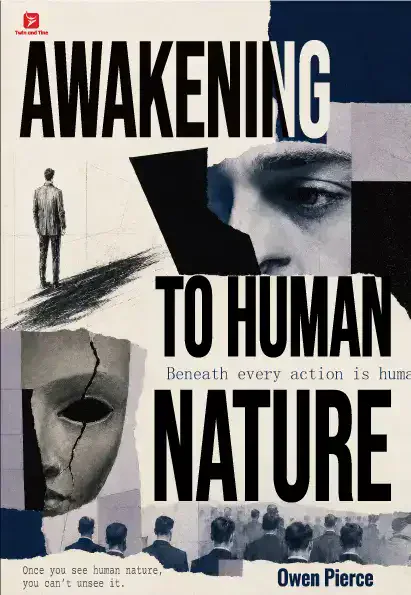
That question is where Owen Pierce’s Awakening to Human Nature begins, and it’s also the question the book spends two hundred pages answering in ways that are useful and, honestly, a little unsettling.
The book’s central argument is that most social pain comes from one source: we explain behavior with character when we should explain it with interest. Pierce calls this a cognitive law, and he returns to it constantly. People don’t betray you because they’re villains. They betray you because their needs changed and you stopped being useful.
The book asks whether understanding this makes you safer, or just lonelier.

The Protagonist Is the Reader, and That’s the Problem
There’s no hero in this book. The protagonist is you, or rather the version of you that keeps getting blindsided.
Pierce builds that character with uncomfortable precision. It’s the person who explains a boss’s sudden coldness as a bad mood. The one who assumes a friend’s loyalty has no expiration date. The one who mistakes being kind for being protected.
I recognized this character. I didn’t want to.
The core conflict runs through every chapter: the gap between what people say and what they actually want. Pierce names it the double standard problem. Someone praises honesty and punishes the person who delivers it. Someone preaches teamwork while quietly ensuring they are the only one visible.
The book keeps circling this gap without ever closing it, which I think is deliberate. There’s no reconciliation, only recognition.
What gives the book its tension is Pierce’s refusal to offer comfort. He doesn’t tell you that good people eventually win. He tells you that the most capable voices are often the ones pushed out, and that this isn’t a malfunction of the system. It is the system.
That’s a hard thing to sit with. And it leads somewhere deeper than tactics.
Why the Book’s Coldness Is Its Most Honest Quality
The imagery Pierce returns to is temperature. Warmth and coldness run through the whole book. Warmth is what you feel when someone needs you. Coldness is what arrives when they don’t. He uses this so consistently that by the middle chapters I started noticing it in my own week, which is either a sign of good writing or a sign that I need a hobby.
His most important concept is what he calls “interest alignment.” Relationships hold, he argues, when two people’s needs happen to point the same direction. Not because of love, not because of history. Because of alignment. When the alignment shifts, the relationship follows. This is a bleak claim, and Pierce doesn’t soften it.
But here’s where I think the book is more interesting than it lets on. If relationships are alignment, then the moments that matter most are the ones where alignment fails and someone stays anyway. Pierce doesn’t emphasize this. He barely mentions it. Yet it’s the shadow the entire book casts.
The manipulation tactics section is the most practical part. Recognizing emotional blackmail, spotting the person who makes you feel guilty for having boundaries, understanding why validation is craved more than truth. These chapters are useful in a way that feels almost clinical.
Who This Book Is For, and What It Leaves Out
This book is for anyone who has recently realized they misread a situation badly. It’s for the person who gave too much and got a lesson instead of gratitude. It will land hardest with people in workplaces where competence is not the same as safety.
Its weakness is real, though. Pierce treats human nature as something to be decoded once and then managed forever. He offers very little room for people who change, or for the possibility that some kindness is not a resource to be exploited. The book’s framework is sharp, and like most sharp tools, it cuts both ways. Read it too literally and you become the person who sees calculation everywhere, including where there is none.
I’ll be honest. I finished it feeling more capable and slightly worse. That’s not a complaint. Some books earn their discomfort.
Maybe that’s what it means to grow up. Not learning that everyone is dangerous, but learning to keep your eyes open without closing your heart. The book teaches the first half. The second half, I suspect, is yours.