I folded laundry the other night. A plain white t-shirt. Price tag still on: $39.99.
I looked at it. Then I looked at my hands. I had no idea where this thing came from. Not the store. I mean really came from. The cotton. The thread. The hands that sewed it. The ship that carried the raw materials. The bank that loaned money to the factory owner. The government that made the laws.
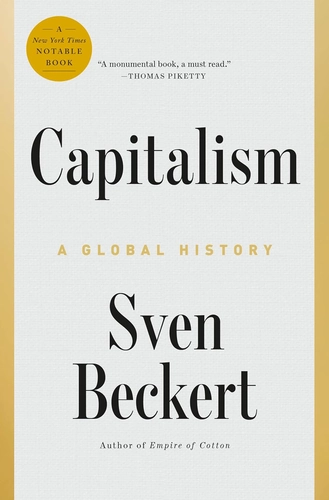
I put the shirt down. I picked up Sven Beckert’s “Capitalism: A Global History.”
Honestly, I had avoided it. A 500-year history of capitalism? It sounded like homework. But Beckert is a Harvard historian. He won the 2025 New York Times 100 Best Nonfiction. And my curiosity got the better of me. I wanted to know: Can one book really explain the system that made my t-shirt possible?
“The Protagonist Is a System, Not a Person”
Beckert doesn’t give us a hero.
He gives us something stranger. The system itself is the main character. It has a birth. A childhood. A violent adolescence. And now, a middle age that looks tired and dangerous.
The book starts in the 15th century. European merchants. African slave traders. American plantations. Cotton. Sugar. Tobacco. Beckert shows how this wasn’t a collection of separate stories. It was one machine. The slave ship and the London bank were connected. The cotton field and the Manchester factory were connected. My t-shirt and a 17th-century plantation in Barbados are connected.
I found this unsettling. I had learned history in school as a series of events. The Industrial Revolution. The Great Depression. Globalization. Beckert says no. Those events are symptoms. The real story is the system underneath. A system built on violence, yes. But also on contracts, insurance, credit, and the state.
The core conflict isn’t between nations. It’s between the logic of capital and the limits of the earth. Between the desire for infinite growth and the reality of finite resources. Beckert traces this tension through wars, depressions, and revolutions. He never tells us the ending, because we are living it.
I started to see my t-shirt differently. It wasn’t just a piece of cloth. It was a document. A record of 500 years of decisions. Some good. Some terrible. All of them real.
“The Imagery of Cotton and Concrete”
Beckert’s central image is the thread.
He uses it literally and metaphorically. Cotton threads connect continents. Money threads connect investors. Power threads connect governments. The image is deceptively simple. But he keeps returning to it. Each time, the thread grows heavier.
He also focuses on the built world. The plantation. The factory. The port. The shipping container. These are not backdrops. They are actors in the story. The plantation shaped the lives of millions. The shipping container reshaped global trade. The factory floor dictated human movement.
I appreciated this. Beckert doesn’t just tell us ideas. He shows us concrete realities. The mud. The noise. The heat. The exhaustion. He reminds us that capitalism has always been a physical experience for most people. Not an abstraction.
The weakness of the book, I think, is its scope. 500 years is a lot. Some periods get short shrift. The 19th century is treated as the dramatic peak, which makes sense. But the 20th century feels compressed. The post-1970 era of financialization gets just a few chapters. I wanted more on the 2008 crisis and the pandemic supply chain collapse.
Still, the core theme holds: capitalism is not natural. It was made. It can be remade. That is both terrifying and hopeful.
“The Ghost in the Machine”
I finished the book on a Sunday afternoon.
I went back to my closet. I pulled out the white t-shirt. I held it up to the light. I thought about the people I would never meet. The cotton picker in India. The seamstress in Bangladesh. The truck driver in California. The banker in New York. The politician in Washington.
They were all there. In my hands.
Beckert ends with a quiet warning. The system that created my t-shirt is the same system that is warming the planet, widening inequality, and fraying social bonds. It is not broken. It is working exactly as designed. The question is whether we want to keep designing it this way.
This book is for anyone who has ever looked at a price tag and wondered. It is for the person who senses that something is off but can’t name it. It is for the student who wants a framework, not a lecture.
I won’t say everyone should read it. That feels too strong. But I will say this: I looked at my t-shirt differently after. I saw the thread. I saw the ghost. And I couldn’t look away.
Maybe that is what a good history book does. It doesn’t give you answers. It gives you better questions.
