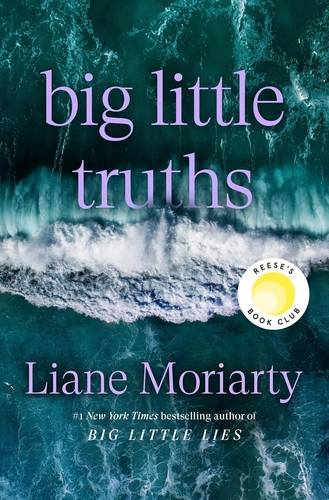
I finished Big Little Truths at 1:47 AM on a Tuesday, and I sat there in the dark feeling slightly betrayed. Not by the plot, which I had guessed roughly forty pages earlier, but by myself. I had liked Melody Montclair. I had thought she seemed lovely.
That is the trick of this book. It grooms you.
Ten years have passed since the trivia night that ended Big Little Lies. The Pirriwee children are in Year 10 now. Madeline, Celeste, Jane, Renata, and Bonnie still orbit each other, still carry the weight of what happened when their kids were five. Moriarty opens with a severed finger mailed to the school principal, but the real story is slower and more uncomfortable than that.
The question at the heart of this sequel is simple. What does a predator look like when she is warm, helpful, and genuinely good at her job?
The Machinery of Charm, and How It Works on You
Madeline is facing the biggest challenge of her life, and for once it is not her own drama. Celeste watches her mother-in-law Mary Louise slide into something that looks like dementia but might be something else. Jane has reached a fork in her marriage. Bonnie has discovered that yoga cannot fix everything. Renata is thriving, and revenge is sweet.
But the spine of the novel is a new history teacher named Melody Montclair. She arrives at the high school and makes herself essential. She fast-tracks a biopsy for a worried mother. She talks a school-refusing boy back through the gate. She takes a lonely woman dancing. She is wonderful. She is everywhere.
Moriarty braids the mothers’ perspectives with four other registers. A detective ticks toward a date the kids have named D-Day. The principal sends magnificently pompous all-parent emails. The Year 10 group chat reacts to a criminal investigation with four deleted messages and a question about band practice. And in a school counselor’s office, six teenagers narrate the whole affair to a woman named Brenda.
That transcript is the engine of the book. Chloe, Skye, Amabella, Ziggy, and the twins interrupt each other, correct each other’s idioms, and reveal the plot roughly forty pages before their parents get there. One of them says almost nothing for most of the story. The silence is doing work.
The novel’s true subject is the sexual exploitation of teenage girls by an adult everyone has decided to love, and the machinery of charm that makes it possible for years at a time. The reader gets groomed alongside the characters. For most of the book, Moriarty supplies genuine evidence that this woman is wonderful, then makes you sit with having believed it.
That is harder than a twist. A twist tells you the truth. This book makes you complicit in the lie.
I thought about my own daughter’s high school, about the teacher who always seemed to have time for the troubled kids, about how we parents praised her at pickup. I thought about how we never asked what she wanted.
What the Book Does Not Let You Look Away From
Moriarty handles consent across three generations without a lecture. A fifteen-year-old insists she said yes. A mother cannot say what happened in her delivery room. A car park full of parents announces that teenagers know exactly what they are doing. These voices grate against each other, and none of them is entirely wrong, and that is the point.
The book is not without flaws. It is overstuffed. A motorbike, an engagement, a broken hip, a phone scam, and a local gangster all compete for space. The villain stays a mechanism, no interior life, one gestured-at fragment of backstory. The coincidence engine runs hot, and the last act hands down a verdict that the courtroom the book spent its final pages promising was better placed to deliver.
You should read Big Little Lies first. Not as homework, but genuinely. The friendships here carry a decade of accumulated debt. The reason Bonnie standing in a fountain at midnight is unbearable rather than merely odd is that you were on the balcony at the trivia night. The sequel gives away the first book’s ending anyway, so skip the HBO series if you have not watched it, read the original, then come here.
If you want a fast thriller, this will bore you. If you found Big Little Lies already too long, this is longer. If you need your villains obvious from page one, look elsewhere. But if you are a mother of teenagers, or anyone who has watched a charming person operate and wondered, this book will make you feel seen. It will make you listen differently.
The Showcase, the Children, and the Question You Carry
The final act builds to a school showcase where students argue whether a historical figure was a villain or a hero. The teacher who set the assignment opens the evening dressed as Marie Antoinette, explaining that the queen never said the line everyone quotes at her. History is interpretation, she tells them. Truth is a matter of perspective.
The children have been paying closer attention than she realized.
That is what this book is finally about. Who gets to write the account? What happens when the people with the fewest legal rights in the room decide to write it themselves? The adults spend the novel being competent about the wrong things. The teenagers, who cannot drive and are not believed, build the only piece of evidence that matters.
Moriarty’s first ever sequel is messier than its predecessor, less disciplined, and angrier in a way that suits its subject. It is not as funny as Big Little Lies, because it cannot be. The humor is still there, but it curdles when you realize what you were laughing at.
This book will not give you the clean satisfaction of justice served. It will not tell you what to think about Mary Louise, who gets interiority, grief, and the final chapter, and who remains morally ambiguous to the last page. It will not let you off the hook for having liked the charming person.
But it will make you ask what the helpful adult actually wants. It will make you sit with your own complicity in the small lies that protect predators.
It ends on a wet road at six in the morning, with a woman who has decided she is finished looking backward. I closed the book and looked at my sleeping house. I thought about all the things I do not ask my daughter. I wondered what I am not seeing.
What are the big little truths you are not telling yourself?
