I was walking through my neighborhood last week and noticed a gap between two newer apartment buildings. A parking lot now. But I remembered there used to be a small brick bakery there, with a faded sign. I never thought about how it disappeared. I just assumed it got old, or the owner retired. This book made me stop and wonder about all the gaps I never questioned.
What if whole blocks of a city didn’t just fall apart, but were actively pulled apart? That is the question Bench Ansfield asks in Born in Flames: The Business of Arson and the Remaking of the American City. It is a history of the South Bronx in the 1970s. But it is not a history of decline. It is a history of deliberate destruction. And it left me feeling like I had been looking at maps upside down my whole life.
The arsonist as a businessman
The book focuses on the landlords. Not the poor families who lived in those burning buildings. The landlords. Ansfield shows how they figured out that a burned building was worth more than a standing one. Insurance payouts were higher than rent collections. So they hired arsonists. Kids, sometimes. Drifters. They paid them fifty bucks and a bottle of whiskey to set a match to a stairwell.
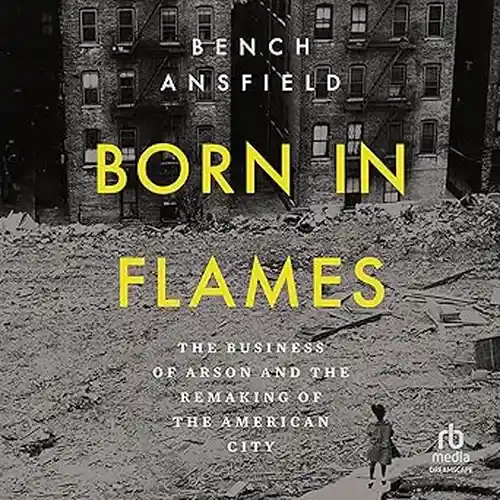
I found this hard to believe at first. It sounds like a conspiracy theory. But Ansfield pulls out the court records. The city documents. The insurance files. He shows that the fires were not random. They clustered on certain blocks. They happened in buildings that were already underinsured or over-mortgaged. There was a system. A grim, cold logic.
The protagonist of this story is not a person. It is a process. The process of converting a neighborhood into cash. The landlords did not see themselves as criminals. They saw themselves as rational actors in a broken market. And in a way, they were right. The city government looked the other way. The banks stopped lending. The fire department was overwhelmed. So the arson became normal. It became just another business expense.
What does that do to a community? That is the question that hangs over every page. You watch families lose their homes. You watch a whole borough turn into a wasteland. And you realize it was not an accident. It was a business plan.
The economics of fire
The core theme of Born in Flames is that urban decay is not a natural disaster. It is a financial product. Ansfield shows how the insurance industry enabled the arson. They kept paying out. They did not investigate. Because the premiums were high, and the losses were tax-deductible. The whole system was rigged for fire.
There is a subtle light in this book too. I did not expect it. But Ansfield finds it in the tenants. The people who stayed. Who organized. Who tried to save their buildings with fire extinguishers and buckets of water. They did not always win. Often they lost. But their struggle is not a footnote. It is the moral center of the story.
I think about that light when I look at my neighborhood now. The new developments with their glass facades. The coffee shops. The bike lanes. They are not just improvements. They are the result of something being cleared away. Something that was burned, not just faded. It is a hard truth to sit with.
What progress really cost
Born in Flames is for anyone who has ever wondered why cities look the way they do. It is for people who feel uneasy when they hear the words “urban renewal” or “revitalization.” It is for those who suspect that the shiny new building might have been built on ashes.
The book has one limitation. It is deeply focused on the South Bronx. It does not try to tell a national story. That is fair. But I did wish for a little more connection to other cities. Detroit. Baltimore. Cleveland. The patterns are there. Ansfield hints at them but does not chase them.
Still, the story he tells is enough. It changed how I see the gaps in my city. That parking lot where the bakery used to be. I do not just see a hole anymore. I see a question. Who benefited from its absence? And what else was lost in the fire?
This is not a book that gives you hope in the usual way. It is not uplifting. It is sobering. It is the kind of book that makes you distrust easy answers. And maybe that is a kind of hope too. The hope that comes from seeing clearly, even when what you see is ugly.
Here is the real emotion I carry now: I walk my streets differently. I look at the old buildings with new eyes. I wonder how many of them survived because someone decided not to strike a match. I wonder how many of them are still standing by luck, not by design. And I wonder what we are burning right now, without noticing.
