I found myself rereading a text message from a colleague for the eleventh time the other night. Was my tone too sharp? Did I sound annoyed? She probably hates me now. My chest tightened, my stomach churned, and I realized I had spent forty minutes replaying a conversation that lasted less than two minutes.
That’s the loop. That’s the exhausting, endless spin cycle of the anxious mind.
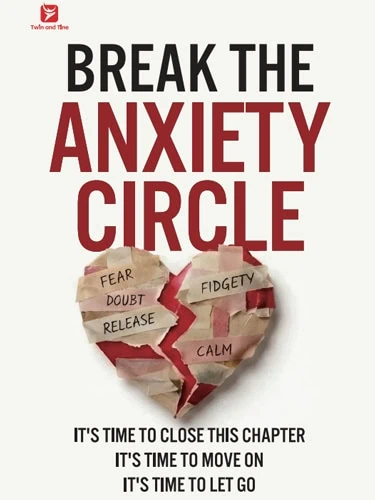
When I picked up Miles Carter’s Break the Anxiety Circle, I half expected another collection of vague platitudes about breathing deeply and thinking positive thoughts. I was wrong.
Carter doesn’t pretend to have a magic wand. He opens with a disarmingly honest confession about his own battles with indecision and self-blame, which immediately disarms the reader. How can you argue with someone who admits he still catches himself spiraling, even after years of work?
The book asks a central question that haunted me throughout: what would it feel like to simply stop fighting your own mind? To stop treating every anxious thought as a crisis that demands immediate resolution? That question sits at the heart of the entire book, and it’s not one I could answer easily.

The Anxiety Trap We All Live In
Carter frames anxiety not as a personality flaw but as a learned response pattern. He shows how overthinking masquerades as problem-solving when it’s actually a form of avoidance. We think we’re being diligent by replaying conversations, analyzing every angle, and preparing for every possible outcome. In reality, we’re just postponing the discomfort of living with uncertainty.
This resonated deeply with me because I have spent years convincing myself that my worrying was a form of care, a way of being thorough. Carter calls this out with gentle precision: you’re not protecting yourself by overthinking. You’re just rehearsing pain before it arrives.
That reframe alone shifted something in my chest.
Practical Methods That Actually Stick
The book offers a range of exercises, and I’ll admit I approached them with skepticism. But Carter avoids the trap of offering abstract advice without application. He includes specific scripts for talking back to anxious thoughts, concrete steps for setting boundaries with draining people, and a surprisingly effective method for separating past regrets from present reality.
The healing quotes scattered throughout aren’t decorative. Each one lands like a small anchor, pulling you back to the present moment when you feel yourself drifting into old patterns. I found myself dog-earing pages and returning to certain passages on days when my mind felt particularly loud.
The chapter on emotional attachment was especially uncomfortable, in the best way. Carter doesn’t let you off the hook. He asks hard questions about why we cling to relationships that deplete us, and he doesn’t accept easy answers.
The Larger Pattern Beneath the Symptoms
What elevates this book beyond a standard self-help manual is Carter’s willingness to trace anxiety back to its roots. He argues that overthinking is almost always a symptom of a deeper fracture: a broken relationship with the self.
People who cannot tolerate their own internal discomfort will seek external validation. People who fear their own judgment will obsess over the judgment of others. This isn’t a new insight, but Carter presents it with a clarity that feels fresh.
He uses an extended metaphor of an internal court where we are simultaneously judge, prosecutor, and defendant, and we never stop ruling against ourselves. That image stayed with me long after I closed the book.
What This Book Leaves You With
The book isn’t perfect. Some chapters feel repetitive, and Carter occasionally circles back to points he’s already made. The writing is straightforward rather than poetic, which may not appeal to readers who prefer more literary self-help. But these are minor quibbles.
What matters is that Break the Anxiety Circle delivers on its promise. It offers a genuine mental reset, not a temporary distraction. Carter teaches you to recognize the moment when your mind starts to spiral and gives you permission to step off the ride. He doesn’t demand that you become a different person. He simply shows you that the person you already are is enough, once you stop endlessly second-guessing every thought and impulse.
I finished the book on a Sunday evening. I sat on my couch, the apartment quiet around me, and realized I had not checked my phone for over an hour. That felt like a small miracle.
The book has stayed with me since, not as a set of rules but as a quiet voice reminding me that peace isn’t something I need to earn through constant vigilance. Maybe that’s what true mental freedom looks like. Not the absence of anxious thoughts, but the ability to watch them pass without chasing after every single one.
If you’re tired of living inside your own head, this book offers a way out. It won’t do the work for you, but it will walk beside you while you do it.