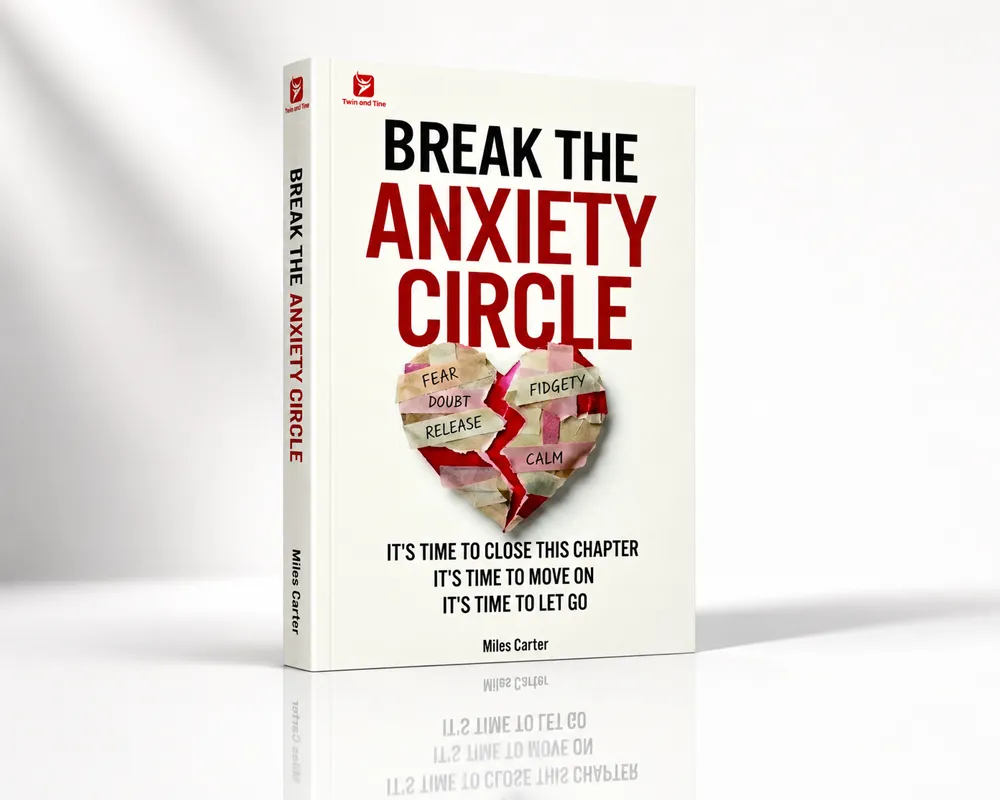
I caught myself rehearsing a conversation from three days ago while standing in the shower. Same sentences. Same imagined responses. Same faint knot in my chest. Nothing had changed, and nothing would, yet my brain kept running the tape as if a different ending might surface. That is the exact moment Miles Carter’s book found me, and I suspect it will find a lot of people the same way.
His central question is not how to feel calm. It is why the mind returns to the same wound again and again, long after the danger has passed. What if the loop is not a malfunction to be crushed, but a pattern to be understood?

A Man Who Cannot Put Down the Phone
Carter builds the book around a recurring type of person: someone who looks composed at work, laughs at the right moments, and then lies awake cataloguing every wrong turn of the day. He gives this figure a name in the reader’s head, though it is really all of us.
There is a scene early on where a man rereads a text he sent hours ago, checking the punctuation, then the timing, then the punctuation again. Carter does not mock him. He sits beside him.
The overthinker in these pages is not weak. He is vigilant. He has learned that scanning for threats keeps him safe, and the book takes that seriously before it asks him to put the habit down.
The conflict that gives the book its pull is quieter than most self-help narratives. It is the tug between wanting relief and being terrified of what happens without the worry. If I stop monitoring everything, who protects me?
That tension runs through every chapter, and Carter refuses to resolve it cheaply. I will not tell you how he handles the ending. I will tell you it earned its keep.
The Loop Is a Form of Loyalty
Here is the idea that stayed with me. Carter suggests that rumination is often a way of staying faithful to something unresolved. We replay the argument because we still owe the other person a sentence. We replay the mistake because we still owe ourselves an apology.
That reframing changes the texture of the book. Suddenly the loop is not just noise. It is grief wearing the mask of problem-solving.
What the loop might actually be:
| What It Looks Like | What It Often Is |
|---|---|
| Replaying an argument | Unfinished grief |
| Rereading a text | Fear of abandonment |
| Cataloguing mistakes | Unmet need for forgiveness |
| Scanning for threats | Old survival pattern |
His key concept, the “circle,” works as both image and argument. A circle implies return, repetition, the illusion of progress. You move, and you arrive where you started, slightly more tired.
He contrasts this with what he calls stepping sideways, a small deliberate move off the track rather than a heroic leap forward. I found that image honest. Recovery rarely looks like a straight line.
The writing itself is plain and warm, more workshop than lecture hall. Carter uses short case sketches, most of them ordinary, and resists the urge to make every story tidy.
Where the Book Stumbles
The later chapters on boundaries get thin, almost generic. I wanted more specific examples, the kind he supplies so well elsewhere. It is a minor crack, not a fracture.
Still, the core insight holds. We do not repeat because we are foolish. We repeat because some part of us believes the repetition is love, or duty, or atonement. That is a hard thing to admit.
Who Should Read This
This book is for you if:
- You have already tried the obvious fixes and found them slippery
- You have been told to “just let it go” and felt the words land like a stone
- You want to understand why your mind repeats instead of fighting it
- You prefer understanding over quick techniques
This book is not for you if:
- You are in acute crisis and need immediate support
- You want a step-by-step program to eliminate anxiety
- You prefer clinical approaches with cited research
It suits readers who have already tried the obvious fixes and found them slippery. It suits anyone who has been told to just let it go and felt the words land like a stone. It is less useful for someone in acute crisis, and Carter is honest enough to say so.
What the Circle Finally Teaches
By the end, Carter has not promised silence. He has offered something stranger and more durable: a way of relating to your own mind that does not require winning.
What you carry away is not a technique. It is a shift in posture. You start noticing the moment the tape begins, and that noticing is itself the interruption.
The circle does not break because you force it. It loosens because you finally stop mistaking it for the truth.
Maybe healing begins the day you realize the loop was never protecting you. It was waiting for you to look at it.

