I went to a quiet suburban wedding recently, the kind with folding chairs and a playlist someone’s cousin made. Halfway through the vows, I noticed the woman beside me wasn’t watching. She was staring at her hands, and I could almost hear the loop running behind her eyes. Did I lock the car. Did I say the wrong thing at the shower last month. Did everyone notice I arrived alone.
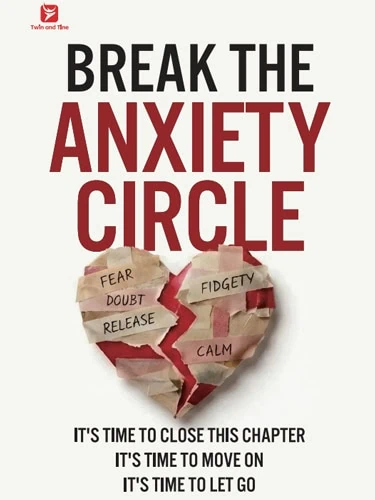
I thought about her when I started Miles Carter’s Break the Anxiety Circle. The book opens with a simple promise: a mental reset for people trapped in the overthinking loop. That phrase, the loop, is the whole book in miniature. Carter isn’t interested in anxiety as a dramatic event. He’s interested in it as a habit, a groove your brain wears into itself.
So the real question the book keeps circling, quietly, without ever quite saying it out loud, is this. Can you interrupt a loop you built yourself, and if so, what actually interrupts it?

The Argument Is the Author’s Own Struggle
Carter writes like someone who has spent a lot of nights in that loop. That’s the book’s central strength. He doesn’t stand above the reader and hand down techniques. He walks beside you and admits he still trips.
You can feel the thesis in his tone before you can name it. The book argues that anxiety is not a character flaw. It’s an energy problem. Every hour you spend replaying a conversation is an hour stolen from the life in front of you, and Carter treats that theft as the real damage, not the worry itself.
The structure follows this logic. He moves through self-blame, then indecision, then people-pleasing, then boundaries. Each chapter takes one knot and works it loose with a few concrete methods, like writing down the worst-case scenario until it shrinks to its actual size. It sounds small. It works more often than you’d expect.
What I appreciated most is that he never pretends the past can be deleted. He asks you to understand it instead. That’s a harder instruction, and a more honest one.
The Quiet Craft of a Healing Book
The imagery Carter leans on is light and shadow, though he never overplays it. He describes overthinking as standing in a dark hallway, opening door after door, finding the same empty room. It’s a simple image. It stays with you.
His real craft is in the small reframes. He suggests that when you catch yourself people-pleasing, you ask one question: whose voice is this, mine or theirs. That single question does more work than a chapter of theory.
The weakness, honestly, is that the book can feel like a collection of good advice rather than a single argument. Some chapters repeat the same reassurance in different words. Readers who want a rigorous framework may find it light. Readers who want a hand on the shoulder will not mind at all.
This is the pattern his struggling protagonist reveals, and it’s universal. The person who cannot stop thinking is often the person who cares the most. The loop is not laziness. It’s love that lost its direction.
Who This Book Is For, and What It Leaves You With
If you are the person at the wedding staring at your hands, this book is for you. It suits readers who want something warm and usable, not clinical. It suits people who have read the theory and now want the practice.
It suits you less if you are looking for diagnosis, or for a single grand system. Carter gives you tools, not architecture. And he would probably be the first to say the tools are enough.
I finished the book still unsure whether I’ve broken my own loop. I suspect that’s the point. The loop doesn’t end. You just get better at noticing when you’ve stepped into it.
There’s a line early in the book I keep coming back to, and I’ll leave it here. “You are not your thoughts. You are the one who notices them.” Maybe that’s what healing really is. Not a mind that finally goes quiet, but a person who learns to sit with the noise and stop mistaking it for the truth.

